Your child stops at a building-site fence and stares: "How can that digger lift such a big rock?"
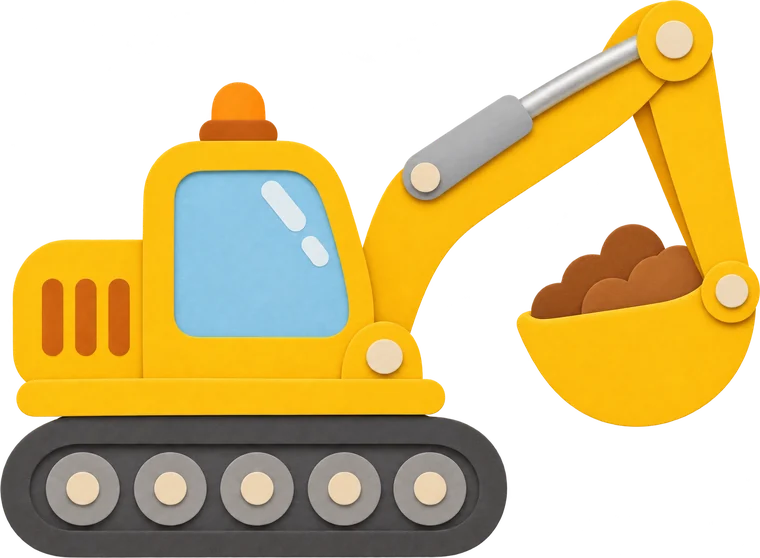
An excavator moves its long arm - boom, arm and bucket - with hydraulic power to dig and shift soil. Its top half can turn all the way round, so it scoops, swings and drops the soil straight into a truck. Below are the questions children ask most, plus simple building-site safety.
Fact cardExcavator Vehicle · construction machine
- Job
- digging and moving soil and rock
- Also called
- digger
- Three parts of the arm
- boom, arm (stick), bucket
- What moves the arm
- hydraulics (pushing oil)
- Weight
- about 1 tonne for the smallest, tens of tonnes on big sites
- Biggest of this kind
- about 900-1,000 tonnes (mining machines; sources differ)
- The building-site worker that digs with a giant arm
Excavator in a child's words
- An excavator is a construction machine that digs the ground and moves soil and rock. In Korea it is often called a 'po-cle-in'.
- Its long arm has three parts: the big boom fixed to the body, the arm (or stick) in the middle and the bucket at the end.
- The arm is moved by hydraulics: oil pushed hard through pipes into shiny rams that slide in and out.
- The top half, with the cab and arm, can turn all the way round on the base, so it can drop soil to the side without driving anywhere.
- Some excavators run on crawler tracks made of linked steel plates; others run on rubber tyres. Tracks cope well with mud and bumpy ground.
- Small mini excavators weigh about 1 tonne; ones on big building sites weigh tens of tonnes.
- Operators need a special licence. They work the arm and bucket with levers in the cab.
When your child asks, answer like this
 Is a 'po-cle-in' the same as an excavator?

How is an excavator so strong?
Why does an excavator spin around?
Why do its wheels look like a belt?
Do excavators only dig?
Can I go close to an excavator at a building site?
Excavator facts that make kids say “Wow!”
- The biggest boom-and-bucket excavators like this one work in mines and weigh roughly 900 to 1,000 tonnes - sources give different figures.
- Mini excavators weigh only about a tonne and can squeeze into a back garden or a narrow alley.
- The French company whose name Koreans use for excavators was already building a hydraulic excavator in 1951.
A quiz to do together
Tap an answer.
What is the scoop at the end of the excavator's arm called?
Can the top of an excavator turn all the way round?
Where should you watch an excavator working?
You finished the quiz! Well done.
Colouring page
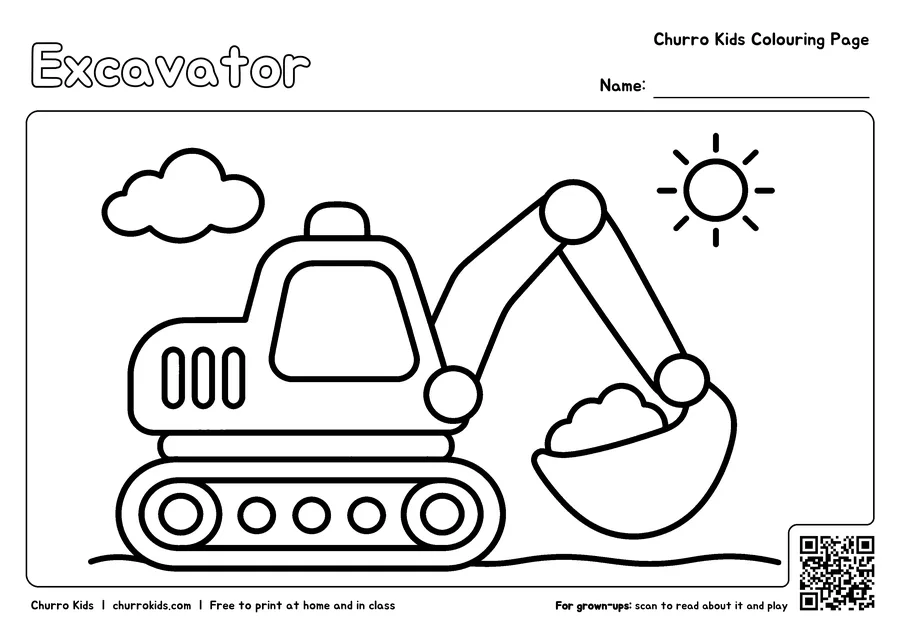
One A4 page, and it is free. Print it freely at home or in class.
Good for parents to know
- 'Po-cle-in' comes from the name of a French company; the National Institute of Korean Language recommends '굴착기', and Korean law now uses that word too. If your child says 'po-cle-in', you can simply add the other name rather than correct them.
- Weights vary hugely: about 1 tonne for mini excavators (some are lighter still), tens of tonnes on ordinary sites, and for the largest hydraulic mining excavator figures from about 889 to more than 980 tonnes depending on the source and version. Bucket-wheel excavators, a completely different mining machine, can weigh over 10,000 tonnes, so if 'the biggest excavator in the world' comes up, say which kind you mean.
- Excavators swing as they work and have blind spots, so the area around them is dangerous. Always watch from outside the fence, holding hands.
Things to try together
- In the sandpit, dig with a spoon like an excavator: lower the boom, pull in the arm, curl the bucket.
- Join two syringes with a tube full of water: push one and the other slides out. That's how hydraulics carry force (best done in the bathroom).
- From outside a site fence, point to the boom, arm, bucket and tracks and name them together.
Sources
- koreadaily.com/article/20220627182427348
- en.wikipedia.org/wiki/Poclain
- en.wikipedia.org/wiki/Excavator
- dozr.com/blog/parts-of-an-excavator
- sankun.com/blog/detail/239_굴삭기__굴착기__천공기_뜻__용도__작동_원리__종류
- mining-technology.com/features/featurethe-worlds-biggest-mining-excavators-4153289
- en.wikipedia.org/wiki/Bagger_293
- oshacademy.com/courses/training/814-heavy-equipment-safety/814-4-8.php
- geteduify.com/career-guidance/포크레인-자격증-취득-조건-및-비용-필수-체크사항/
- nepla.ai/wiki/국토와-건설-부동산/건설-건축-주거환경/-유권해석-건설기계관리법-시행규칙-제73조-건설기계조종사면허의-특례-mo59y60vr81v