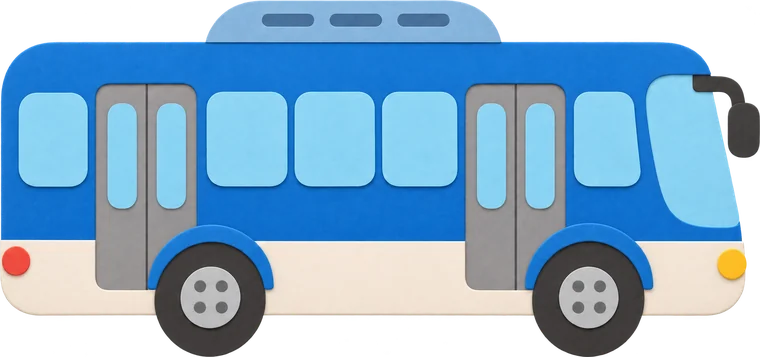
Waiting at the stop, your child points: "Why is that bus blue and this one green?"
A bus is a big vehicle that carries lots of people along a fixed route. In Seoul the colour shows what kind of route it runs, and there are low-floor buses with no steps and bendy buses that fold in the middle. Below are the questions children ask most, with simple bus-safety habits to practise together.
Fact cardBus Vehicle · public transport
- Length (city bus)
- about 11 m (36 ft)
- Bendy bus length
- about 18 m (59 ft)
- Who drives it
- a bus driver
- Seoul city buses
- 7,383 (January 2026)
- Low-floor bus floor height
- a little over 30 cm (about 1 ft), varies by model
- Stop bell
- since 1984 in Korea
- The big vehicle we all ride together
Bus in a child's words
- A bus is a big vehicle that carries many people at once. It follows a fixed route and stops at each bus stop.
- A big city bus is about 11 m (36 ft) long - as long as six or seven grown-ups lying head to toe.
- A bendy bus looks like two buses joined together. It is about 18 m (59 ft) long and bends in the middle to turn corners.
- When your stop is coming up, you press the stop bell and the driver stops at the next stop.
- Low-floor buses have no steps and a floor only a little over 30 cm (about 1 ft) high, so wheelchair users, parents with prams and older people can get on easily.
- Seoul's city buses are colour-coded: blue ones link distant areas, green ones go around neighbourhoods, red ones run fast to nearby cities. A few yellow circular buses still run in a loop.
- In January 2026 Seoul had 7,383 city buses.
Bus: measure it with your own height
When your child asks, answer like this
 Why are buses different colours?

Why do we press the bell before getting off?
Why do some buses have such a low floor?
How does a bendy bus get round corners?
What do I need to be careful about with buses?
What if I have to stand on the bus?
Bus facts that make kids say “Wow!”
- Korean buses once carried a conductor who took fares and called out the stops. The last ones stopped working in 1989.
- Buses first ran in Korea more than 100 years ago.
- A bendy bus is about 18 m long, roughly 7 m longer than an ordinary city bus.
A quiz to do together
Tap an answer.
What do you press when your stop is coming up?
What do we call a bus with a low floor and no steps?
When do you get on or off a bus?
You finished the quiz! Well done.
Colouring page
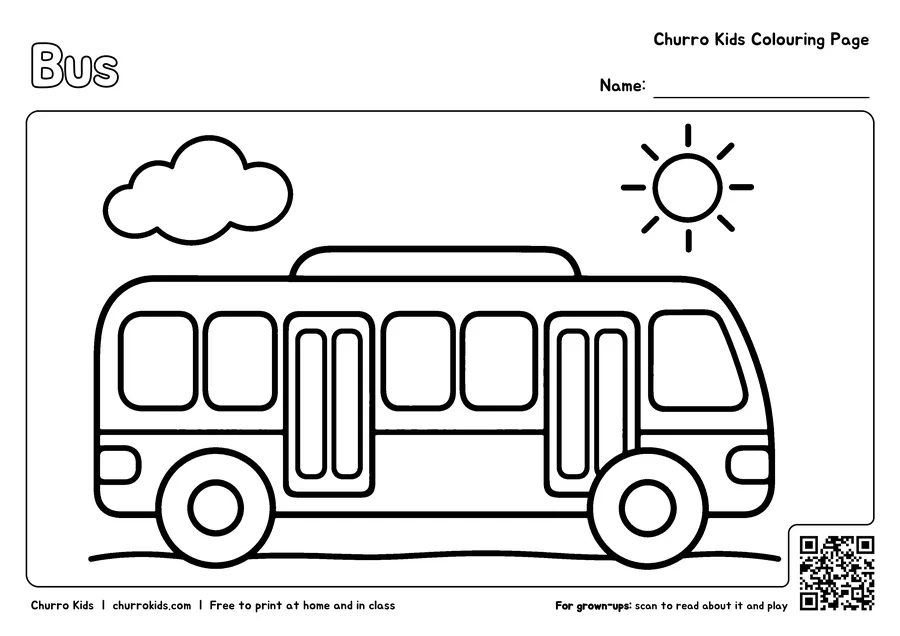
One A4 page, and it is free. Print it freely at home or in class.
Good for parents to know
- The colour scheme is Seoul's, introduced with the 2004 bus reform. Other cities use different colours, so look at your local buses together.
- Sources disagree on Korea's first bus (1911 in one, 1912 in Daegu in another), so the page just says "more than 100 years ago". Bus lengths vary by model; about 11 m is typical for a large city bus.
- Many bus accidents involving children happen right after they get off, when they cross in front of or behind the bus. Agree together: wait until the bus has left, then look both ways.
Things to try together
- Let your child press the stop bell, and look up the name of your stop together beforehand.
- Measure 11 m with a tape measure, lay a string along the ground and walk the length of a city bus.
- Play colour bingo with blue, green and red buses on the street; a yellow circular bus is rare, so it counts as a bonus.
Sources
- mediahub.seoul.go.kr/archives/143950
- news.seoul.go.kr/traffic/archives/300
- khan.co.kr/article/200406021948081
- m.seoul.co.kr/news/plan/2004/02/09/20040209013001
- theme.archives.go.kr/next/koreaOfRecord/guideGirl.do
- theme.archives.go.kr/next/koreaOfRecord/publicTransport.do
- ibabynews.com/qa/c2g-child-traffic-safety
- en.wikipedia.org/wiki/Transit_bus
- en.wikipedia.org/wiki/Buses_in_Seoul
- ko.wikipedia.org/wiki/버스_안내양
- ko.wikipedia.org/wiki/저상버스
- ko.wikipedia.org/wiki/대한민국의_버스