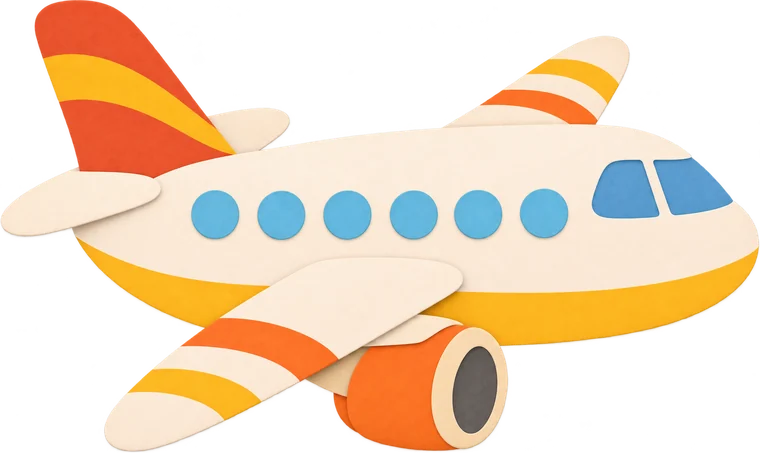
Watching a big jet lift off from the airport window, your child asks: "It's so heavy - why doesn't it fall down?"
Engines push the plane forward, and its wings push air downwards, so the air pushes the plane up. Airliners cruise about 10 km (33,000-38,000 ft) up at roughly 800-900 km/h (500-560 mph), fold their wheels away in flight and are flown by two pilots. Below are the questions children ask most, with answers you can read aloud as they are.
Fact cardAirplane Vehicle · flying vehicle
- Job
- flies people and cargo over long distances
- Cruising speed
- about 800-900 km/h (500-560 mph)
- Cruising height
- about 10 km (33,000-38,000 ft)
- A typical airliner
- about 38-40 m long (125-130 ft), 150-190 seats
- Largest airliner
- two full decks, about 80 m (262 ft) wingspan
- First powered flight
- 17 December 1903, 12 seconds
- Big wings that carry us above the clouds
Airplane in a child's words
- An airplane is a vehicle that carries people and cargo through the sky over long distances.
- Its engines push it forward. As it moves fast, the wings push air downwards and the air pushes the wings upwards. This upward force is called lift.
- Big airliners cruise about 10 km (33,000-38,000 ft) above the ground at about 800-900 km/h (500-560 mph).
- The tail keeps the plane from swinging side to side or bobbing up and down, and its moving parts help it turn.
- The wheels are only needed on the ground. In the air they fold up inside the body and wings so they do not catch the air.
- Airliners are usually flown by two pilots: the captain, who is in charge, and the first officer.
- On 17 December 1903 a plane with a person aboard first flew under engine power. It stayed up for 12 seconds and flew about 37 m (120 ft).
Airplane: measure it with your own height
When your child asks, answer like this
 Planes are so heavy - how do they stay up?

How high do planes fly?
Where do the wheels go?
Why do we wear seat belts on a plane?
Why do my ears feel funny on a plane?
Who flies the plane?
How far did the very first plane fly?
Airplane facts that make kids say “Wow!”
- That very first powered flight (about 37 m) was shorter than a typical airliner of today (about 38-40 m long).
- The largest airliner has two full decks from nose to tail and, depending on how the seats are arranged, can carry more than 500 people.
- At 800-900 km/h, an airliner is roughly three times as fast as the KTX at about 300 km/h.
A quiz to do together
Tap an answer.
Which part makes most of the force that holds a plane up?
What happens to a plane's wheels in the air?
How many pilots usually fly an airliner?
You finished the quiz! Well done.
Colouring page
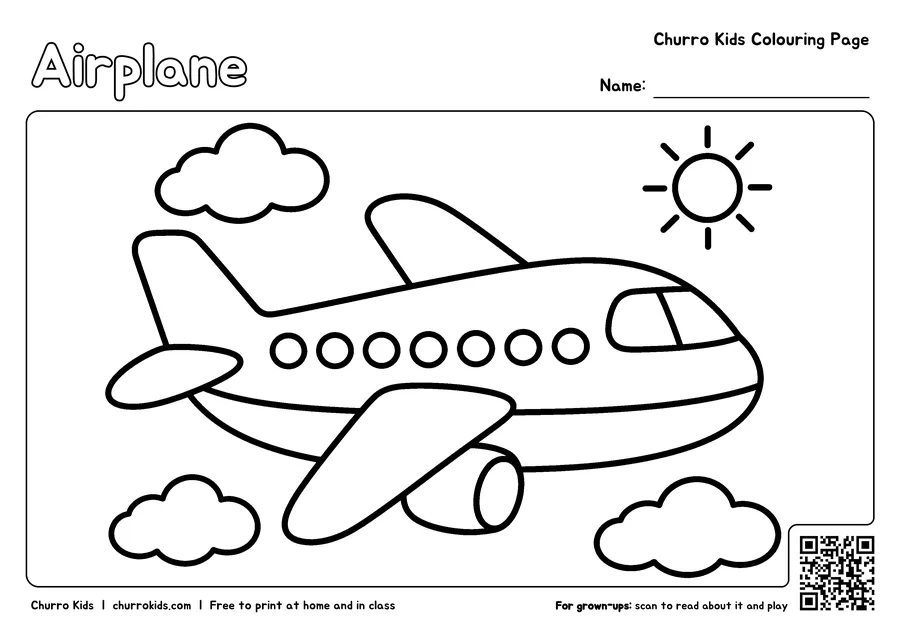
One A4 page, and it is free. Print it freely at home or in class.
Good for parents to know
- Many books say wings lift because air over the top 'has further to go in the same time'; this is a widespread misconception. NASA's education pages warn that many popular explanations of lift are wrong and describe lift as the wing (both surfaces) turning the airflow and being pushed the other way. 'The wing pushes air down, the air pushes the wing up' is accurate and easy for children.
- Speed and height depend on the aircraft, its weight and the day's winds: common single-aisle jets cruise at about 830 km/h, big wide-bodies at about 900 km/h, usually between about 9.4 and 11.6 km up. That is why the page says 'about'.
- Before a flight, tell your child their ears may feel funny at take-off and landing. Sipping a drink and yawning help, and staying awake for take-off and landing makes it easier. If your child has a cold or ear infection, ask a doctor before flying.
Things to try together
- Fold paper planes and fly them. Bend the back edges of the wings slightly up or down and compare how they fly.
- Hold a stiff piece of card with its front edge tilted slightly up in front of a fan on a low setting. Feel it being pushed upwards - that is the same kind of force a wing gets.
- Draw an airplane and label the wings, engines, tail, cockpit and wheels.
Sources
- www1.grc.nasa.gov/beginners-guide-to-aeronautics/four-forces-on-an-airplane/
- www1.grc.nasa.gov/beginners-guide-to-aeronautics/what-is-lift/
- www1.grc.nasa.gov/beginners-guide-to-aeronautics/airplane-parts-function/
- nasa.gov/feature/115-years-ago-wright-brothers-make-history-at-kitty-hawk
- militaryaerospace.com/commercial-aerospace/news/55399427/why-commercial-aircraft-cruise-around-35000-feet
- scienceabc.com/innovation/why-have-commercial-aircraft-not-gotten-any-faster-in-recent-decades
- centennialofflight.net/essay/Evolution_of_Technology/landing_gear/Tech16.htm
- planefyi.com/id/systems/landing-gear-structure/
- planefyi.com/aircraft/airbus-a380-800/
- law.cornell.edu/cfr/text/14/121.385
- aviationweek.com/tackling-turbulence-simply-put-seat-belts-are-still-key
- nzherald.co.nz/travel/how-to-stay-safe-during-turbulence-according-to-pilots/UT3PEB45PRG2HK5CEYVGNPAEMY
- kidshealth.org/CHW/en/parents/flying-ears.html
- en.wikipedia.org/wiki/Cruise_(aeronautics)
- en.wikipedia.org/wiki/Airbus_A380
- en.wikipedia.org/wiki/Airbus_A320_family
- en.wikipedia.org/wiki/Boeing_737_Next_Generation
- en.wikipedia.org/wiki/First_officer_(aviation)
- en.wikipedia.org/wiki/Wright_Flyer
- en.wikipedia.org/wiki/Boeing_747-8
- en.wikipedia.org/wiki/Mount_Everest