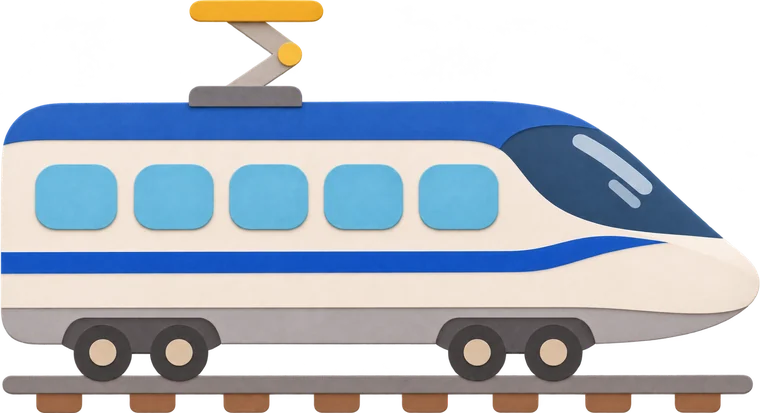
A KTX sweeps into the station with a rush of wind, and your child shouts: "Why is that train so fast? And why does it have such a pointy nose?"
The KTX is Korea's high-speed train. It runs at about 300 km/h (186 mph), takes its power from an overhead wire through a pantograph on the roof, and cuts through the air with its long, smooth nose. It first carried passengers on 1 April 2004, and about a quarter of a million people ride it every day. Below are the questions children ask most, with answers you can read aloud as they are.
Fact cardKTX High-Speed Train Vehicle · rail vehicle
- Job
- carries people quickly between faraway cities
- Speed in service
- about 300 km/h (186 mph)
- First service
- 1 April 2004
- The first KTX trains
- 20 cars, about 388 m long (1,273 ft)
- Seoul to Busan
- about 2 h 20 min to 2 h 50 min
- Riders per day
- about 254,000 (2026)
- Korea's bullet train, covering 80 metres every second
KTX High-Speed Train in a child's words
- The KTX is Korea's high-speed train. It carries people quickly between faraway cities.
- It runs at about 300 km/h (186 mph), which is more than 80 metres every second.
- It first carried passengers on 1 April 2004; Korean news at the time called Korea the fifth country with high-speed trains, after Japan, France, Germany and Spain.
- The first KTX trains are 20 cars long and measure about 388 m (1,273 ft).
- The KTX runs on electricity. A folding arm on the roof, the pantograph, touches the wire above the track and picks up power.
- On the first KTX trains, the cars at the front and back are power cars that pull and push the train. The driver sits in the front one.
- Seoul to Busan now takes about 2 hours 20 minutes to 2 hours 50 minutes (trains with fewer stops are faster), and about 254,000 people ride the KTX every day.
When your child asks, answer like this
 How fast is the KTX?

What makes the KTX go?
Why is the front of the KTX so pointy?
How many cars does a KTX have?
Who drives the KTX?
Is there a train faster than the KTX?
Where do we wait at the station?
KTX High-Speed Train facts that make kids say “Wow!”
- When the KTX opened, Seoul to Busan took 2 hours 40 minutes. Once the high-speed line reached all the way to Busan in 2010, it dropped to 2 hours 18 minutes.
- Add up everyone who has ridden the KTX since 2004 and you get more than 1.2 billion rides by spring 2026.
- In 2026 KTX trains make about 395 runs a day, and daily riders have grown more than threefold since 2004, from about 72,000 to about 254,000.
A quiz to do together
Tap an answer.
What powers the KTX?
About how far does the KTX go in an hour?
Where should you wait on the platform?
You finished the quiz! Well done.
Colouring page
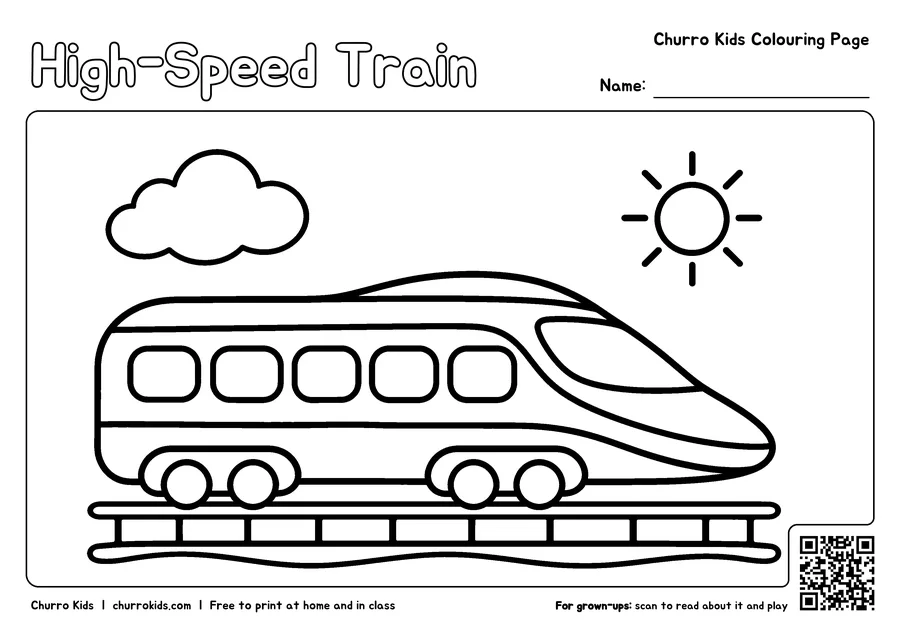
One A4 page, and it is free. Print it freely at home or in class.
Good for parents to know
- Speed figures vary slightly: Korail lists 305 km/h as the original KTX's maximum operating speed, while press releases and news usually say 300 km/h. The new KTX-Cheongryong is built for 320 km/h, but reports say it will run at about 300 km/h until extra track between Pyeongtaek and Osong is finished (planned for 2028). That is why the page says 'about 300 km/h'.
- Journey times depend on the train type and number of stops. After the full high-speed line opened in 2010, Seoul to Busan took 2 h 18 min; in 2024 the fastest KTX-Cheongryong service (stopping only at Daejeon and Dongdaegu) was reported at 2 h 17 min, against up to 2 h 50 min for trains with many stops. The '2 h 10 min' figure published before its launch was a forecast.
- On the platform, hold your child's hand so they do not run towards the train, and agree together that once the doors start closing you never try to get on - you simply wait for the next train.
Things to try together
- Before boarding, find the yellow safety line on the platform together and practise waiting behind it.
- Look for the pantograph on the roof of a KTX in a photo or a passing train - the arm touching the wire above.
- Line up cardboard boxes as a train and count the cars. Twenty boxes make a train as long, in cars, as the first KTX.
Sources
- info.korail.com/infoeng/contents.do?key=1276
- ytn.co.kr/_ln/0308_200404011614122479
- biz.sbs.co.kr/amp/article/20000164381
- zdnet.co.kr/view/?no=20260331181649
- heraldk.com/article/2026033019351241458
- m.etnews.com/20250401000093
- ajunews.com/view/20240422151706070
- news.bizwatch.co.kr/article/real_estate/2024/04/22/0036
- korea.kr/news/reporterView.do?newsId=148928837
- m.go.seoul.co.kr/news/2010/10/29/20101029005014
- koreascience.kr/article/JAKO201332479507646.pub?lang=ko
- koreascience.kr/article/CFKO201035738819093.page?lang=ko
- wikitree.co.kr/articles/1128490
- news.seoul.go.kr/traffic/archives/10362
- en.wikipedia.org/wiki/KTX-I
- en.wikipedia.org/wiki/KTX-Sancheon
- en.wikipedia.org/wiki/HEMU-430X