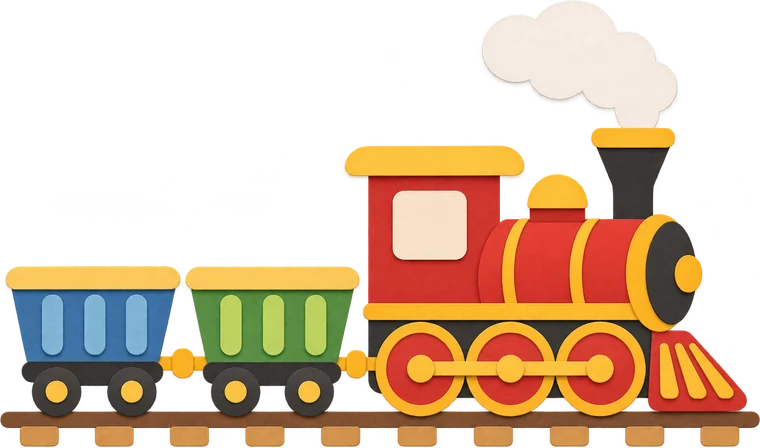
Turning the pages of a train book, your child asks: "Why does the train go choo-choo? Why is there smoke coming out?"
The train in most picture books is a steam engine: it burned coal to boil water, and the steam drove the wheels. Korea's first train ran in 1899; today's trains run on electricity or diesel. Below are the questions children ask most, with simple safety habits for stations and level crossings.
Fact cardTrain Vehicle · railway
- Runs on
- two steel rails
- Front car
- the locomotive, which pulls the rest
- Korea's first train
- 18 September 1899
- First line
- Incheon to Noryangjin, about 33 km (21 miles)
- First train's speed
- about 20-30 km/h (12-19 mph)
- Power today
- electricity or diesel
- The long vehicle that chugs along the rails
Train in a child's words
- A train runs on two steel rails. Many cars can be coupled together, so it carries lots of people and goods at once.
- The locomotive at the front pulls the cars behind. Cars for people are passenger coaches; cars for goods are wagons.
- Each wheel has a raised rim on the inside that catches the rail, so the train cannot slide off the track.
- Old steam locomotives burned coal to boil water. The steam pushed pistons back and forth, and the pistons turned the wheels.
- The first railway with steam locomotives opened in England in 1825.
- Korea's first train ran on 18 September 1899, over about 33 km between Incheon and Noryangjin, on what is now the Gyeongin Line.
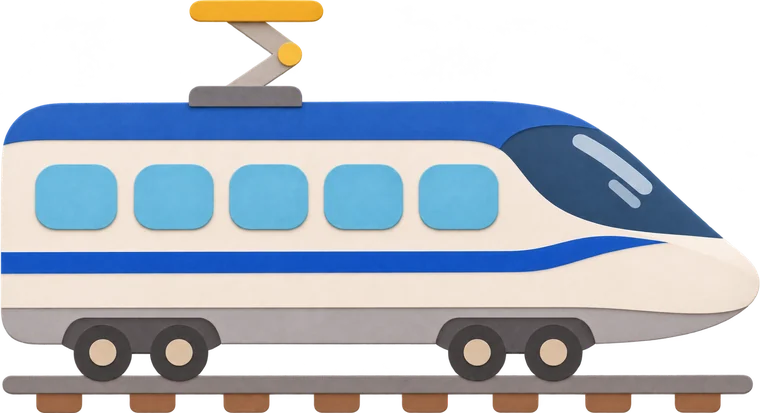
- Korean trains today run on electricity or diesel. Electric trains collect power from overhead wires through a frame on the roof called a pantograph.
When your child asks, answer like this
 Why can trains only go on railway tracks?

What is the 'choo-choo' sound?
What's the white stuff coming out of the chimney?
How fast was Korea's first train?
What is the frame on top of the train?
Do steam trains still run?
What should I be careful about at the station?
Train facts that make kids say “Wow!”
- Korea's first train took more than an hour and a half to travel about 33 km from Incheon to Noryangjin.
- Korea's first train was pulled by a steam locomotive of the type called a 'Mogul'.
- Real steam locomotives that once worked Korea's railways stand in the outdoor yard of the Railroad Museum in Uiwang.
A quiz to do together
Tap an answer.
What are the steel tracks a train runs on called?
What did old steam engines burn?
When did Korea's first train run?
You finished the quiz! Well done.
Colouring page
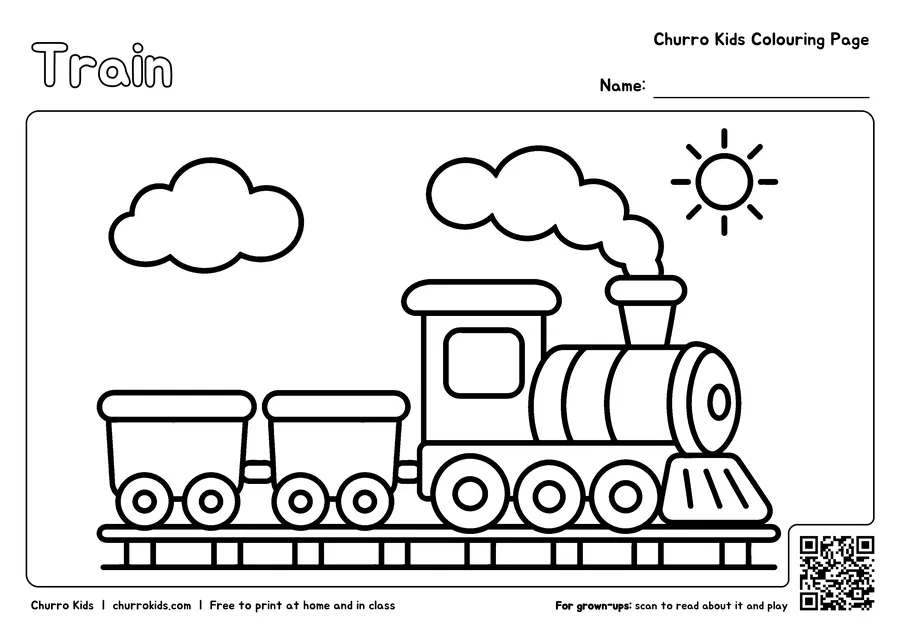
One A4 page, and it is free. Print it freely at home or in class.
Good for parents to know
- Accounts of the first Gyeongin Line run differ slightly: 33 or 33.2 km, 1 hour 30 or 1 hour 40 minutes, a top speed of 30 km/h in one source, while 1 hour 40 minutes works out to an average of about 20 km/h. The page gives ranges.
- "The first railway in 1825" means the first public railway worked by steam locomotives. A steam locomotive had already run on rails in 1804.
- Railway tracks and level crossings are very dangerous for children. Agree firmly: never go onto the tracks or put things on them, and always stop when the barrier comes down.
Things to try together
- Watch steam rise from a kettle together from a safe distance, and talk about how steam once powered trains. (It's hot - no touching.)
- Tie boxes together into a train, make the front box the locomotive and pull. Feel how much heavier it gets with each extra car.
- On your next train ride, look for the pantograph and the overhead wire.
Sources
- theme.archives.go.kr/next/koreaOfRecord/rapidRailway.do
- mediahub.seoul.go.kr/archives/165551
- explainthatstuff.com/steamengines.html
- railroadmuseum.co.kr/page/floor/outside
- ko.wikipedia.org/wiki/경인선
- ko.wikipedia.org/wiki/증기_기관차
- en.wikipedia.org/wiki/Gyeongin_Line
- en.wikipedia.org/wiki/Train_wheel
- en.wikipedia.org/wiki/Pantograph_(transport)
- ko.wikipedia.org/wiki/디젤_기관차
- en.wikipedia.org/wiki/Richard_Trevithick