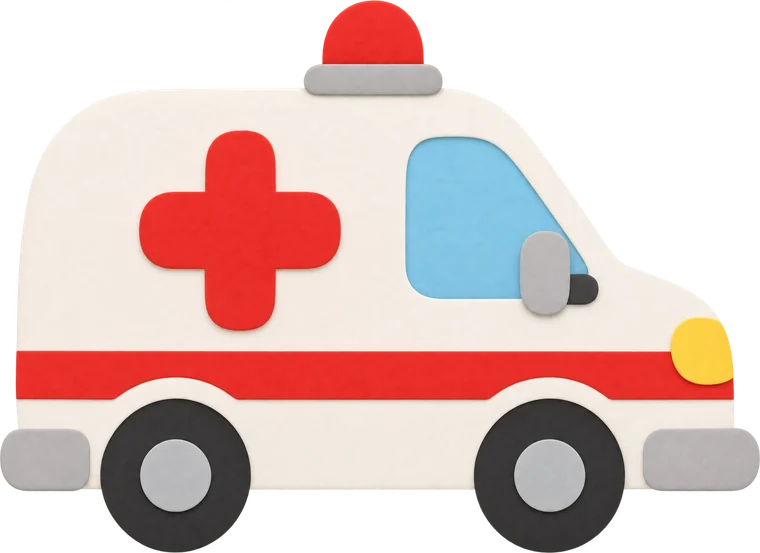
Waiting at the lights, your child spots an ambulance in the mirror: "Why is its writing backwards?"
An ambulance rushes people who are suddenly very sick or badly hurt to hospital. The lettering on the front is often written backwards on purpose, so drivers ahead can read it in their mirrors. Below are the questions children ask most, with simple answers and calm advice for calling 119 and making way for a siren.
Fact cardAmbulance Vehicle · emergency vehicle
- Job
- taking sick or injured people to hospital
- Who rides it
- paramedics and emergency medical crews
- Number to call in Korea
- 119
- 119 ambulances in Korea
- about 1,600
- Call-outs in 2025
- about 3.29 million, roughly one every 10 seconds
- Inside
- stretcher, oxygen, defibrillator
- The emergency vehicle that rushes sick people to hospital
Ambulance in a child's words
- An ambulance is an emergency vehicle that quickly takes people who are suddenly very ill or badly hurt to hospital.
- In Korea, calling 119 sends a fire-service ambulance. It is crewed by trained emergency medical staff who give first aid before the patient reaches hospital.
- Inside are a stretcher, oxygen for breathing and a defibrillator, a machine that helps a stopped heart start again.
- The back is built like a small room so the crew can care for the patient while the ambulance is moving.
- Korea has about 1,600 fire-service (119) ambulances.
- In 2025, 119 ambulances went out about 3.29 million times - roughly once every 10 seconds.
- On an average day they took about 4,800 people to hospital.
When your child asks, answer like this
 Why is the writing on the front of an ambulance backwards?

What is inside an ambulance?
What do the crew do in the ambulance?
What do I say when I call 119?
Do we call an ambulance when we feel a little unwell?
What should I do when I hear an ambulance siren?
Ambulance facts that make kids say “Wow!”
- Some ambulances have their name written backwards on the front, so it reads correctly in the rear-view mirror of the car ahead.
- Korea's 119 ambulance service began in Seoul in 1982 with just nine ambulances. Today there are about 1,600 across the country.
- In 2025, 119 ambulances took about 1.75 million patients to hospital - about 4,800 a day.
A quiz to do together
Tap an answer.
Which number calls an ambulance in Korea?
What makes the backwards writing on an ambulance read the right way?
What is the bed a patient lies on in an ambulance called?
You finished the quiz! Well done.
Colouring page
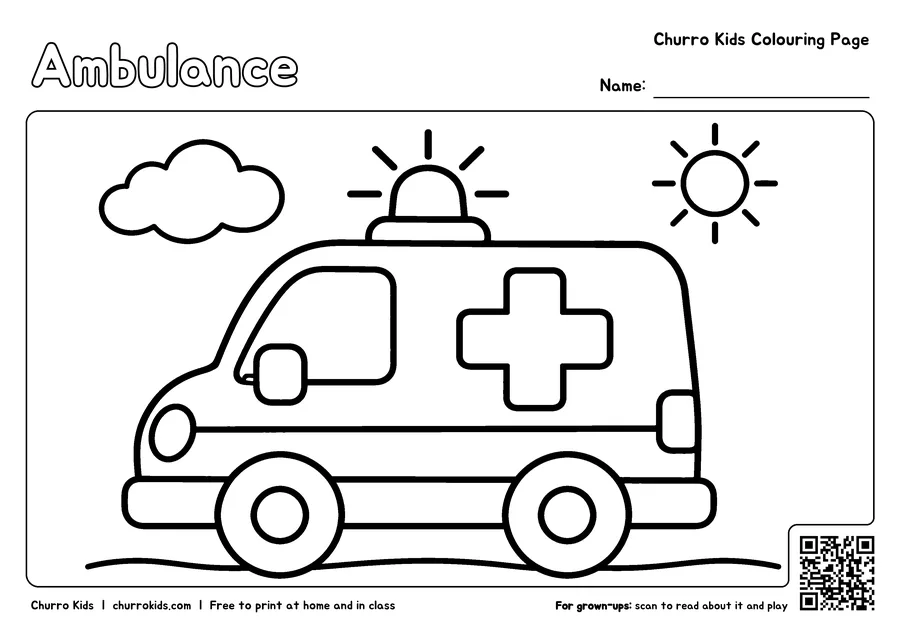
One A4 page, and it is free. Print it freely at home or in class.
Good for parents to know
- The call-out figures (3,285,957 dispatches and 1,747,940 patients transported in 2025) come from 2026 news reports of the National Fire Agency's statistics; the fleet size of about 1,600 is a rounded figure from summer 2026 reports. Both change every year. About 38.8% of 2025 call-outs ended without anyone being taken to hospital, which is a good way to explain why 119 is only for real emergencies.
- Mirror writing on the front is common in many countries, but not every ambulance has it. Look for it together next time one passes.
- If someone in the family once rode in an ambulance, your child may find them frightening. Say calmly that an ambulance is a vehicle that hurries to help, and that the crew are helpers. Practising your home address helps too.
Things to try together
- Write "119" or "AMBULANCE" on paper and hold it up to a mirror. Then write it backwards and see it turn the right way round in the mirror.
- Turn your address into a little song and practise saying it into a toy phone.
- Make a stretcher from a box and play ambulance crew with a teddy as the patient, using a handkerchief as a bandage.
Sources
- newsis.com/view/NISX20260727_0003724781
- youthdaily.co.kr/mobile/article.html?no=223648
- newsis.com/view/NISX20260313_0003547784
- fnnews.com/news/202607130909218338
- segye.com/newsView/20260713510070
- theme.archives.go.kr/next/koreaOfRecord/119.do
- kukinews.com/article/view/kuk202602060151
- kenyans.co.ke/news/84774-reason-word-ambulance-painted-upside-down-vehicles
- daihatsu.co.id/en/tips-and-event/tips-sahabat/detail-content/mengapa-tulisan-ambulance-di-bagian-depan-mobil-ditulis-terbalik
- en.wikipedia.org/wiki/Ambulance
- ko.wikipedia.org/wiki/구급차
- ko.wikipedia.org/wiki/119구급대