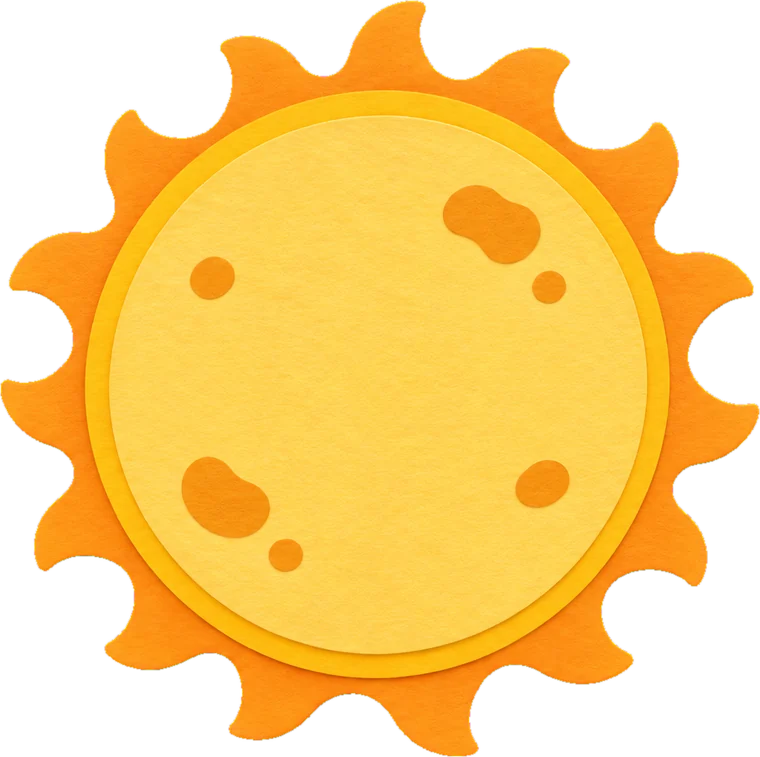
Squinting in the playground, your child asks: "Why is the Sun so hot? Is it on fire?"
The Sun is not a planet but our nearest star. It is about 109 Earths wide and about 150 million km (93 million miles) away. It does not burn like a campfire; it is a hot ball of gas that makes its own light. Below are the questions children ask most, with answers you can read aloud as they are.
Fact cardThe Sun Space · star
- Type
- a star (it makes its own light)
- Width
- about 1.39 million km (about 109 Earths across)
- Distance from Earth
- about 150 million km (93 million miles)
- Surface temperature
- about 5,500 °C (10,000 °F)
- Core temperature
- about 15 million °C
- Age
- about 4.6 billion years
- Our very own star, making its own light
The Sun in a child's words
- The Sun is a star, not a planet. It is a hot ball of gas that makes its own light.
- It is huge: about 109 Earths lined up would stretch across it.
- If the Sun were hollow, about 1.3 million Earths could fit inside.
- The Sun is about 150 million km (93 million miles) away. Sunlight takes a little over 8 minutes to reach us.
- Its surface is about 5,500 °C, and its centre is thought to be about 15 million °C.
- The Sun formed about 4.6 billion years ago, and scientists think it will shine for about 5 billion years more.
- Earth, Mars, Jupiter and the other planets all travel around the Sun. Together they are called the solar system.
When your child asks, answer like this
 Is the Sun on fire?

Not like a campfire. Deep in the middle of the Sun, tiny particles are squeezed so hard that they join together, and that gives off light and heat. So the Sun is a hot ball of gas that makes its own light.
How big is the Sun?
You would have to line up about 109 Earths to cross it. If the Sun were a big watermelon, Earth would be about the size of a sesame seed.
How far away is the Sun?
About 150 million km (93 million miles). Even light, the fastest thing there is, needs a little over 8 minutes to get here. The sunlight you see now left the Sun 8 minutes ago.
Where does the Sun go at night?
It doesn't go anywhere. Earth spins once a day like a top, and when our side faces away from the Sun, it is night. On the other side of the world it is daytime.
Can I look at the Sun?
No. Sunlight is so strong that even a short direct look can hurt your eyes. Sunglasses are not enough, and never look through a telescope or binoculars. To watch the Sun, use proper solar viewers with a grown-up.
Will the Sun ever go out?
It will change one day, very far in the future. Scientists think it will keep shining for about another 5 billion years, which is far too long for us to worry about.
What colour is the Sun?
Seen from space, the Sun is close to white. Our air makes it look yellow, and orange or red at sunrise and sunset.
The Sun facts that make kids say “Wow!”
- The Sun holds about 99.8% of all the mass in the solar system.
- The Sun spins too. Its middle turns once in about 25 days, while the regions near its poles turn more slowly.
- Every star in the night sky is a sun. Ours looks big and bright only because it is so close.
A quiz to do together
Tap an answer.
Is the Sun a planet or a star?
How long does sunlight take to reach Earth?
Why does night come?
You finished the quiz! Well done.
Colouring page
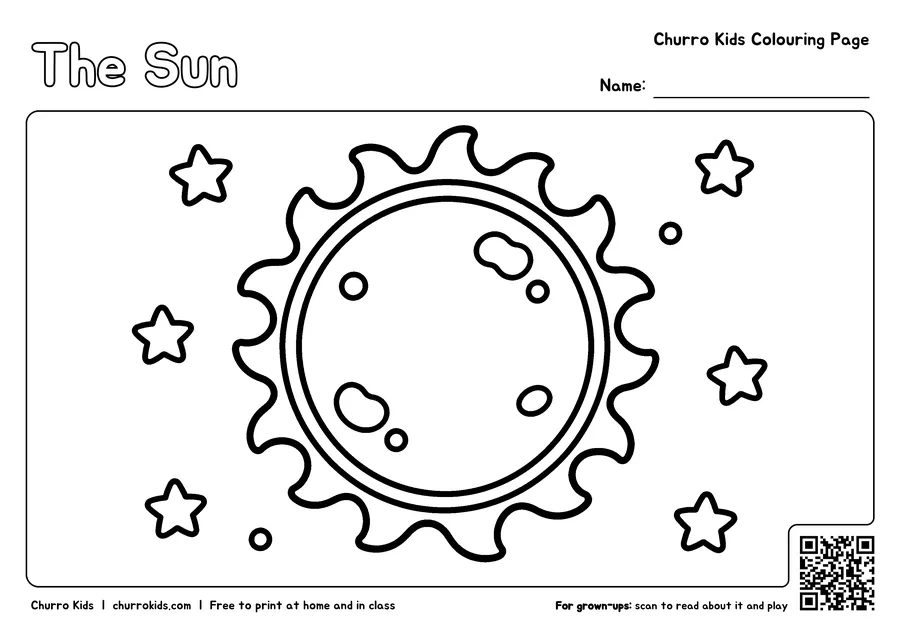
Get the colouring page (PDF)
One A4 page, and it is free. Print it freely at home or in class.
Good for parents to know
- "The Sun is burning" is a common phrase but not accurate. The Sun shines by nuclear fusion (hydrogen joining into helium), not by fire that needs oxygen. For a child, "a hot ball of gas that makes its own light" is right.
- The surface temperature (about 5,500 °C), core temperature (about 15 million °C) and age (about 4.6 billion years) are rounded estimates. Some sources say 4.5 billion years, and the remaining lifetime is given as anything from 4 to 7 billion years.
- Please teach that nobody should look straight at the Sun. Sunglasses and coloured film do not protect eyes, even during an eclipse; only certified solar viewers do.
Things to try together
- On a sunny day, trace your shadow with chalk in the same spot in the morning, at noon and in the evening. Watch how its length and direction change.
- Let a torch be the Sun and a ball be Earth. Turn the ball slowly to see how day and night happen.
- On a big sheet of paper, draw the Sun the size of a plate and Earth as a dot the size of a sesame seed.