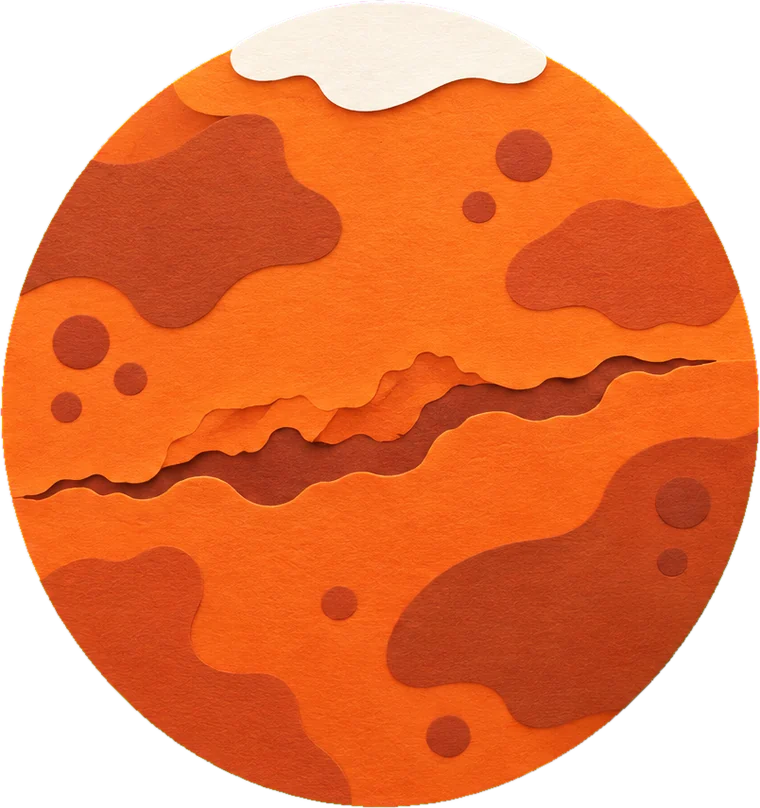
Looking at a picture book of the planets, your child points to the red ball and asks: "Why is Mars red? Do people live there too?"
Mars is the fourth planet from the Sun and Earth's neighbour. It is about half as wide as Earth and looks red because the iron in its soil has rusted. Its air is thin and it is very cold, so people could not simply live there, but robot explorers are studying its ground right now. Below are the questions children ask most, with answers you can read aloud as they are.
Fact cardMars Space · planet
- Type
- a planet (fourth from the Sun)
- Width
- about 6,780 km (about half of Earth's)
- Day
- about 24 hours 40 minutes
- Year
- about 687 Earth days
- Moons
- 2 (Phobos and Deimos)
- Weather
- very cold (about 20 °C down to -153 °C)
- Our red neighbour, covered in rusty dust
Mars in a child's words
- Mars is the fourth planet from the Sun, the next one out from Earth.
- It is about 6,780 km (4,200 miles) wide, roughly half the width of Earth.
- Mars looks red because the iron in its soil and rocks has rusted.
- A day on Mars lasts about 24 hours 40 minutes, much like ours, but a year lasts about 687 Earth days.
- The air is very thin and mostly carbon dioxide. People could not breathe it.
- Mars is very cold: it can reach about 20 °C (70 °F) but can drop to about -153 °C (-225 °F).
- Mars has two small moons, Phobos and Deimos, lumpy like potatoes.
When your child asks, answer like this
 Why is Mars red?

Do aliens live on Mars?
Has anyone been to Mars?
Could I breathe on Mars?
Are there mountains on Mars?
Is there water on Mars?
What colour is the sky on Mars?
Mars facts that make kids say “Wow!”
- Olympus Mons is the tallest volcano on any planet in the solar system, and about 600 km (370 miles) wide.
- Now and then a dust storm grows big enough to cover most of the planet, and the dust can take months to settle.
- Mars is tilted like Earth, so it has seasons too. Because its year is long, each season lasts about twice as long as ours.
A quiz to do together
Tap an answer.
Why is Mars red?
Which is bigger, Mars or Earth?
How many moons does Mars have?
You finished the quiz! Well done.
Colouring page
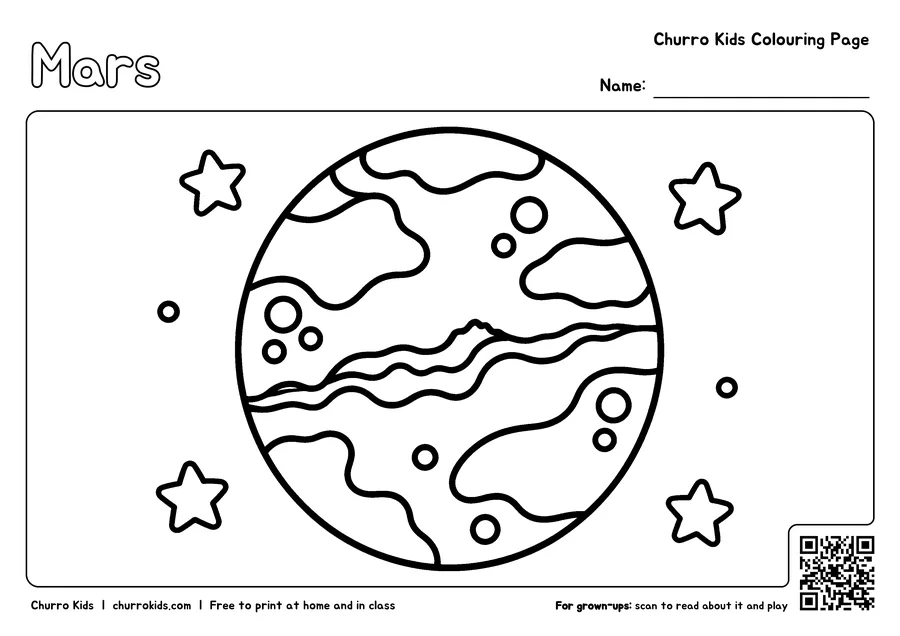
One A4 page, and it is free. Print it freely at home or in class.
Good for parents to know
- The height of Olympus Mons depends on where you measure from: figures run from about 21.9 km to 27 km, and NASA's Mars facts page quotes an even larger number (40 km). That is why this page only says "more than 20 km".
- Temperature ranges differ between sources too. We follow NASA's range of about 20 °C down to -153 °C; the average is around -60 °C.
- Nobody knows yet whether Mars ever had life. Rather than "there are no aliens", try "none have been found yet, and scientists are still looking".
Things to try together
- With a grown-up, leave a piece of wet steel wool on a plate for a few days and watch red rust appear. Mars is red for the same reason.
- Put a big ball next to one half its width to compare Earth and Mars.
- Talk about what you would need to live on Mars (air, water, warm clothes) and draw a Mars house.