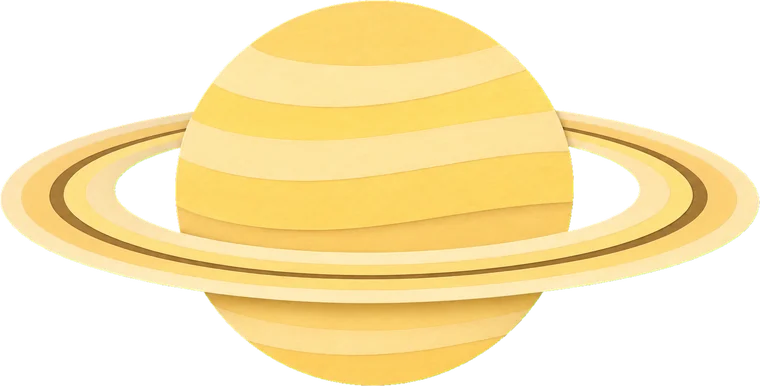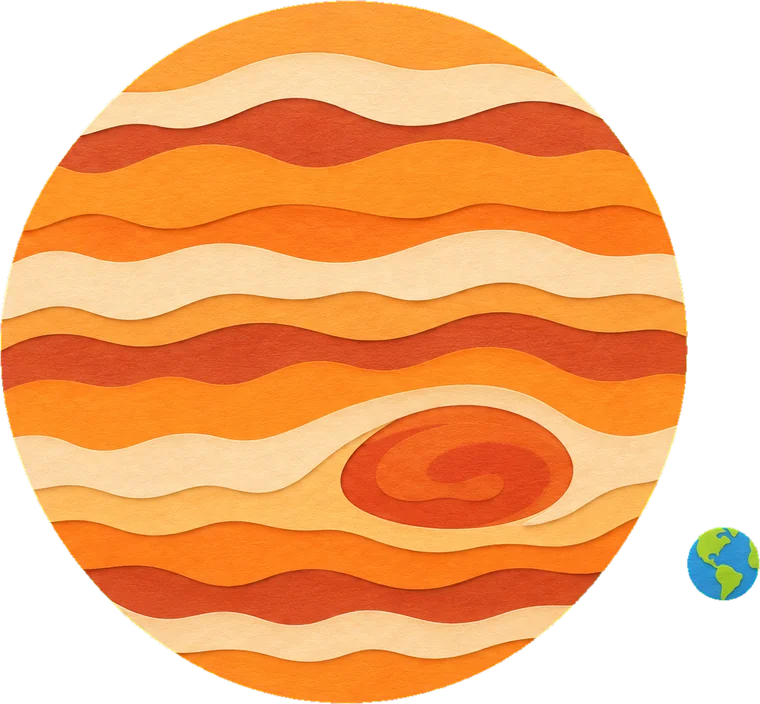
Looking at a picture of the solar system, your child points at the striped planet: "What's that red spot on Jupiter? Is it an eye?"
Jupiter is the largest planet in the solar system, about 11 Earths wide, and made almost entirely of gas, so there is no ground to stand on. The red spot is a storm wider than Earth, and more than 110 moons are known so far. Below are the questions children ask most, with answers you can read aloud as they are.
Fact cardJupiter Space · planet
- Type
- a planet (fifth from the Sun, the biggest)
- Width
- about 140,000 km (about 11 Earths across)
- Day
- about 10 hours
- Year
- about 12 Earth years
- Moons
- more than 110 (more keep being found)
- Distance from the Sun
- about 778 million km (484 million miles)
- The giant planet that could hold 1,000 Earths
Jupiter in a child's words
- Jupiter is the largest planet in the solar system, about 11 Earths wide.
- If Jupiter were hollow, more than 1,000 Earths could fit inside.
- It is made mostly of the gases hydrogen and helium, with no solid ground to stand on.
- Jupiter spins once in about 10 hours, the shortest day of any planet.
- One trip around the Sun takes Jupiter about 12 Earth years.
- Its stripes are clouds, and the Great Red Spot is a storm wider than Earth.
- More than 110 moons of Jupiter are known so far, and more keep being found.
When your child asks, answer like this
 How big is Jupiter?

Could I stand on Jupiter?
What is the red spot on Jupiter?
Why does Jupiter have stripes?
How many moons does Jupiter have?
Which is Jupiter's biggest moon?
Does Jupiter have rings?
Jupiter facts that make kids say “Wow!”
- Jupiter is more than twice as massive as all the other planets put together.
- Sunlight takes about 43 minutes to reach Jupiter, compared with about 8 minutes to reach Earth.
- Its four big moons can be seen as tiny dots through binoculars. Galileo first found them with a telescope about 400 years ago.
A quiz to do together
Tap an answer.
Which is the biggest planet in the solar system?
What is Jupiter's red spot?
Does Jupiter have solid ground to stand on?
You finished the quiz! Well done.
Colouring page
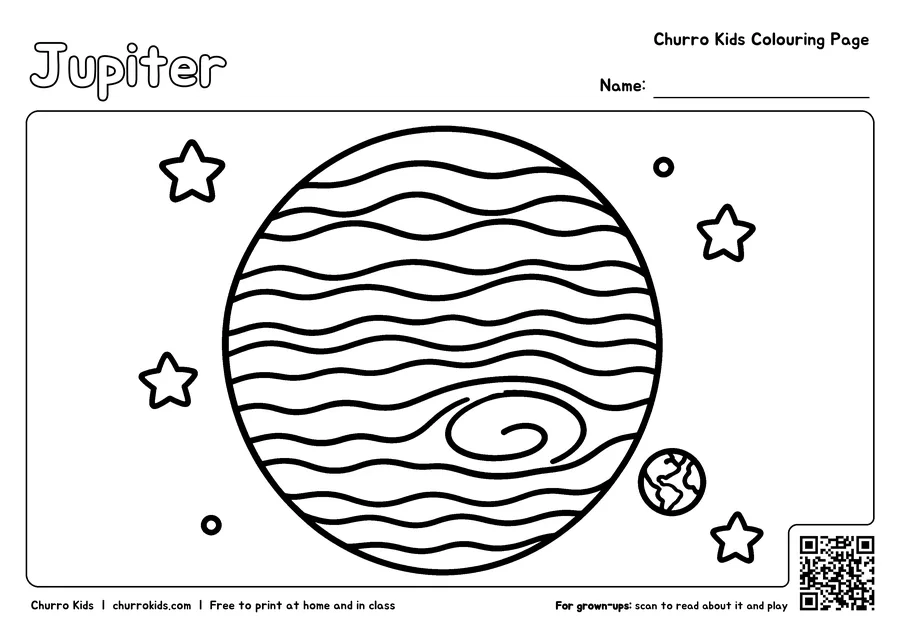
One A4 page, and it is free. Print it freely at home or in class.
Good for parents to know
- Jupiter's moon count keeps changing. NASA (page updated September 2026) lists 115 moons recognised by the International Astronomical Union; 4 were added in March 2026 and 14 more in April. Older books say 79, 92 or 95; they were right when printed.
- "1,000 Earths" is a round figure: NASA says about 1,000, and a strict volume calculation gives about 1,300. NASA says the Great Red Spot has been observed for more than 300 years, but the unbroken record of this storm starts in 1831.
- Whether Jupiter has a solid centre is still being studied; the Juno spacecraft suggests a large, 'fuzzy' core. For a child, "there is no ground to stand on" is accurate.
Things to try together
- Put a basketball beside a grape to compare Jupiter and Earth.
- Add a drop or two of milk to a glass of water and stir once to see bands and swirls like Jupiter's clouds.
- On a night when Jupiter is bright, look through binoculars with a grown-up for the tiny dots beside it. Those are its big moons.
Sources
- science.nasa.gov/jupiter/jupiter-facts/
- science.nasa.gov/jupiter/jupiter-moons/
- astro.kasi.re.kr/kor/post/solarSystemOverview/71363
- ssd.jpl.nasa.gov/sats/discovery.html
- earthsky.org/space/more-moons-for-jupiter-and-saturn-total-satellite-discoveries/
- en.wikipedia.org/wiki/Jupiter
- en.wikipedia.org/wiki/Moons_of_Jupiter