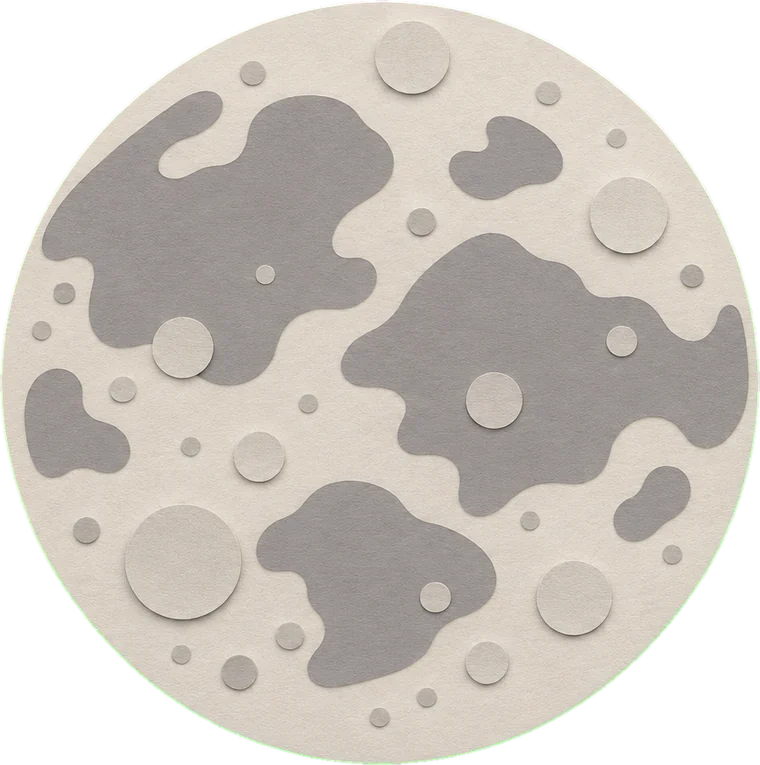
On an evening drive your child looks out of the window and asks: "Why does the Moon keep following us?"
The Moon is Earth's only natural satellite. It is about 384,000 km (239,000 miles) away on average, and over about a month it seems to change from a thin crescent to a full Moon. It does not make its own light; it shines with sunlight. Below are the questions children ask most, with answers you can read aloud as they are.
Fact cardThe Moon Space · Earth's moon
- Type
- a moon (it travels around Earth)
- Width
- about 3,470 km (about a quarter of Earth's)
- Distance from Earth
- about 384,000 km on average (239,000 miles)
- One trip around Earth
- about 27 days
- Full cycle of shapes
- about 29.5 days
- Gravity
- about one-sixth of Earth's
- Earth's companion that changes shape every night
The Moon in a child's words
- The Moon is a satellite: a smaller world that travels around a planet. It travels around Earth.
- It is about 3,470 km wide, roughly a quarter of Earth's width.
- It is about 384,000 km (239,000 miles) away on average. About 30 Earths would fit in the gap.
- The Moon makes no light of its own. We see it because sunlight bounces off it.
- It goes around Earth in about 27 days. From one full Moon to the next takes about 29.5 days.
- There is almost no air. In sunlight the ground is hotter than 120 °C, and in darkness it drops to about -170 °C.
- Between 1969 and 1972, twelve people walked on the Moon.
When your child asks, answer like this
 Why does the Moon change shape?

Why does the Moon follow me?
Is there a rabbit on the Moon?
Could I jump higher on the Moon?
Have people been to the Moon?
Why can I see the Moon in the daytime?
How was the Moon made?
The Moon facts that make kids say “Wow!”
- The Moon always shows us the same face, because it turns exactly once for each trip around Earth.
- The Moon is drifting away from Earth by about 3.8 cm a year, roughly as fast as fingernails grow.
- Korea's Moon orbiter Danuri left Earth in August 2022 and has circled the Moon since that December, taking many pictures.
A quiz to do together
Tap an answer.
Does the Moon make its own light?
How many people have walked on the Moon?
If you jump on the Moon, compared with Earth you go...
You finished the quiz! Well done.
Colouring page
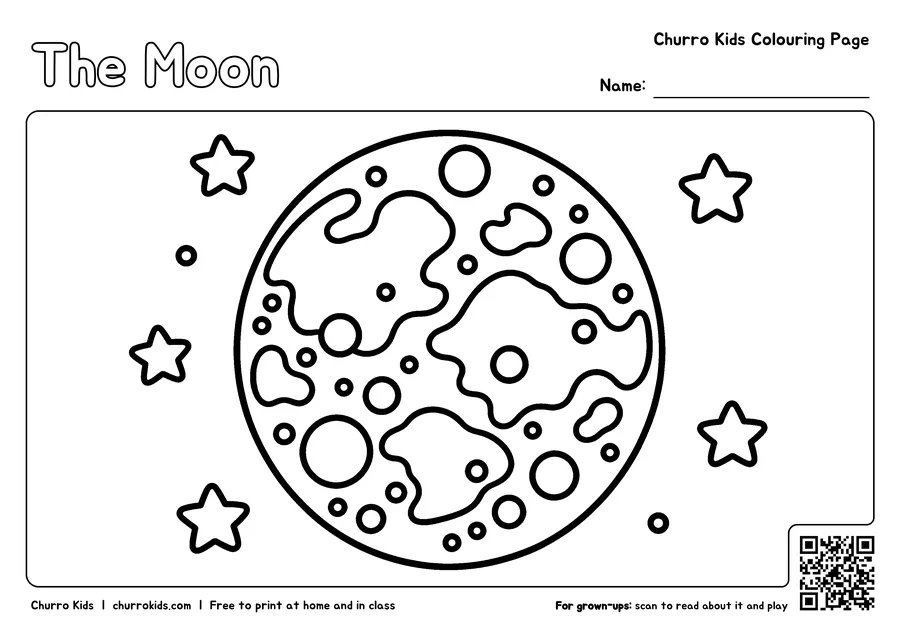
One A4 page, and it is free. Print it freely at home or in class.
Good for parents to know
- The Moon's phases are not caused by Earth's shadow, a mix-up many adults share. Earth's shadow causes a lunar eclipse; the nightly change of shape is simply how much of the sunlit half we can see.
- The giant-impact idea is the most widely accepted explanation of the Moon's origin, but research continues, and the Moon's age is given as about 4.35 to 4.5 billion years. "Scientists think..." is the honest wording.
- 384,000 km is an average; the distance swings between about 363,000 and 405,000 km. The far side is not a "dark side": it gets just as much sunlight, we simply never see it from Earth.
Things to try together
- Look at the Moon at the same time every day for a month and draw its shape on a calendar.
- In a dark room, use a torch as the Sun and a ball as the Moon. Hold the ball at arm's length and turn slowly on the spot to watch the lit part change.
- On a full-Moon night, talk about what the dark patches look like to each of you.