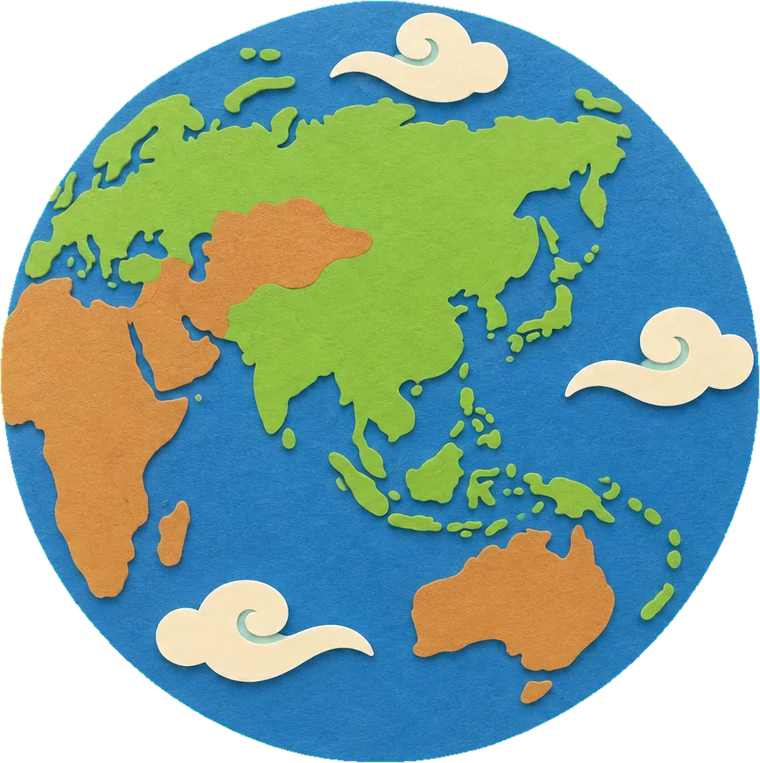
Spinning the globe on the shelf, your child suddenly asks: "If Earth turns like this, why aren't we dizzy?"
Earth is the third planet from the Sun and the only place where life has been found so far. About 71% of its surface is ocean, which is why it looks blue from space. It spins once a day and travels around the Sun in about 365 days. Below are the questions children ask most, with answers you can read aloud as they are.
Fact cardEarth Space · planet
- Type
- a planet (third from the Sun)
- Width
- about 12,756 km (7,926 miles)
- Day
- 24 hours (one spin)
- Year
- about 365 days (one trip around the Sun)
- Ocean
- about 71% of the surface
- Age
- about 4.5 billion years
- Our blue home, with oceans and life
Earth in a child's words
- Earth is the third planet from the Sun. A planet is a round world that travels around a star.
- Earth is round like a ball, about 12,756 km (7,926 miles) across.
- About 71% of its surface is ocean, which is why it looks blue from space.
- Earth spins once a day. That gives us day and night.
- Earth goes around the Sun in about 365 days. That is one year.
- The air around Earth is about 78% nitrogen and about 21% oxygen, the gas we breathe.
- So far, Earth is the only place in the universe where life has been found.
When your child asks, answer like this
 Is Earth really round?

Earth is spinning, so why don't we feel dizzy?
Why don't people on the other side of Earth fall off?
Why do we have summer and winter?
Why is Earth blue?
Is there life anywhere besides Earth?
How old is Earth?
Earth facts that make kids say “Wow!”
- Earth spins faster than you might think: at the equator the ground moves about 1,670 km (1,040 miles) every hour.
- Earth is the fifth largest of the eight planets, and the largest of the rocky ones.
- Earth is about 150 million km from the Sun. Scientists use that distance like a ruler for measuring the solar system.
A quiz to do together
Tap an answer.
Is there more ocean or more land on Earth's surface?
How long does Earth take to spin once?
Which planet from the Sun is Earth?
You finished the quiz! Well done.
Colouring page
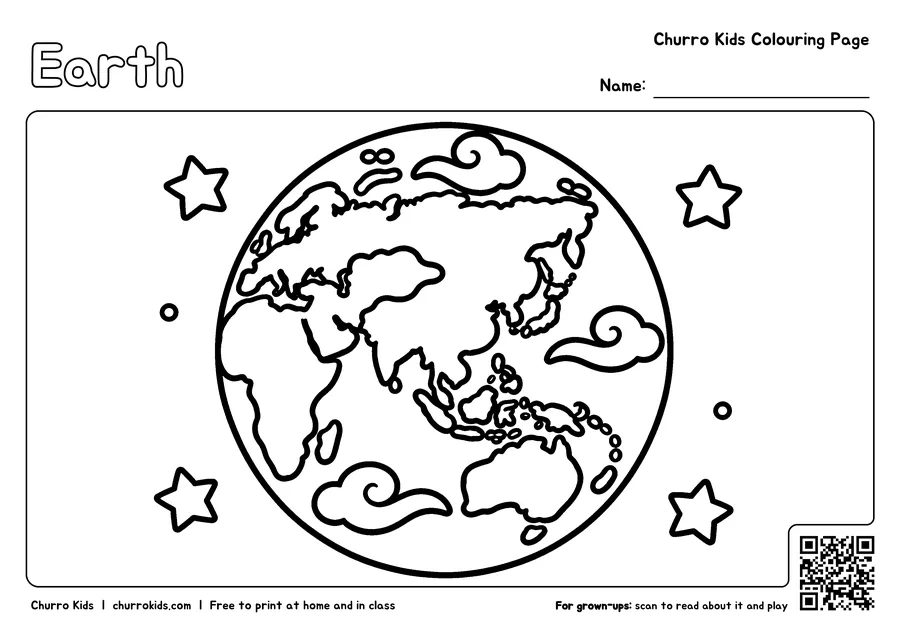
One A4 page, and it is free. Print it freely at home or in class.
Good for parents to know
- Many people believe summer comes because Earth is nearer the Sun. In fact Earth is closest to the Sun in early January. Seasons come from Earth's tilt, not from distance.
- One spin actually takes about 23 hours 56 minutes; the 24-hour day is measured against the Sun. "Once a day" is fine for a child.
- Earth is very slightly squashed, but the difference is tiny, so "round like a ball" is correct. The age of about 4.5 billion years is an estimate from meteorites and very old rocks.
Things to try together
- Put a sticker on your country on a globe or ball, shine a torch on it and turn it slowly to make day and night.
- Trace the oceans and the land on a globe with a finger and compare which covers more.
- Tilt the globe a little and carry it around the torch in a circle. Find where your country gets more light and where it gets less.