Watching a video of a floating astronaut, your child asks: "Why is he floating? How does he eat dinner?"
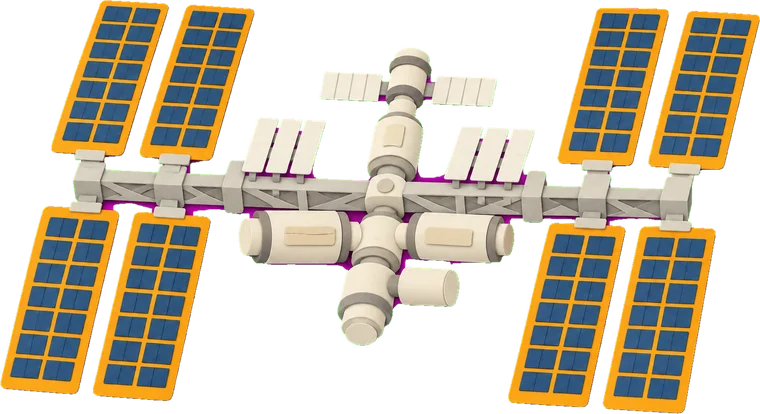
The International Space Station is a home in space about the size of a football pitch, circling Earth about 400 km (250 miles) up. It goes around the planet about every 90 minutes, and people have lived on it without a break since November 2000. Below are the questions children ask most, with answers you can read aloud as they are.
Fact cardInternational Space Station Space · space station
- Job
- astronauts live and do experiments there
- Size
- about 109 m long and 73 m wide (356 ft by 239 ft)
- Height above the ground
- about 400 km (250 miles)
- Speed
- about 28,000 km/h (17,500 mph)
- One trip around Earth
- about 90 minutes
- Lived in
- without a break since November 2000
- A home in the sky as big as a football pitch
International Space Station in a child's words
- The International Space Station is a home in space where astronauts live and do experiments.
- It is about 109 m long and 73 m wide (356 ft by 239 ft), the size of a football pitch.
- It circles Earth about 400 km (250 miles) above the ground.
- It travels at about 28,000 km/h (17,500 mph) and goes around Earth about every 90 minutes.
- It circles Earth about 16 times a day, so the crew can see about 16 sunrises and sunsets every day.
- People have lived there every single day since November 2000. Usually about seven are on board.
- Five space agencies, from the United States, Russia, Europe, Japan and Canada, built it and look after it together, with 15 countries taking part.
When your child asks, answer like this
 Why do astronauts float on the space station?

What do astronauts eat?
How do astronauts sleep?
How do they go to the toilet?
What do they do up there?
Can I see the space station from the ground?
How do people get to the space station?
International Space Station facts that make kids say “Wow!”
- The station covers about 8 km (5 miles) every second.
- It was not launched in one piece. The first part went up in 1998, and the rest was joined on in space, piece by piece.
- The station has a mass of about 420 tonnes, yet it does not fall to the ground because it keeps circling Earth.
A quiz to do together
Tap an answer.
How long does the space station take to go once around Earth?
The space station is about the size of...
Where do astronauts sleep?
You finished the quiz! Well done.
Colouring page
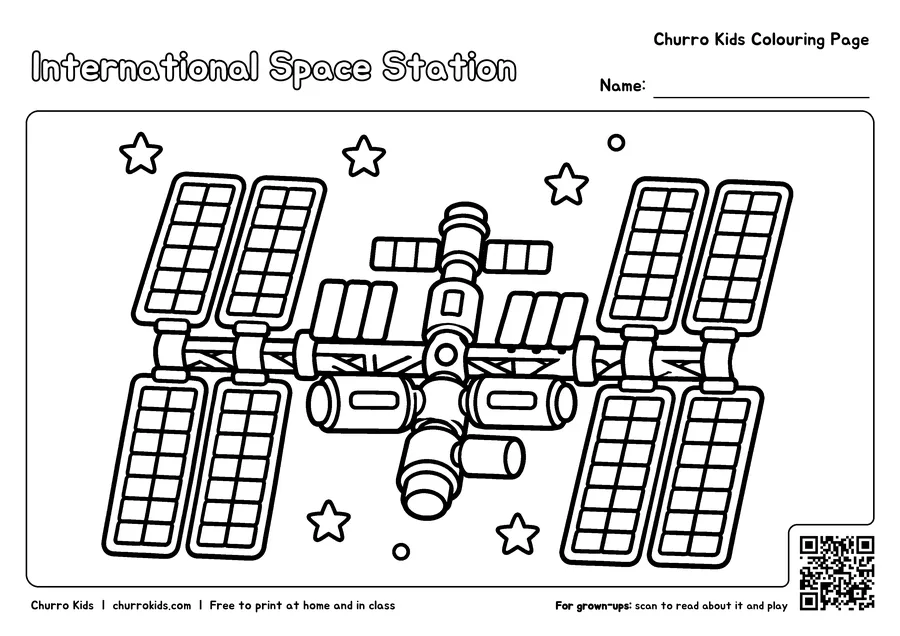
One A4 page, and it is free. Print it freely at home or in class.
Good for parents to know
- "There is no gravity in space" is not accurate. At the station's height Earth's pull is still about 90% of what we feel on the ground. Astronauts feel weightless because they and the station are falling together all the time.
- Figures differ a little by source: altitude varies between 370 and 460 km, speed is given as 27,500 to 28,000 km/h, one orbit as 90 to 93 minutes, and mass as about 420 to 450 tonnes. The usual crew is seven, with more during handovers.
- The current plan is to use the station until 2030 and then bring it down safely into the ocean. There is talk of keeping it longer, so plans can change; look up the latest news together when your child is older.
Things to try together
- With a grown-up, look up when the station will pass over your town, then watch after sunset for a bright dot gliding across the sky.
- Carry a small toy slowly once around a globe and say "that was 90 minutes". Imagine doing it 16 times a day.
- Wriggle into a sleeping bag or a quilt and pretend to be an astronaut sleeping on the wall.