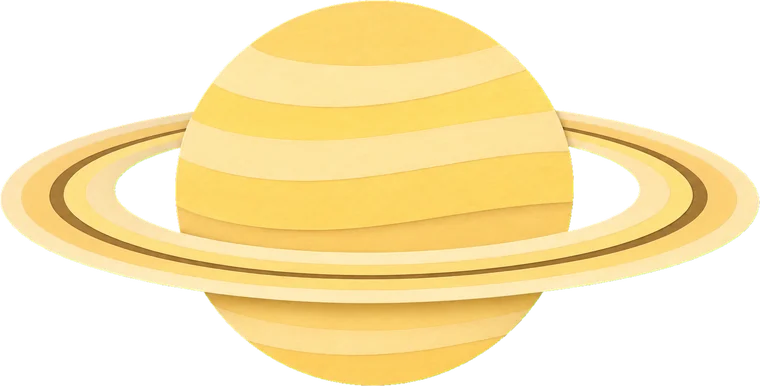
Sorting planet stickers, your child holds up the one with the hoop: "What's this ring? Could I walk on it?"
Saturn is the second-largest planet in the solar system and famous for its big, bright rings. The rings are not a solid plate but countless pieces of ice and rock. With more than 290 known moons so far, Saturn has more than any other planet. Below are the questions children ask most, with answers you can read aloud as they are.
Fact cardSaturn Space · planet
- Type
- a planet (sixth from the Sun, second biggest)
- Width
- about 120,000 km (about 9 Earths across)
- Day
- about 10.5 hours
- Year
- about 29 Earth years
- Moons
- more than 290 (more keep being found)
- Rings
- pieces of ice and rock
- The stylish planet wearing rings of ice
Saturn in a child's words
- Saturn is the sixth planet from the Sun and the second largest, about 9 Earths wide.
- Its rings are not one solid plate. They are countless pieces of ice and rock circling the planet.
- The pieces range from specks as small as dust to chunks as big as a house.
- The rings reach out to about 282,000 km (175,000 miles) from Saturn, yet most of them are only about 10 to 20 m (30 to 65 ft) thick.
- Like Jupiter, Saturn is made of hydrogen and helium gas, with no ground to stand on.
- Saturn spins once in about 10.5 hours and takes about 29 Earth years to go around the Sun.
- More than 290 moons of Saturn are known so far, the most of any planet, and more keep being found.
When your child asks, answer like this
 What are Saturn's rings made of?

Could I walk on the rings?
How did the rings form?
Would Saturn really float in water?
How many moons does Saturn have?
Which is Saturn's biggest moon?
Can I see Saturn without a telescope?
Saturn facts that make kids say “Wow!”
- For their width, Saturn's rings are far thinner than a sheet of paper: hundreds of thousands of kilometres wide but only as thick as a building is tall.
- Saturn is the only planet in the solar system that is less dense than water.
- The Cassini spacecraft circled Saturn from 2004 to 2017, studying the rings and moons up close.
A quiz to do together
Tap an answer.
What are Saturn's rings made of?
Which planet has more known moons?
Compared with how wide they are, Saturn's rings are...
You finished the quiz! Well done.
Colouring page
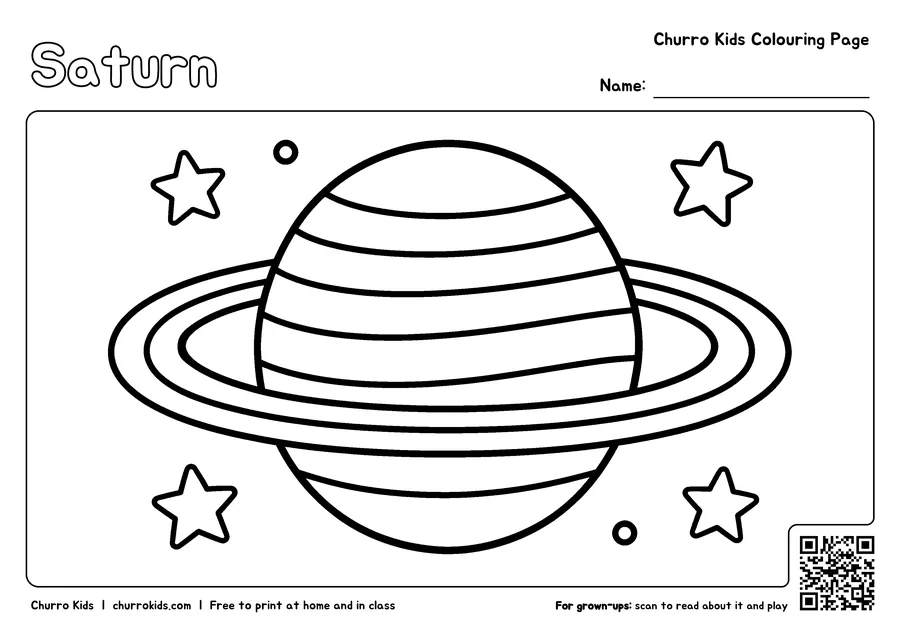
One A4 page, and it is free. Print it freely at home or in class.
Good for parents to know
- Saturn's moon count has jumped in recent years: NASA listed 274 in March 2025 and 293 in August 2026. Older books saying 62, 82 or 145 were correct when printed.
- Scientists disagree about the age of the rings: as old as Saturn (about 4.5 billion years) or only about 100 million years. Ring thickness is also quoted as about 10 m or about 20 m on average.
- Saturn is not the only planet with rings. Jupiter, Uranus and Neptune have them too, but theirs are dark and faint. "Saturn has the biggest, brightest rings" is the accurate line.
Things to try together
- Push a ball through a paper plate to make Saturn, and stick glitter or coarse salt on the plate for the pieces of ice.
- Visit an observatory or science-centre viewing night and find Saturn's rings through a telescope.
- Tilt your model slowly at eye level. Seen exactly edge-on, the rings shrink to a thin line.