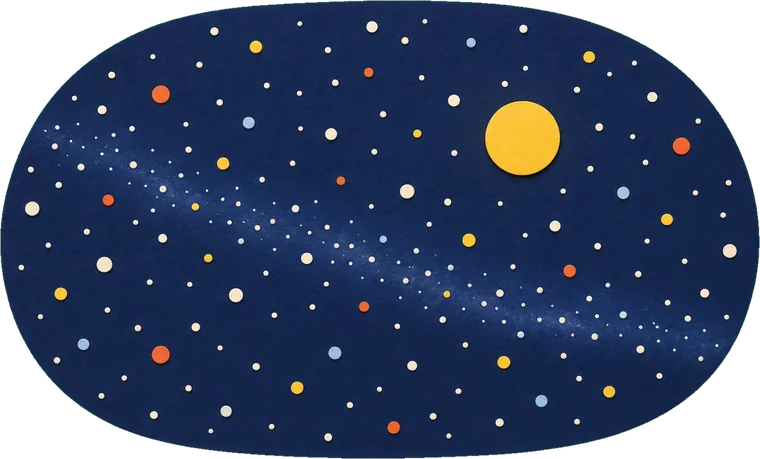
Looking out of the window at bedtime, your child asks: "Why do stars twinkle? Where do they go in the daytime?"
Stars are hot balls of gas that make their own light, and the Sun is one of them. The others are so far away that they look like tiny dots. They twinkle because their light wobbles on its way through our air, and they are still up there during the day. Below are the questions children ask most, with answers you can read aloud as they are.
Fact cardStars Space · stars
- What they are
- hot balls of gas that make their own light
- Nearest star
- the Sun
- Next nearest
- about 4.2 light-years (Proxima Centauri)
- Stars in our galaxy
- more than 100 billion
- Colours
- blue stars are hottest, red stars are coolest
- Lifetime
- millions to trillions of years
- Other suns, very far away
Stars in a child's words
- A star is a hot ball of gas that makes its own light. The Sun is a star.
- The stars at night are big and bright like the Sun, but so far away that they look like tiny dots.
- The nearest star after the Sun is Proxima Centauri. Even at the speed of light it would take about 4.2 years to get there.
- Our galaxy holds more than 100 billion stars. A galaxy is a huge family of stars.
- Stars come in different colours. Blue stars are the hottest and red stars the coolest.
- Stars are born inside clouds of gas and dust floating in space.
- Stars grow old too. Big stars shine for a few million years, small ones for up to trillions of years.
When your child asks, answer like this
 Why do stars twinkle?

Where do stars go in the daytime?
How many stars are there?
Are stars really pointy?
Why are stars different colours?
Is a shooting star a star?
Can we travel to a star?
Stars facts that make kids say “Wow!”
- Starlight is old light. Even from the nearest star it has travelled for more than four years before reaching your eyes.
- A bright dot in the night sky that shines steadily without twinkling is often a planet, not a star.
- The gas and dust a star gives back to space at the end of its life become material for new stars.
A quiz to do together
Tap an answer.
Is the Sun a star?
Which is hotter, a blue star or a red star?
Why do stars twinkle?
You finished the quiz! Well done.
Colouring page
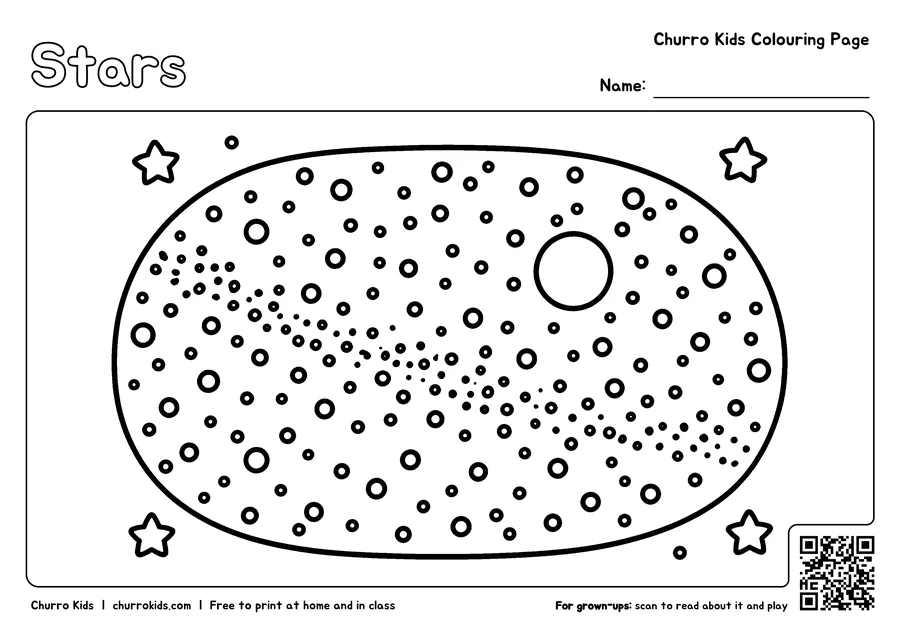
One A4 page, and it is free. Print it freely at home or in class.
Good for parents to know
- On a tap, red means hot and blue means cold; with stars it is the other way round, and blue stars are hotter. The blue flame of a gas cooker is a helpful comparison.
- All star counts are estimates. Figures for our galaxy range from 100 billion to several hundred billion, and how many you can see by eye depends on how dark your sky is. In a city it may be only a few dozen.
- A light-year is a distance, not a time: how far light travels in one year. For a child, say "a place light needs more than four years to reach".
Things to try together
- In a dark place with a grown-up, let your eyes adjust for 10 minutes, then count stars. Look for a reddish one and a bluish one.
- Compare bright dots that twinkle with ones that do not. A steady one may be a planet.
- Poke holes in black paper and shine a torch from behind to make your own constellation.