Reading a space book, your child looks up, worried: "What if a black hole swallows Earth?"
A black hole is an object whose gravity is so strong that, close to it, not even light can get away. But it does not pull in distant things like a vacuum cleaner. The nearest one known is about 1,500 light-years away, so Earth is safe. Below are the questions children ask most, with answers you can read aloud as they are.
Fact cardBlack Hole Space · object
- What it is
- an object with extremely strong gravity
- Colour
- dark: no light gets out
- How it forms
- when a very big star reaches the end of its life
- Nearest known
- about 1,500 light-years away
- At our galaxy's centre
- one as massive as about 4 million Suns
- First picture
- 2019
- So heavy that not even light gets out
Black Hole in a child's words
- A black hole is a huge amount of matter squeezed into a very small space.
- Its gravity is so strong that, close to it, not even light, the fastest thing there is, can get away.
- Because no light comes out, a black hole is dark and cannot be seen directly.
- Black holes form when stars much bigger than the Sun reach the end of their lives.
- A black hole does not pull in things from far away. Only what comes very close cannot escape.
- At the centre of our galaxy is a black hole as massive as about 4 million Suns, about 27,000 light-years from Earth.
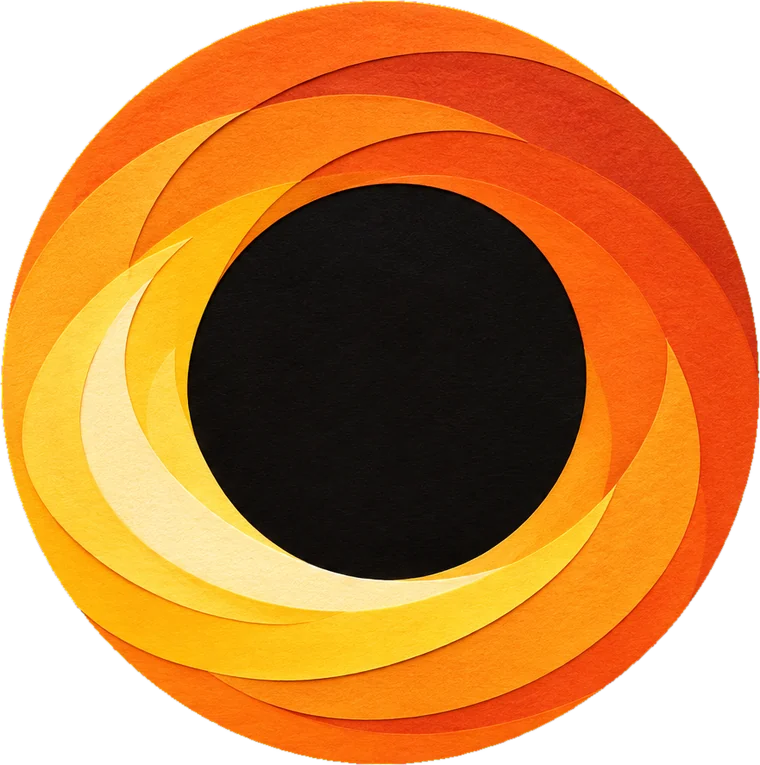
- In 2019 scientists released the first picture ever taken of a black hole.
When your child asks, answer like this
 Does a black hole suck in everything?

Could a black hole swallow Earth?
Will the Sun turn into a black hole?
If we can't see it, how do we find it?
Is a black hole a hole?
What is inside a black hole?
How was a black hole photographed?
Black Hole facts that make kids say “Wow!”
- If the Sun were swapped for a black hole of the same mass, Earth and the planets would not fall in. They would keep circling as now, though it would get very cold without sunlight.
- The first black hole ever pictured sits in the middle of another galaxy about 55 million light-years away.
- In 2015 scientists first caught the ripples in space made when two black holes merged.
A quiz to do together
Tap an answer.
Can light escape from a black hole?
Does a black hole swallow things that are far away too?
Will the Sun become a black hole?
You finished the quiz! Well done.
Colouring page
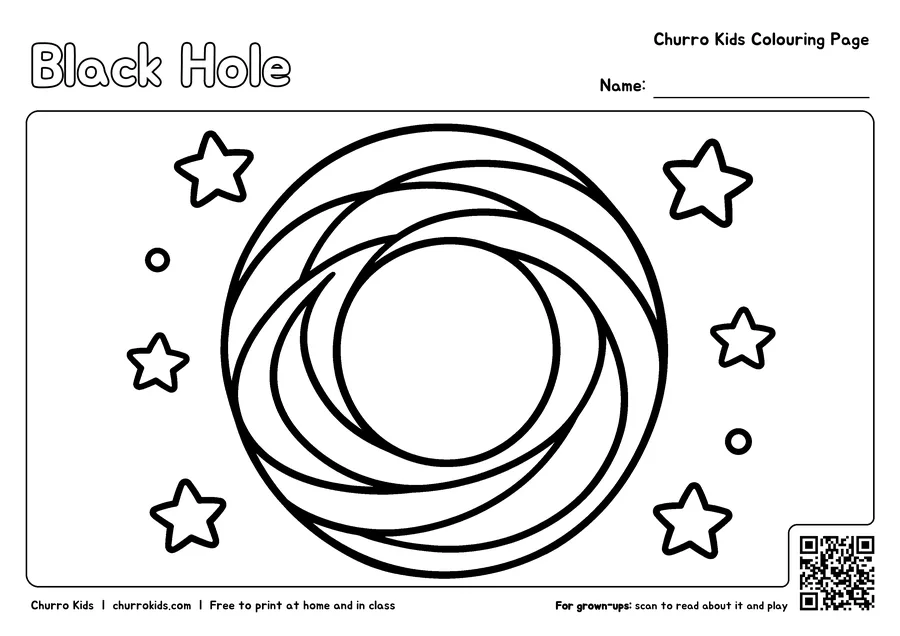
One A4 page, and it is free. Print it freely at home or in class.
Good for parents to know
- Black holes can frighten children. Three calm facts help: they do not pull in distant things, the nearest known one is about 1,500 light-years away, and the Sun will never become one.
- The numbers are estimates. The black hole at our galaxy's centre is given as about 4 to 4.3 million solar masses and about 26,000 to 27,000 light-years away. The nearest known black hole is quoted at 1,500 or 1,560 light-years, and a closer one may yet be found.
- A 'photo of a black hole' shows the glowing gas around it and the shadow in the middle, not the black hole itself. What is inside is still unknown to science, and "we don't know yet" is a good answer.
Things to try together
- Stretch a thin cloth tight and put a heavy ball in the middle. Roll marbles across: ones rolled far from the ball pass by, ones rolled close curve in.
- Draw a glowing orange-and-yellow ring on black paper to copy the black hole picture.
- Ask your child to explain in their own words why a black hole cannot be seen.