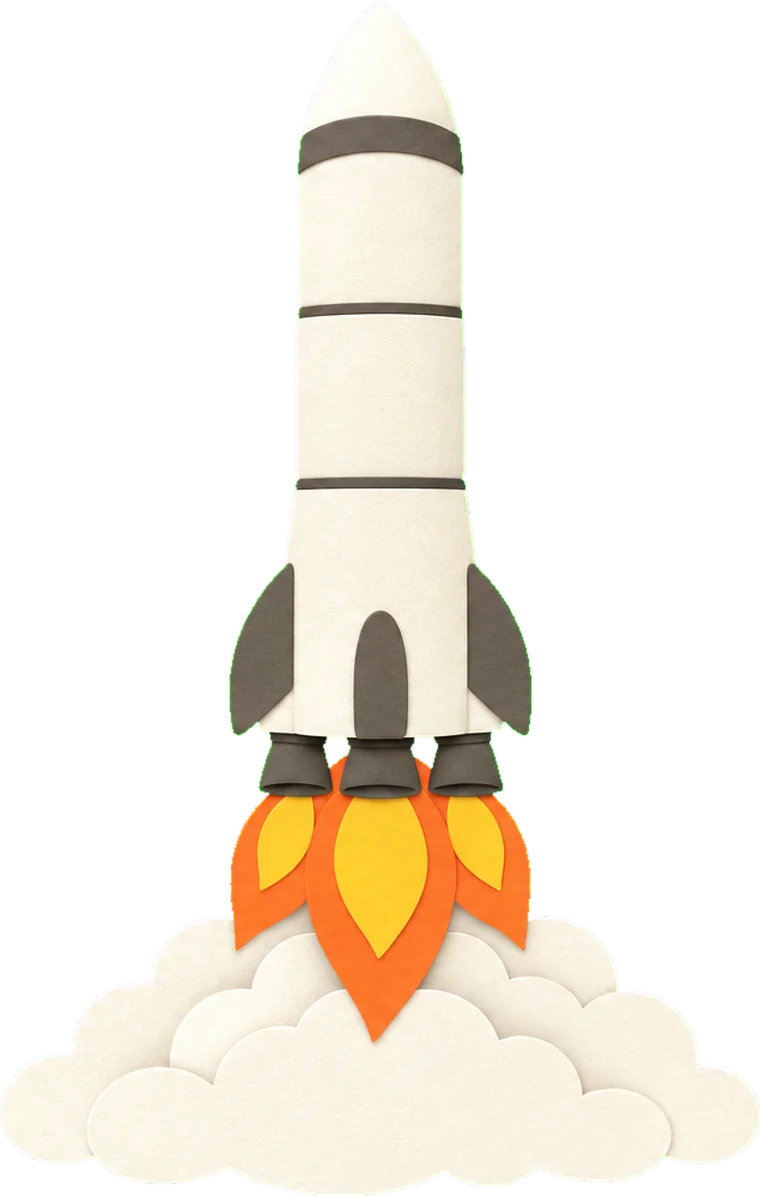
Watching a launch video, your child asks, wide-eyed: "It has no wings, so how does it fly? And there's no air in space!"
A rocket blasts hot gas out behind it and is pushed the other way. It does not push against air, so it works perfectly well in space. To circle Earth it must reach about 28,000 km/h (17,500 mph), and it drops used stages to get lighter. Below are the questions children ask most, with answers you can read aloud as they are.
Fact cardRocket Space · vehicle
- Job
- carries people and satellites to space
- How it flies
- pushes hot gas out behind it
- Speed to stay in orbit
- about 28,000 km/h (17,500 mph)
- Korea's Nuri
- 47.2 m tall (155 ft)
- Saturn V Moon rocket
- 111 m tall (363 ft)
- Nuri's first success
- 21 June 2022
- Pushes back to shoot forward: the bus to space
Rocket in a child's words
- A rocket is a vehicle that carries people and satellites into space.
- It burns fuel to make hot gas and blasts the gas out behind it. That pushes the rocket the opposite way, forwards.
- There is no air in space, so a rocket carries its own oxygen for burning its fuel.
- To keep circling Earth, it has to travel at about 28,000 km/h (17,500 mph).
- Rockets are built in stages. When a stage runs out of fuel it is dropped to make the rocket lighter.
- Korea's Nuri rocket is 47.2 m (155 ft) tall and has three stages.
- Saturn V, the rocket that launched the first people to land on the Moon in 1969, stood 111 m (363 ft) tall.
When your child asks, answer like this
 How does a rocket fly?

How does it work in space, where there is no air?
Why does a rocket drop pieces?
How fast is a rocket?
Does Korea have a rocket?
Where do people sit in a rocket?
Why do people watch a launch from far away?
Rocket facts that make kids say “Wow!”
- Nuri weighs about 200 tonnes at lift-off, and most of that is fuel.
- In April 2026 a rocket about 98 m (322 ft) tall sent a spacecraft with four astronauts towards the Moon. They flew around it and came home safely.
- Rockets began in China long ago: tubes packed with gunpowder and fixed to a stick. The first record of them is about 800 years old.
A quiz to do together
Tap an answer.
Which way does a rocket push its gas?
What is Korea's rocket called?
Why does a rocket drop its used stages?
You finished the quiz! Well done.
Colouring page
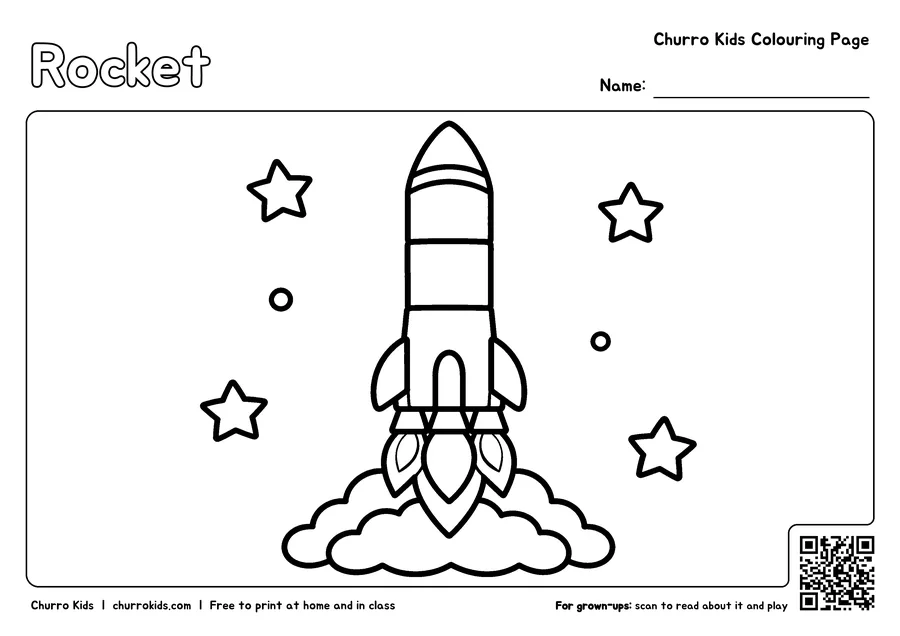
One A4 page, and it is free. Print it freely at home or in class.
Good for parents to know
- "Rockets push against the air or the ground" is a common misunderstanding. A rocket moves by reaction to the gas it throws out, so it actually works better in airless space.
- About 28,000 km/h is the speed for a low orbit around Earth; heading for the Moon takes more (about 39,000 km/h, or 24,500 mph). Nuri's first flight in 2021 did not reach orbit; it has succeeded from the second flight in 2022 onwards, with five flights by October 2026.
- Some children find the noise and flames of a launch frightening. Reassure them that people watch from a safe distance and that everything is prepared carefully, and make clear that rocket play at home never involves fire or fireworks.
Things to try together
- Stretch a string across the room through a straw. Tape a blown-up balloon to the straw, let go, and watch your balloon rocket race along the string.
- Stack three cardboard tubes as a three-stage rocket and act out a launch, dropping one stage at a time from the bottom.
- Watch a Nuri launch video together, count down, and spot the moment a stage separates.
Sources
- nasa.gov/learning-resources/for-kids-and-students/what-is-a-rocket-grades-5-8/
- nasa.gov/reference/space-launch-system/
- grc.nasa.gov/www/k-12/TRC/Rockets/history_of_rockets.html
- nasa.gov/spot-the-station/
- eos.org/research-and-developments/artemis-ii-crew-splashes-down
- en.wikipedia.org/wiki/Nuri_(rocket)
- en.wikipedia.org/wiki/Saturn_V