Stories · Earth & Weather · Weather
Snow Facts for Kids: Why Is Snow White and Why Do Snow Crystals Have Six Sides?
· Churro Kids
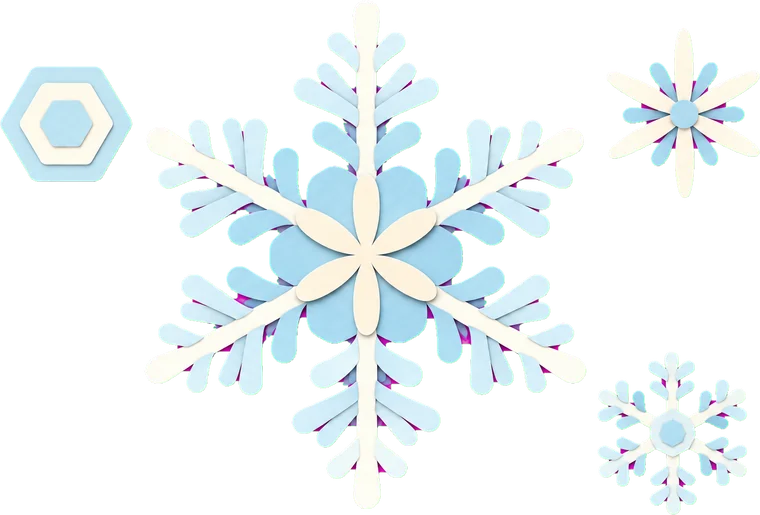
On the first snowy day, your child studies a flake on a mitten and asks, "Why is snow white? Ice is see-through."
Snow begins as tiny ice crystals high in the clouds that grow as they fall. Because of the way water freezes, the crystals branch in six directions. Each one is clear, but together they scatter light and look white, and a pile of snow is mostly air. Below are the questions children ask most, with answers you can read aloud.
Fact cardSnow Weather · ice flowers from the sky
- What it is
- ice crystals grown inside a cloud
- Shape
- six-sided
- Snowflake size
- most are under 1.3 cm
- Colour
- clear ice that looks white because it scatters light
- Inside a snow pile
- mostly air
- Six-sided ice flowers that grow in the clouds and drift down
Snow in a child's words
- Snow is not frozen raindrops. It is born as tiny ice crystals high inside a cloud.
- A very cold water droplet freezes onto a speck of dust or pollen in the air and becomes a tiny ice crystal.
- As the crystal falls, water vapour freezes onto it and branches grow in six directions.
- Snow crystals are six-sided because of the pattern water takes when it freezes.
- The shape depends on temperature: needle shapes tend to form near -5 °C (23 °F) and flat plates near -15 °C (5 °F).
- The snowflakes we see are clusters of many crystals. Most are smaller than 1.3 cm (half an inch).
- Fallen snow is mostly air. Melt fresh snow and the water is often only about a tenth of its depth.
When your child asks, answer like this
 Why does it snow?

Why is snow white?
Why are snow crystals six-sided?
Is it true that no two snowflakes are alike?
Can I eat snow?
Why is there so little water when snow melts?
Snow facts that make kids say “Wow!”
- It can snow even when it is extremely cold, as long as there is moisture in the air. But heavy snowfalls usually happen when it is warmer than about -9 °C (15 °F).
- On calm days near freezing, snowflakes can grow to nearly 5 cm (2 inches) across.
- The six arms of one crystal travel the same path and grow alike, though perfectly matching arms are rare.
A quiz to do together
Tap an answer.
In how many directions do the branches of a snow crystal grow?
What colour is a single snow crystal really?
What takes up most of the space in a pile of snow?
You finished the quiz! Well done.
Colouring page
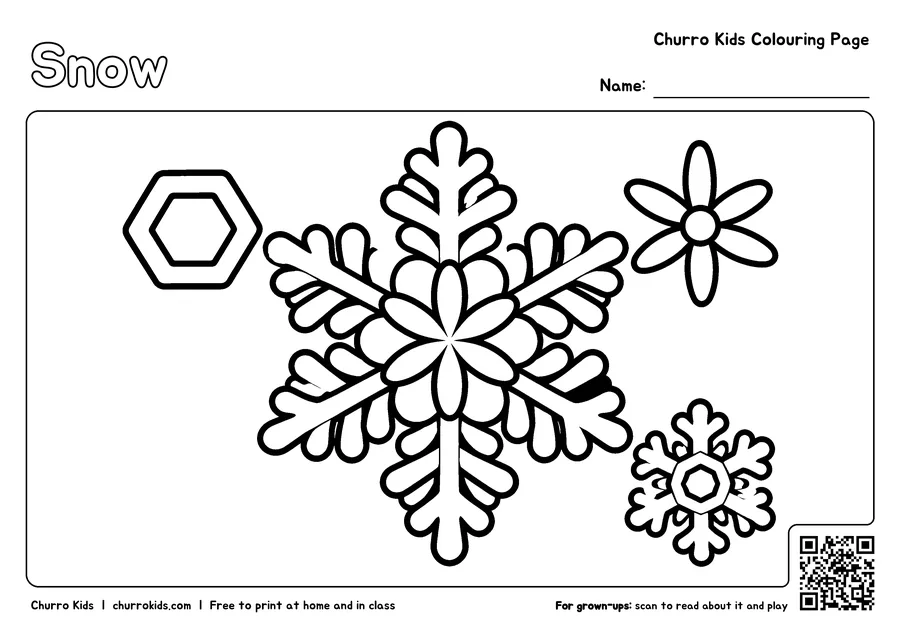
One A4 page, and it is free. Print it freely at home or in class.
Good for parents to know
- 'No two snowflakes are alike' is a statement about probability, not a proven law. Near-identical 'twin' crystals that match even under a microscope have been grown in laboratories, and perfectly symmetrical crystals like those in pictures are actually uncommon.
- The familiar 10-to-1 snow-to-water ratio varies a great deal. According to the US National Snow and Ice Data Center, 25 cm of fresh snow can melt down to anything from 0.25 cm to 10 cm of water.
- Snowy pavements are slippery. Teach your child to keep hands out of pockets and take small, slow steps. Pack gloves and a hat, and change wet clothes promptly.
Things to try together
- Catch snowflakes on black paper or a dark glove and look at them with a magnifying glass. Can you find six arms?
- Fill a cup with snow, measure its height, let it melt indoors and measure the water. You will see how much of snow is air.
- Cut paper snowflakes. The trick for six arms is to fold the paper in half and then into thirds, not quarters.