Stories · Earth & Weather · Ice
Glacier Facts for Kids: How Do Glaciers Form and Why Are They Blue?
· Churro Kids
Watching a film about penguins, your child points at the wall of ice behind them: "Why is that ice blue? Who froze it?"
A glacier is a huge body of ice made from snow that piled up and was squeezed over a very long time. It flows slowly under its own weight. Glaciers and ice sheets cover about 10% of the Earth's land and hold about 70% of its fresh water. Below are the questions children ask most, with answers you can read aloud.
Fact cardGlacier Earth · ice
- What it is
- a huge mass of ice made from old packed snow
- Share of land
- covers about 10%
- Share of fresh water
- about 70% is in glaciers and ice sheets
- Movement
- flows very slowly
- Thickest
- Antarctica, over 4 km
- Colour
- bluish ice
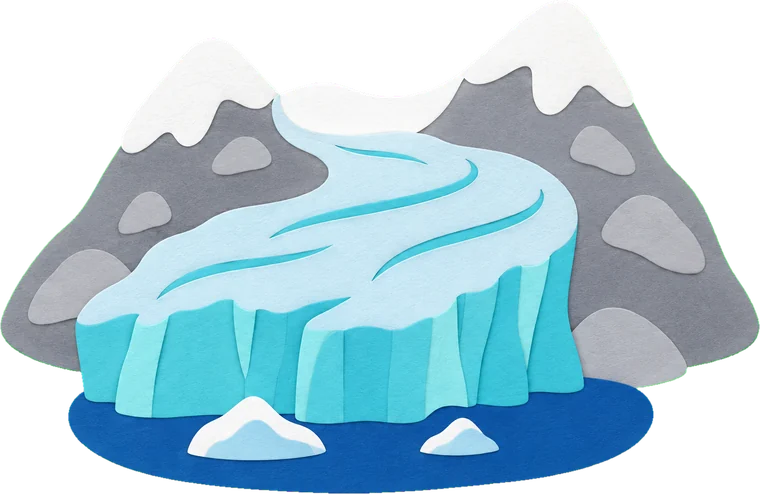
- A river of ice made from snow that piled up and was squeezed
Glacier in a child's words
- In very cold places the snow does not all melt in summer, and more snow falls on top every year.
- The snow underneath is squeezed by the weight above until it becomes hard ice. This huge mass of ice is a glacier.
- A glacier looks still, but its own weight makes it flow very slowly downhill. That is why it is called a river of ice.
- Glaciers cover about 10% of the Earth's land. Most of that ice is in Antarctica and Greenland.
- About 70% of the fresh (non-salty) water on Earth is frozen in glaciers and ice sheets.
- In places the ice of Antarctica is more than 4 km (2.5 miles) thick.
- Glacier ice looks bluish because thick ice absorbs red light and lets blue light through.
When your child asks, answer like this
 How is a glacier made?

Do glaciers really move?
Why are glaciers blue?
What is the difference between a glacier and an iceberg?
What happens if all the glaciers melt?
Where are glaciers found?
Glacier facts that make kids say “Wow!”
- Ice more than a million years old has been found in Antarctica.
- At the coldest point of the last ice age, ice covered about 32% of the land, roughly three times as much as today.
- As glaciers flow they grind rock and soil. They leave behind wide valleys and lakes.
A quiz to do together
Tap an answer.
What piles up and gets squeezed to make a glacier?
Do glaciers move?
What is a piece of glacier floating in the sea called?
You finished the quiz! Well done.
Colouring page
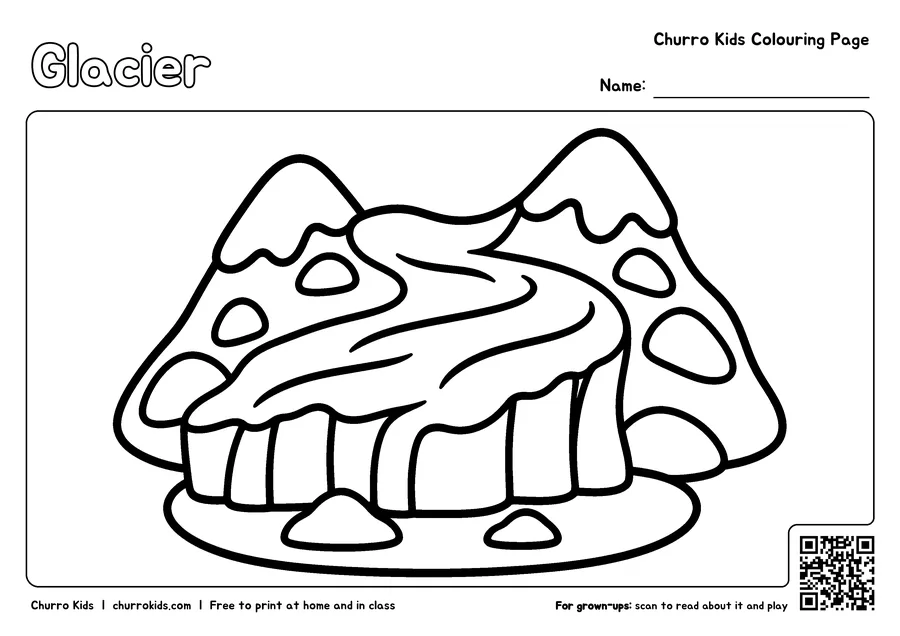
One A4 page, and it is free. Print it freely at home or in class.
Good for parents to know
- The fresh-water share varies by source: about 68.7% according to the US National Snow and Ice Data Center, 'about three-quarters' according to the USGS. Antarctic ice is up to 4.9 km thick according to the NSIDC. For the oldest ice, a core drilled in 2025 reaches back at least 1.2 million years, and pieces of ice about 6 million years old have been reported from another part of Antarctica.
- Glacier speeds differ enormously, from less than a few centimetres a day to more than 40 m a day at Jakobshavn in Greenland at its fastest (about 46 m a day in summer 2012). The 70 m sea-level figure is a calculation for all land ice, not something expected in the near future.
- Arctic sea ice, where polar bears live, is frozen sea water; glaciers form on land from snow. When climate change comes up, link it to things a child can do, such as saving electricity and walking, rather than to fear.
Things to try together
- Put an ice cube on a tilted tray and watch it slide as it melts.
- On a snowy day, squeeze snow hard in both hands. Fluffy snow turning firm is the first step in making a glacier.
- Find Antarctica and Greenland on a globe or world map and compare the areas shown in white.
Sources
- nsidc.org/learn/parts-cryosphere/glaciers/glacier-quick-facts
- nsidc.org/learn/parts-cryosphere/glaciers/science-glaciers
- usgs.gov/faqs/how-much-earths-water-stored-glaciers
- usgs.gov/faqs/why-glacier-ice-blue
- polarjournal.net/beyond-epica-oldest-ice-1-2-million-years-of-climate-history-unearthed-in-oldest-ice-core/
- phys.org/news310638947.html
- nps.gov/glac/learn/education/a-waterton-glacier-story-the-work-of-ice.htm
- scied.ucar.edu/learning-zone/earth-system/parts-cryosphere
- en.wikipedia.org/wiki/Glacier