Stories · Earth & Weather · Underground
Cave Facts for Kids: How Do Caves Form and Why Do Stalactites Grow?
· Churro Kids
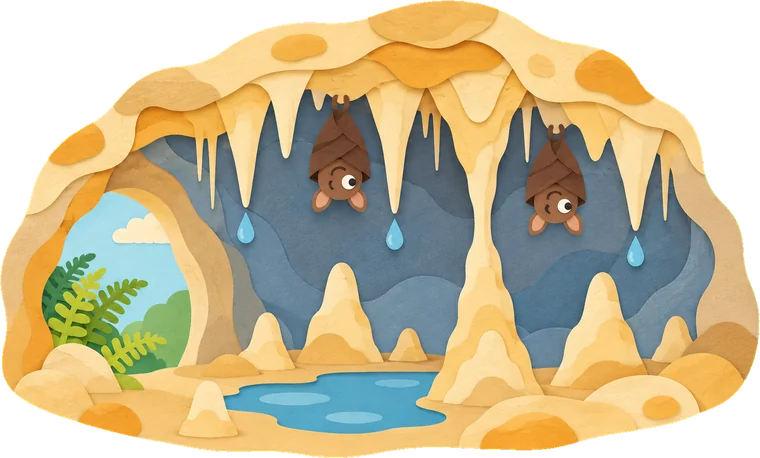
On a visit to a cave, your child looks up at the stone hanging from the ceiling and whispers, "Why do those rocks look like icicles?"
A cave is a natural hollow under the ground. Some are made when rainwater slowly dissolves limestone over a very long time; others, like Manjanggul on Jeju Island, are tunnels left by flowing lava. The stalactites on the ceiling usually grow less than a millimetre a year. Below are the questions children ask most, with answers you can read aloud.
Fact cardCave Earth · underground
- What it is
- a natural hollow in the ground or rock
- Made by
- rainwater, lava or waves
- Stalactite growth
- usually less than 1 mm a year
- Longest cave
- Mammoth Cave, USA, over 600 km
- In Korea
- Manjanggul, Jeju (about 7.4 km)
- An underground passage made by water and lava over a very long time
Cave in a child's words
- A cave is a natural hollow in the ground or inside rock.
- The most common caves form in a rock called limestone. Rainwater becomes very slightly acidic as it passes through soil, and this water slowly dissolves the rock.
- A water passage widens by about 1 mm a year at most, so a large cave takes a very, very long time to form, sometimes more than hundreds of thousands of years.
- Stone hanging from the ceiling like an icicle is a stalactite; stone growing up from the floor is a stalagmite. When they meet they form a column.
- Stalactites grow from the tiny bit of mineral each water drop leaves behind, usually less than 1 mm a year.
- Some caves were left by flowing lava. Manjanggul on Jeju Island is a lava tube about 7.4 km (4.6 miles) long.
- The longest known cave is Mammoth Cave in the United States, with more than 600 km (over 400 miles) surveyed so far.
When your child asks, answer like this
 How are caves made?

What are the things hanging from the cave ceiling?
What is the difference between a stalactite and a stalagmite?
Who lives in caves?
How was Manjanggul made?
Can we go into a cave?
Cave facts that make kids say “Wow!”
- Inside Manjanggul stands a lava column about 7.6 m (25 ft) tall, made when lava poured from the ceiling and hardened.
- The deepest known caves go down about 2,200 m (7,200 ft), deep enough to hide a very tall mountain.
- A stalactite starts life as a thin hollow tube, like a drinking straw.
A quiz to do together
Tap an answer.
Which one grows down from the cave ceiling?
What flowed to make Manjanggul on Jeju?
Is it all right to touch stalactites in a cave?
You finished the quiz! Well done.
Colouring page
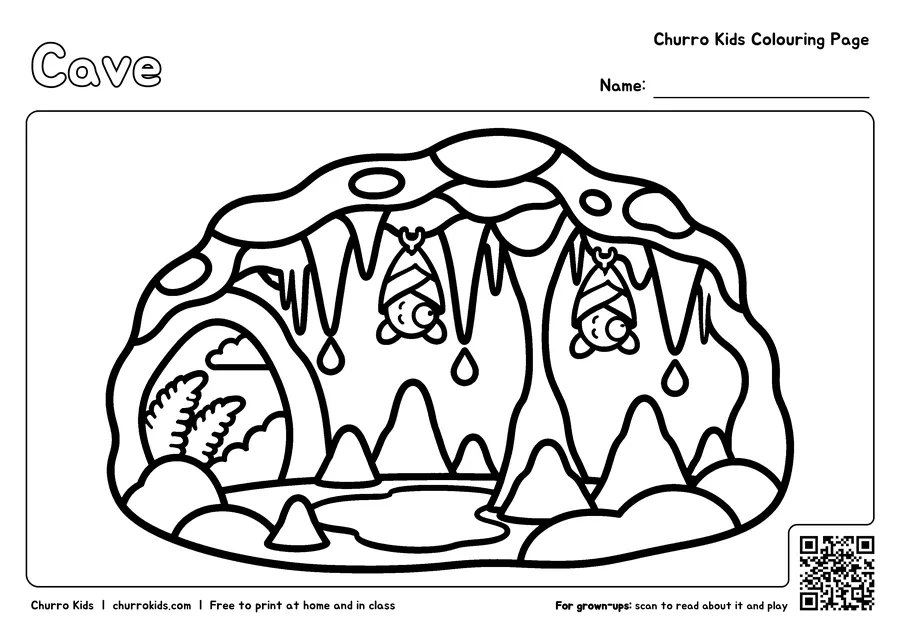
One A4 page, and it is free. Print it freely at home or in class.
Good for parents to know
- Stalactite growth depends on the water supply. Quoted averages run from about 0.1 to 0.3 mm a year, with fast ones reaching 2-3 mm a year, so the text only says 'usually less than 1 mm a year'.
- Manjanggul is about 7.4 km (7,416 m) long in Korean references: a 5.3 km lower passage plus a 2.1 km upper one, of which about 1 km is open to visitors. The figure of about 8.9 km found in some other references is not supported by the Korean sources. For the deepest cave, Veryovkina and Krubera in Georgia are both about 2,200 m and sources disagree on which is first. Mammoth Cave keeps getting longer as surveying continues (over 426 miles, about 686 km, according to the US National Park Service).
- Visit only show caves with paths and lighting, with an adult. Caves are cool and wet, so bring a jacket and non-slip shoes. A child who dislikes the dark can simply look in from near the entrance.
Things to try together
- Learn the two words with your body: arms hanging down for a stalactite, crouch and stand up tall for a stalagmite.
- Build a blanket-and-chair cave and explore it with a torch. Who might live inside?
- Drip water onto a sugar cube one drop at a time. The way water eats a hole in the sugar is like rainwater dissolving limestone.
Sources
- nps.gov/subjects/caves/solution-caves.htm
- nps.gov/subjects/caves/speleothems.htm
- nps.gov/ozar/learn/education/speleothems.htm
- nps.gov/maca/index.htm
- weather.go.kr/w/volcano/archive/korea.do
- ktriptips.com/kor/tourspot/126452
- encykorea.aks.ac.kr/Article/E0017705
- legacy.caves.org/pub/journal/PDF/V24/v24n2-Moore.htm
- home.nps.gov/subjects/science/nrca_maca.htm
- guinnessworldrecords.com/world-records/deepest-cave/
- en.wikipedia.org/wiki/Cave
- en.wikipedia.org/wiki/Stalactite
- en.wikipedia.org/wiki/Mammoth_Cave_National_Park
- en.wikipedia.org/wiki/Manjanggul
- en.wikipedia.org/wiki/Veryovkina_Cave