Stories · Earth & Weather · Weather
Typhoon Facts for Kids: How Do Typhoons Form and What Is the Eye?
· Churro Kids
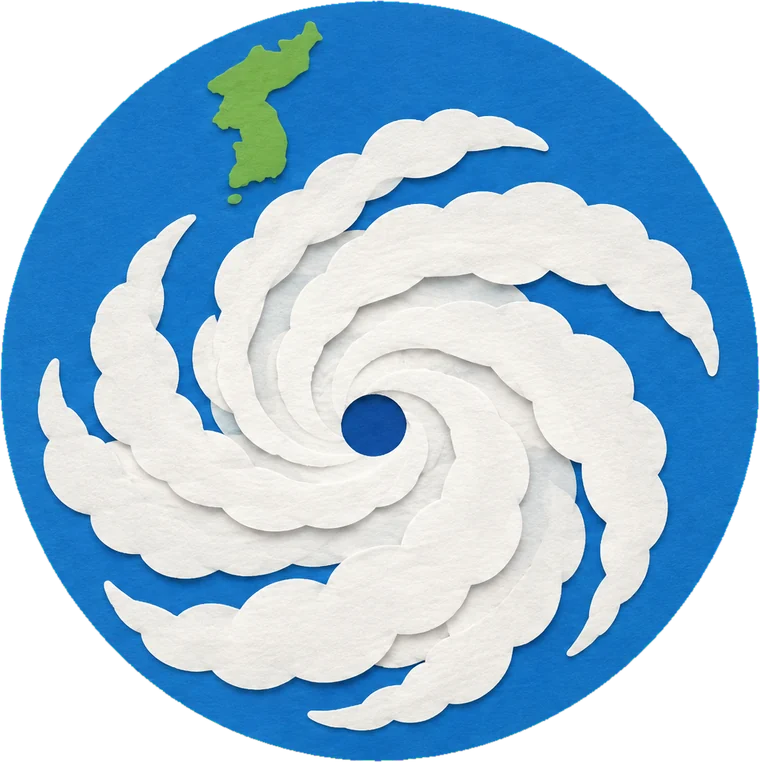
A spinning swirl of cloud appears on the weather forecast and your child asks, "Where do typhoons come from? Why is there a hole in the middle?"
A typhoon is a huge spinning storm of wind and rain that forms over warm seas and travels for days. In the middle is the calm eye, and the strongest winds are right around it. Typhoons, hurricanes and cyclones are the same kind of storm with different regional names. Below are the questions children ask most, with answers you can read aloud.
Fact cardTyphoon Weather · giant storm
- What it is
- a huge spinning storm born over warm seas
- Wind speed
- 17 m/s (about 61 km/h) or more
- The eye
- about 30-65 km wide and calm
- Spin
- counter-clockwise (northern half of the Earth)
- Reaches Korea
- mostly July-October, about 3 a year
- Names
- 140 names from 14 countries, used in turn
- A giant spinning storm born over warm seas
Typhoon in a child's words
- A typhoon is a very large spinning storm of wind and rain that forms over warm tropical seas.
- In Korea a storm is called a typhoon when the winds near its centre reach 17 metres per second (about 61 km/h, 38 mph).
- Seen from above, a typhoon is a swirling mass of cloud. In the northern half of the Earth it spins counter-clockwise.
- In the middle is the eye, about 30-65 km (20-40 miles) wide, where the wind is light and the sky is often clear.
- Typhoons, hurricanes and cyclones are the same kind of storm. The name depends on which ocean they form over.
- Typhoons have names: 14 countries each gave 10, and the 140 names are used in turn. Gaemi (ant), Nari (lily) and Jangmi (rose) are names from South Korea.
- About three typhoons a year affect Korea, mostly between July and October.
When your child asks, answer like this
 How does a typhoon form?

What is the eye of a typhoon?
What do we do when a typhoon comes?
Who names typhoons?
Are typhoons and tornadoes the same thing?
Are typhoons only bad?
Typhoon facts that make kids say “Wow!”
- South of the equator these storms spin the other way, clockwise.
- A storm like this is typically about 500 km (300 miles) across, wider than the distance from Seoul to Busan.
- Twenty of the 140 names are Korean words: ten from South Korea and ten from North Korea.
A quiz to do together
Tap an answer.
What is the calm centre of a typhoon called?
Where are typhoons born?
Are a typhoon and a tornado the same thing?
You finished the quiz! Well done.
Colouring page
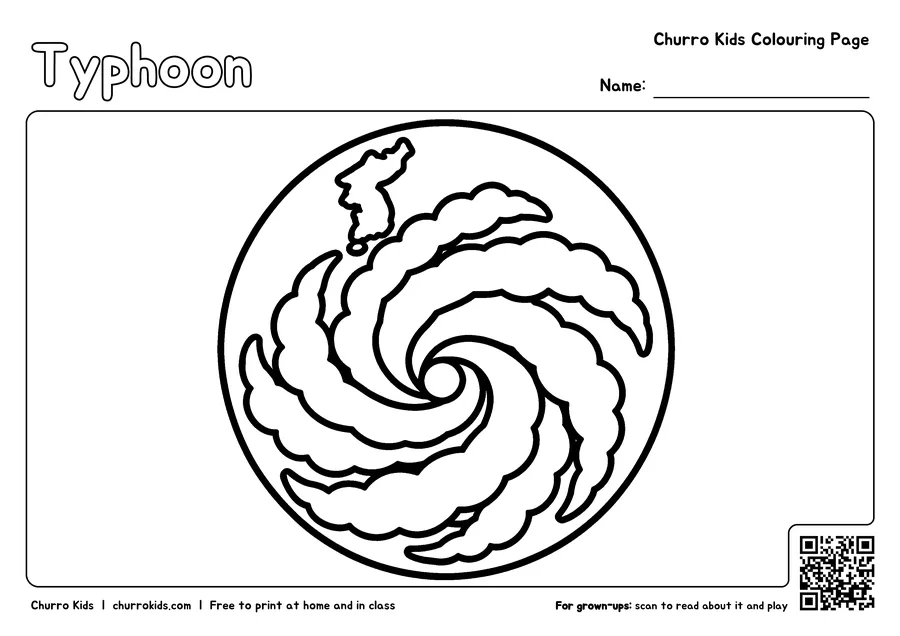
One A4 page, and it is free. Print it freely at home or in class.
Good for parents to know
- Definitions differ. Korea and Japan call a tropical cyclone a typhoon from 17 m/s, while the World Meteorological Organization reserves 'typhoon' for 33 m/s and above, the same threshold as a hurricane (74 mph, about 119 km/h).
- 'About three a year' is a long-term average. The KMA's 1991-2020 normals are 25.1 typhoons a year forming in the north-west Pacific, of which 3.4 affect Korea. Numbers vary a lot from year to year, as do the size of the eye and of the whole storm.
- Korean official guidance: avoid going out, close doors and windows and stay away from the glass, and keep away from flooded roads, streams, the coast and fallen power lines. For a child, 'a typhoon day is a play-at-home day' is a calm way to put it.
Things to try together
- Stir a basin of water in one direction to make a whirlpool. The dip in the middle is like the eye of a typhoon.
- In summer, look for the swirling cloud and the eye of a typhoon in satellite pictures on the weather forecast.
- Look up this year's typhoon names: which country gave each one, and what does it mean?
Sources
- weather.go.kr/w/typhoon/basic/info1.do
- weather.go.kr/w/typhoon/ko/weather/typhoon_02_popup02.jsp
- kma.go.kr/kma/flexer/html/press/2024/05/14/ATC202405140728311_2b271972-7c3b-4543-bef4-b826910f419c.hwp.files/Sections1.html
- weather.go.kr/w/hazard/safety-guide/typhoon.do
- kma.go.kr/kma/flexer/html/press/2021/12/07/ATC202112070936301_ba4505d1-4c64-40b3-b7b0-3ec701f803d0.hwp.files/Sections1.html
- kma.go.kr/kma/flexer/html/press/2026/03/10/ATC202603101343371_4a0b6d03-aa26-4164-9ca6-54ef5ff7951a.hwp.files/Sections1.html
- hko.gov.hk/en/informtc/sound/tcname2026e.html
- oceanservice.noaa.gov/facts/cyclone.html
- noaa.gov/jetstream/tropical/tropical-cyclone-introduction/tropical-cyclone-structure
- knnews.co.kr/news/articleView.php?idxno=574608
- en.wikipedia.org/wiki/Eye_(cyclone)