Stories · Earth & Weather · Weather
Tornado Facts for Kids: How Is a Tornado Different from a Typhoon?
· Churro Kids
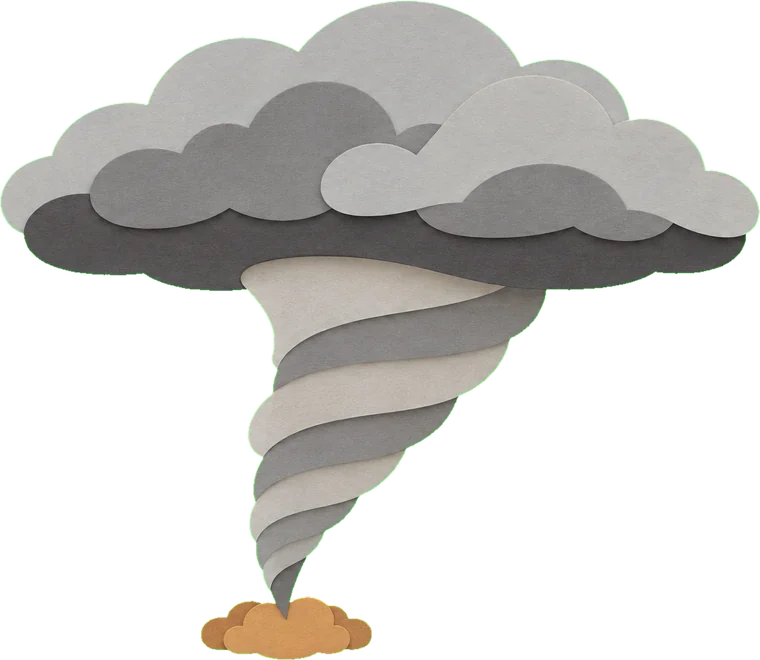
Your child sees a twisting whirlwind in a picture book and asks, "Does this come to our town too?"
A tornado is a violently spinning column of air that reaches from a thunderstorm to the ground. It lasts about five minutes on average, which makes it a completely different thing from a typhoon that travels for days. The United States has about 1,200 a year; in Korea they are very rare. Below are the questions children ask most, with answers you can read aloud.
Fact cardTornado Weather · whirlwind
- What it is
- a spinning column of air under a thunderstorm
- Korean name
- yong-oreum ('rising dragon')
- How long it lasts
- about 5 minutes on average
- Wind speed
- most are under 180 km/h
- Most common in
- the United States (about 1,200 a year)
- A whirlwind reaching from a storm cloud to the ground
Tornado in a child's words
- A tornado is a violently spinning column of air that stretches from a big thunderstorm cloud down to the ground.
- In Korean it is called yong-oreum, 'rising dragon', because it looks like a dragon climbing into the sky.
- A tornado lasts about five minutes on average. A very few last more than an hour.
- Most tornadoes are thought to have winds under 180 km/h (110 mph). The rarest and strongest have been measured at around 500 km/h (roughly 300 mph).
- The United States has more tornadoes than any other country, about 1,200 a year.
- Tornadoes occur on every continent except Antarctica.
- In Korea they are very rare. They are sometimes seen over the sea near Ulleungdo, and one appeared on land in Goyang, near Seoul, in 2014.
When your child asks, answer like this
 How does a tornado form?

How is a tornado different from a typhoon?
Do tornadoes happen in Korea?
What should we do if a tornado comes?
Why is a tornado funnel-shaped?
Why does America have so many tornadoes?
Tornado facts that make kids say “Wow!”
- The widest tornado on record, in the United States in 2013, was about 4.2 km (2.6 miles) across.
- Most tornadoes happen between 4 and 9 in the evening.
- Over a sea or lake a tornado looks like a column of water. Koreans of long ago saw it as a dragon rising to the sky.
A quiz to do together
Tap an answer.
What is the Korean word for a tornado?
Which is bigger, a tornado or a typhoon?
How long does a tornado usually last?
You finished the quiz! Well done.
Colouring page
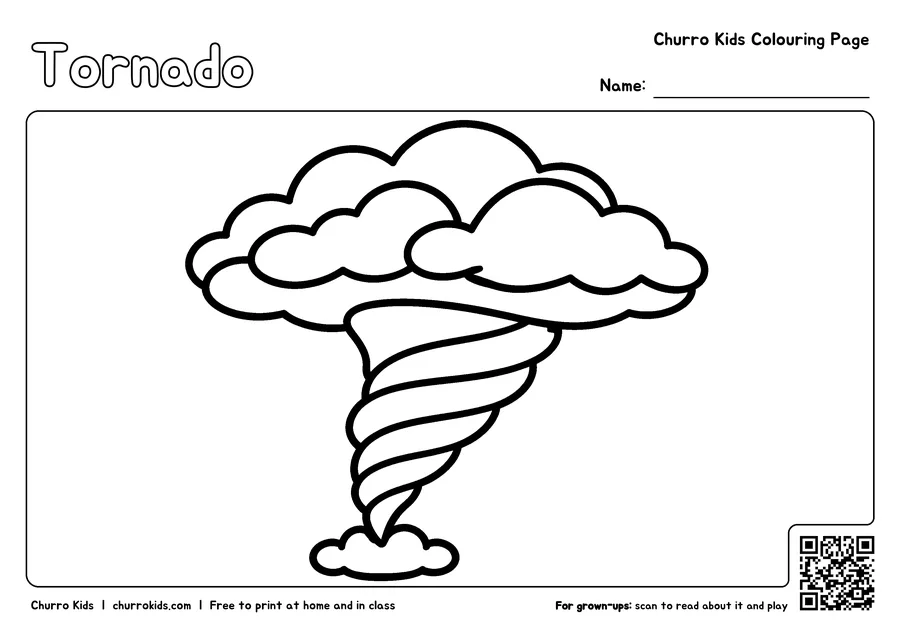
One A4 page, and it is free. Print it freely at home or in class.
Good for parents to know
- Wind inside a tornado is hard to measure and is usually estimated from damage. The highest measurement was made by mobile radar, a little above the ground, at Bridge Creek-Moore, Oklahoma, in 1999. NOAA's National Severe Storms Laboratory gives 318 mph (512 km/h), a 2007 paper about 302 mph (486 km/h, give or take 20 mph), and a later re-analysis is reported as 321 mph (517 km/h), so the text says only 'around 500 km/h'.
- Korean yong-oreum are mostly weak ones over the sea. The best-known case on land was in Goyang in June 2014. If a video frightens your child, explain that they are very rare in Korea and that big ones have not been recorded there.
- Korea has no separate tornado guidance; the official strong-wind guidance applies: shelter in a safe building and keep away from windows. The US National Weather Service advises a basement or an interior room away from windows. The page text keeps only what both agree on: inside a sturdy building, well away from the glass.
Things to try together
- Fill a clear bottle two-thirds with water, close the lid tightly, turn it upside down and swirl it in circles. A small vortex appears inside.
- Watch the whirlpool when the bath drains. The hollow centre looks similar.
- Draw a tornado and a typhoon side by side: one is a funnel touching the ground, the other a giant spiral seen from above.
Sources
- nssl.noaa.gov/education/svrwx101/tornadoes/
- nssl.noaa.gov/education/svrwx101/tornadoes/faq/
- weather.gov/safety/tornado-during
- weather.go.kr/w/hazard/safety-guide/strong-wind.do
- mediahub.seoul.go.kr/archives/2014961
- farm.atmos.illinois.edu/contents/pubs_pdf/2007-Wurman_etal-Low-level_winds_in_tornadoes_and_potential_catastrophic_tornado_impacts_in_urban_areas.pdf
- koreascience.or.kr/article/JAKO201612461131374.page
- mprnews.org/story/2013/06/04/tornado-history-26-mile-wide-ok-monster-is-widest-in-us-history
- en.wikipedia.org/wiki/1999_Bridge_Creek–Moore_tornado
- en.wikipedia.org/wiki/Tornado