Stories · Earth & Weather · Inside the ground
Volcano Facts for Kids: Why Do Volcanoes Erupt? Simple Answers for Curious Children
· Churro Kids
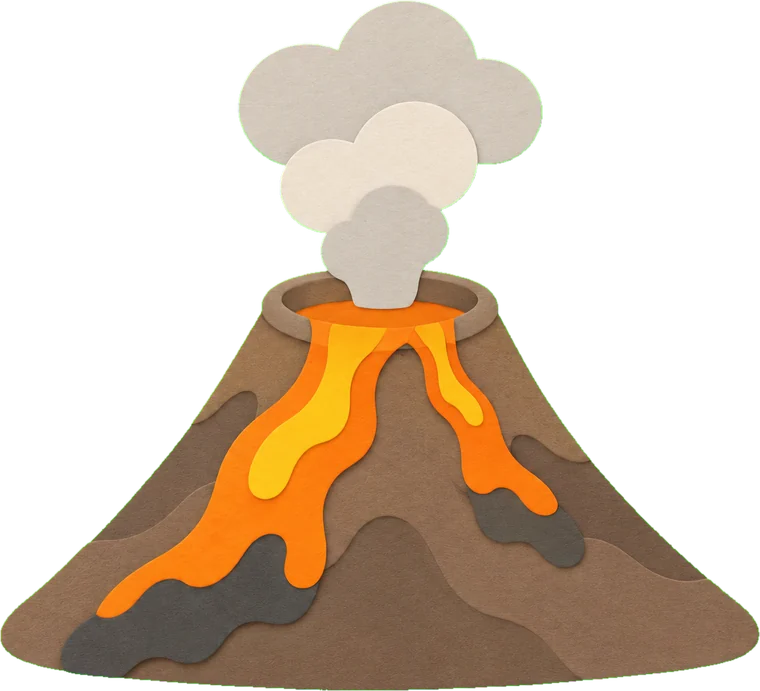
Looking at holiday photos from Jeju, your child points at Hallasan and asks, "Did this mountain breathe fire a long time ago?"
A volcano is a place where melted rock from deep inside the Earth reaches the surface. Underground it is called magma; once it comes out it is called lava. There are about 1,350 potentially active volcanoes on land, many of them around the Pacific Ocean. Below are the questions children ask most, with answers you can read aloud as they are.
Fact cardVolcano Earth · inside the ground
- What it is
- a place where melted rock comes out
- Lava temperature
- about 800-1,200 °C (varies by volcano)
- Volcanoes worldwide
- about 1,350 on land
- Where most are
- the Ring of Fire around the Pacific
- In Korea
- Baekdusan, Hallasan, Ulleungdo
- A mountain where melted rock from deep underground comes up
Volcano in a child's words
- Deep inside the Earth it is so hot that rock melts. This melted rock is called magma.
- When magma reaches the surface and flows out, its name changes to lava.
- Lava measured at a Hawaiian volcano was about 1,170 °C (2,140 °F), more than ten times hotter than boiling water.
- There are about 1,350 potentially active volcanoes on land, and many more under the sea.
- Volcanoes are especially common around the edge of the Pacific Ocean, a belt called the Ring of Fire.
- Baekdusan, Hallasan and Ulleungdo in Korea were all built by volcanoes. Baekdusan is 2,744 m (9,003 ft) high.
- When lava cools it becomes hard rock. The dark basalt stones of Jeju Island formed this way.
When your child asks, answer like this
 Why do volcanoes erupt?

How hot is lava?
What is the difference between magma and lava?
Are there volcanoes in Korea?
Are all volcanoes pointy mountains?
What should we do if a volcano erupts?
Are volcanoes only bad?
Volcano facts that make kids say “Wow!”
- Ulleungdo is a volcanic island that rose from a sea floor about 2,000 m deep. What we see above the water is only the top.
- Cheonji, the lake on top of Baekdusan, filled the hollow left after a huge eruption.
- About 500 volcanoes have erupted in recorded human history.
A quiz to do together
Tap an answer.
What is melted rock called after it comes out of the ground?
Was Hallasan built by a volcano?
Around which place are most volcanoes found?
You finished the quiz! Well done.
Colouring page
One A4 page, and it is free. Print it freely at home or in class.
Good for parents to know
- Volcano counts depend on the definition. The USGS gives about 1,350 potentially active volcanoes; the Smithsonian counts a little over 1,200 that have been active in the last 12,000 years or so. Neither figure includes the long chains of volcanoes on the ocean floor.
- Lava temperature varies from volcano to volcano. About 1,170 °C was measured at Kīlauea in Hawaii; stickier lava at other volcanoes is often cooler, around 800-1,000 °C. Hallasan's official height is about 1,947 m (National Geographic Information Institute, gazetted 2008); the 1,950 m still seen in older references is the earlier figure.
- If your child is frightened, explain that scientists watch Korea's volcanoes every day and grown-ups will be told first if anything changes. Korean official guidance for falling ash is to stay indoors and cover your nose and mouth.
Things to try together
- Find Baekdusan, Hallasan and Ulleungdo on a map of Korea and circle them.
- Look at a piece or a photo of Jeju basalt and talk about why it has holes: gas bubbles escaped from the lava.
- Build a sand mountain at the playground and pour water from the top to watch the paths a lava flow might take.
Sources
- usgs.gov/faqs/how-many-active-volcanoes-are-there-earth
- usgs.gov/faqs/how-hot-a-hawaiian-volcano
- usgs.gov/faqs/what-difference-between-magma-and-lava
- usgs.gov/faqs/what-ring-fire
- weather.go.kr/w/volcano/archive/korea.do
- weather.go.kr/w/earthquake-volcano/evacuation.do
- usgs.gov/observatories/calvo/news/how-hot-hot-when-it-comes-volcanoes
- jnuri.net/news/article.html?no=60300
- usgs.gov/educational-resources/find-feature-vesicles
- en.wikipedia.org/wiki/Volcano
- en.wikipedia.org/wiki/Ring_of_Fire
- en.wikipedia.org/wiki/Paektu_Mountain