Stories · Earth & Weather · Weather
Rainbow Facts for Kids: Why Do Rainbows Appear and Why Are They Curved?
· Churro Kids
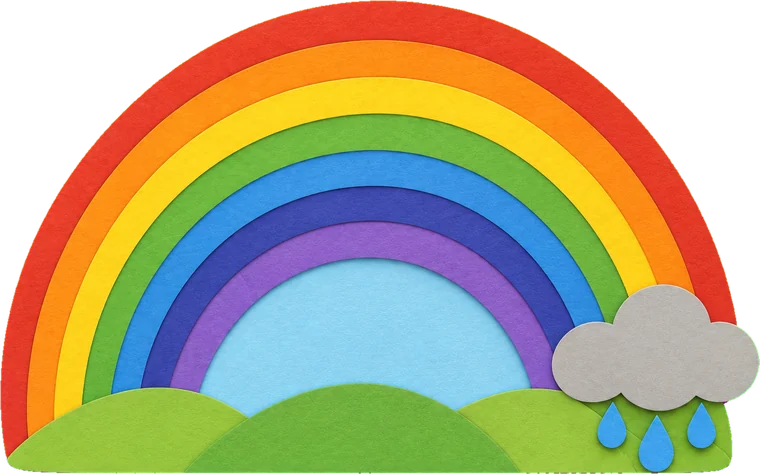
The shower stops, your child looks out of the window and shouts, "A rainbow! Can we go to the end of it?"
A rainbow is a band of coloured light made when sunlight passes through raindrops and spreads into its colours. Red is on the outside, violet on the inside, and it always appears in the part of the sky opposite the Sun. It looks like an arch, but it is really a full circle. Below are the questions children ask most, with answers you can read aloud.
Fact cardRainbow Weather · a trick of light
- What it is
- sunlight split into colours by raindrops
- Colour order
- red, orange, yellow, green, blue, indigo, violet (red outside)
- Where to look
- the sky opposite the Sun
- Real shape
- a full circle
- Best time
- morning or late afternoon after rain
- A band of light painted by sunshine and raindrops together
Rainbow in a child's words
- Sunlight looks white, but it is really many colours mixed together.
- When sunlight enters a raindrop it bends, bounces once off the inside, and bends again on the way out. Each colour bends a slightly different amount, so the colours spread apart.
- Red is on the outside of the bow and violet on the inside: red, orange, yellow, green, blue, indigo, violet.
- A rainbow always forms in the part of the sky opposite the Sun, so you need the Sun behind you to see one.
- A rainbow is really a full circle. The ground hides the lower part, so it looks like an arch.
- The lower the Sun, the bigger the rainbow looks, which is why mornings and late afternoons are best.
- Sometimes there are two bows, a double rainbow. The outer one is fainter and its colours are in reverse order.
When your child asks, answer like this
 Why do rainbows appear?

Why are rainbows curved?
Can we go to the end of the rainbow?
Does a rainbow really have seven colours?
When can we see a rainbow?
Can I make a rainbow myself?
Rainbow facts that make kids say “Wow!”
- From a high-flying aeroplane you can sometimes see a rainbow as a complete circle.
- The rainbow you see and the one the person next to you sees are made by slightly different raindrops, so each person has their own rainbow.
- Bright moonlight can make a rainbow too. It is so faint that it often looks white to our eyes.
A quiz to do together
Tap an answer.
What colour is on the outside of a rainbow?
Where must the Sun be for you to see a rainbow?
What is the real shape of a rainbow?
You finished the quiz! Well done.
Colouring page
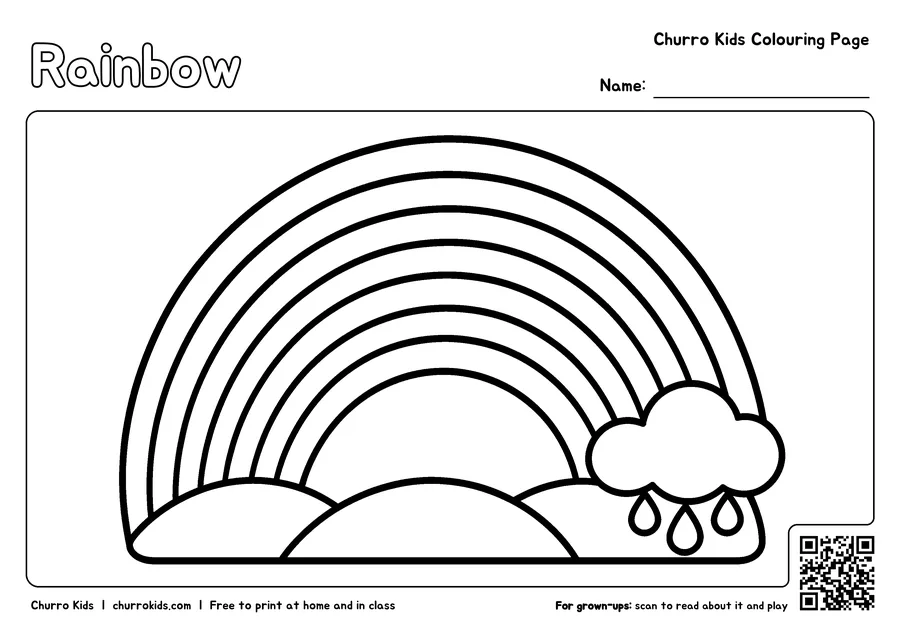
One A4 page, and it is free. Print it freely at home or in class.
Good for parents to know
- Seven colours is a convention. The colours of a rainbow blend continuously; Newton's division into seven simply became popular, and many people teach six without indigo. A child who draws five or eight colours is not wrong.
- The bow lies about 42 degrees (red) to 40 degrees (violet) from the point directly opposite the Sun. When the Sun is higher than 42 degrees above the horizon, the bow falls below the ground and cannot be seen, which is why rainbows are rare at midday in summer.
- Remind your child never to look straight at the Sun while hunting for rainbows. Keep the Sun behind you and look toward where your shadow points.
Things to try together
- On a sunny morning or late afternoon, stand with the Sun behind you and make a rainbow with a spray bottle.
- Put a clear glass of water on a sunny windowsill and look for rainbow colours on the floor or on a sheet of white paper.
- When you draw a rainbow, put red on the outside and violet on the inside.