Stories · Earth & Weather · Inside the ground
Earthquake Facts for Kids: Why Does the Ground Shake? Calm Answers for Curious Children
· Churro Kids
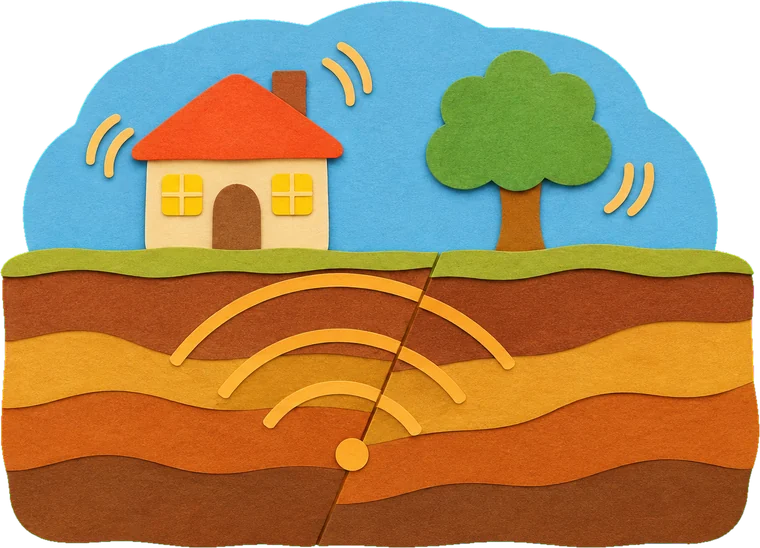
After an earthquake drill at kindergarten, your child asks over dinner, "Why does the ground shake? Will our house shake too?"
An earthquake happens when the huge plates that make up the Earth's surface suddenly slip. About 500,000 detectable earthquakes happen every year, but most are far too weak to feel. Strong shaking rarely lasts more than a minute or two, and the thing to do is shelter under a sturdy table. Below are the questions children ask most, with answers you can read aloud.
Fact cardEarthquake Earth · inside the ground
- What it is
- the ground shaking
- Cause
- pieces of the Earth's crust (plates) slipping suddenly
- Each year
- about 500,000 (most very weak)
- Largest recorded
- Chile 1960, magnitude 9.5
- Strong shaking lasts
- usually a minute or two at most
- Shaking that starts when giant pieces of the Earth slip
Earthquake in a child's words
- The outer layer of the Earth is broken into several huge pieces called plates.
- Plates move very slowly, a few centimetres a year, about as fast as your fingernails grow.
- When two plates push against each other and a stuck place suddenly slips, the ground shakes. That is an earthquake.
- Instruments can detect about 500,000 earthquakes a year. People feel about 100,000 of them.
- The size of an earthquake is given as a number called magnitude. The largest ever measured was magnitude 9.5 in Chile in 1960.
- About 90% of the world's earthquakes happen around the Pacific Ocean.
- In Korea, a magnitude 5.8 earthquake struck Gyeongju in 2016, the largest since instrument records began there.
When your child asks, answer like this
 Why does the ground shake?

What should I do in an earthquake?
How long does an earthquake last?
Do earthquakes happen every day?
Does Korea have earthquakes?
Can we know when an earthquake is coming?
Earthquake facts that make kids say “Wow!”
- The 1960 Chile earthquake made the whole planet vibrate for days, like a bell.
- Most earthquakes start less than 80 km (50 miles) below the surface, but the deepest begin about 750 km down.
- Plates move about as fast as fingernails grow, yet over a very long time that is enough to reshape mountains and oceans.
A quiz to do together
Tap an answer.
If the ground shakes at home, where do you go first?
What are the huge pieces that make up the Earth's surface called?
After the shaking stops, how do you leave the building?
You finished the quiz! Well done.
Colouring page
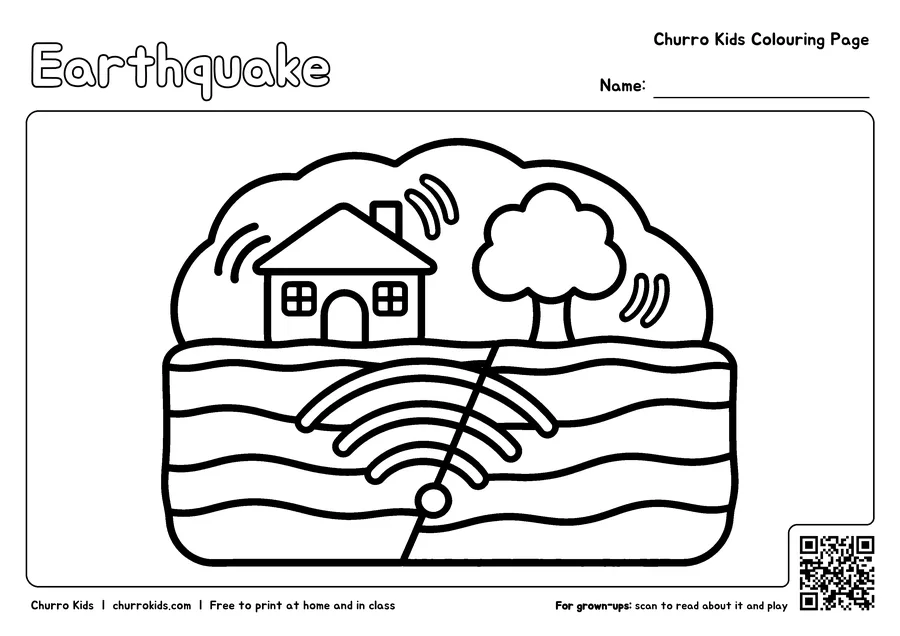
One A4 page, and it is free. Print it freely at home or in class.
Good for parents to know
- Korean official guidance (Ministry of the Interior and Safety, KMA): while it shakes, shelter under a sturdy table, hold a table leg and protect your head; when it stops, turn off gas and electricity, open a door to secure an exit, leave by the stairs and go to an open space away from buildings and walls. Do not use lifts. The Red Cross 'Drop, Cover and Hold On' says the same, and both say not to run outside while the ground is moving. 'A minute or two at most' is the wording of the Korean guidance; the very largest earthquakes can shake for longer.
- The figure of about 500,000 a year is an estimate of detectable earthquakes and changes as monitoring improves. The Gyeongju earthquake was magnitude 5.8 according to the KMA; the USGS, using a different scale, gives 5.4.
- If your child is anxious, say that big earthquakes are rare and that your family knows what to do. Practising once at home, as a game, is the most reassuring thing you can do.
Things to try together
- Find the sturdiest table at home together and practise: when someone calls "Shaking!", get under it and hold a table leg.
- Press two biscuits edge to edge and push slowly. The way they stick and then suddenly slip is like a fault.
- Look around the house for heavy things on high shelves and move them lower together.
Sources
- usgs.gov/programs/earthquake-hazards/cool-earthquake-facts
- usgs.gov/faqs/what-earthquake-and-what-causes-them-happen
- weather.go.kr/w/earthquake-volcano/evacuation.do
- korea.kr/news/policyNewsView.do?newsId=148923236
- ddm.go.kr/www/contents.do?key=817
- redcross.org/content/dam/redcross/get-help/youth/Pedro-teachers-guide-EARTHQUAKE.pdf
- earthquake.usgs.gov/earthquakes/eventpage/us10006p1f/origin
- en.wikipedia.org/wiki/Earthquake
- en.wikipedia.org/wiki/2016_Gyeongju_earthquake