"Dad, why is this dinosaur wearing a furry coat?" Children are amazed when they see a picture of a big meat-eating dinosaur with shaggy feathers.
Yutyrannus was a meat-eating dinosaur that lived in the Early Cretaceous, about 125 million years ago, in what is now Liaoning Province in China. Its name means feathered tyrant, and it is the biggest dinosaur found with feather marks. The place where it lived was quite chilly, so scientists think its long feathers probably worked like a warm coat. Below are the questions children ask most, with answers at a child's level, and you can read them out loud as they are.
Fact cardYutyrannus
- Name means
- feathered tyrant
- Lived
- Early Cretaceous (about 125 million years ago)
- Length
- about 9 m (30 ft)
- Weight
- about 1.1 to 1.4 tonnes
- Food
- Meat-eater
- Found in
- Asia (Liaoning Province, China)
- Group
- Dinosaurs of Korea and Asia
- Long, shaggy feathers
- A crest on top of its nose
- Sharp teeth
How big was Yutyrannus? Measure it with your own height
When your child asks, answer like this
 What does Yutyrannus mean?

How big was it?
What did it eat?
How did it hunt?
Who lived with it?
- Dongbeititan preysame time and place
It is said that bones of a long-necked dinosaur also came from the place where the Yutyrannus fossils are reported to have been found. So some scientists think that several Yutyrannus may have worked together to hunt long-necked dinosaurs. - Psittacosaurus preysame time and place
Psittacosaurus was a small plant-eating dinosaur that lived in Liaoning in very large numbers at the same time. Yutyrannus probably caught and ate one now and then. - Beipiaosaurus neighboursame time and place
Beipiaosaurus was another feathered dinosaur that lived in Liaoning at the same time. Before Yutyrannus was found, it was the biggest dinosaur known with feather marks.
When and where did it live?
What was it like as a baby? Did it live with friends?
Are there dinosaurs that look like it?
Who found it first?
Yutyrannus facts that make kids say “Wow!”
- Yutyrannus is the biggest dinosaur ever found with feather marks.
- Yutyrannus was about 40 times heavier than Beipiaosaurus, which had been the biggest feathered dinosaur until then.
- The place where Yutyrannus lived was chilly, so its long feathers probably worked like a warm coat.
- The species name huali means beautiful in Chinese.
From head to tail
- An adult's skull was about 90 cm (3 ft) long, about as long as a grown-up person's leg.
- Its feathers were up to 20 cm (8 inches) long, about the span of a grown-up's hand.
- Each hand had three clawed fingers, which is different from Tyrannosaurus with its two fingers.
- An adult is thought to have been about 7.5 to 9 m (25 to 30 ft) long and to have weighed about 1.1 to 1.4 tonnes, about as heavy as a small car.
A Yutyrannus story to read aloud
On a chilly morning, mist hangs over the conifer forest by the lake. Yutyrannus fluffs up its long feathers and walks through the forest. Thanks to its feathers, it stays warm even on cold days. The crest on its nose shines in the morning sun. Two younger Yutyrannus walk along beside it. When the long-necked dinosaur Dongbeititan comes into view far away, they all stop and watch quietly. Another day of hunting begins for Yutyrannus.
A quiz to do together
Tap an answer.
What grew on the body of Yutyrannus?
How many fingers did Yutyrannus have on each hand?
What was the weather like where Yutyrannus lived?
You finished the quiz! Well done.
Colouring page
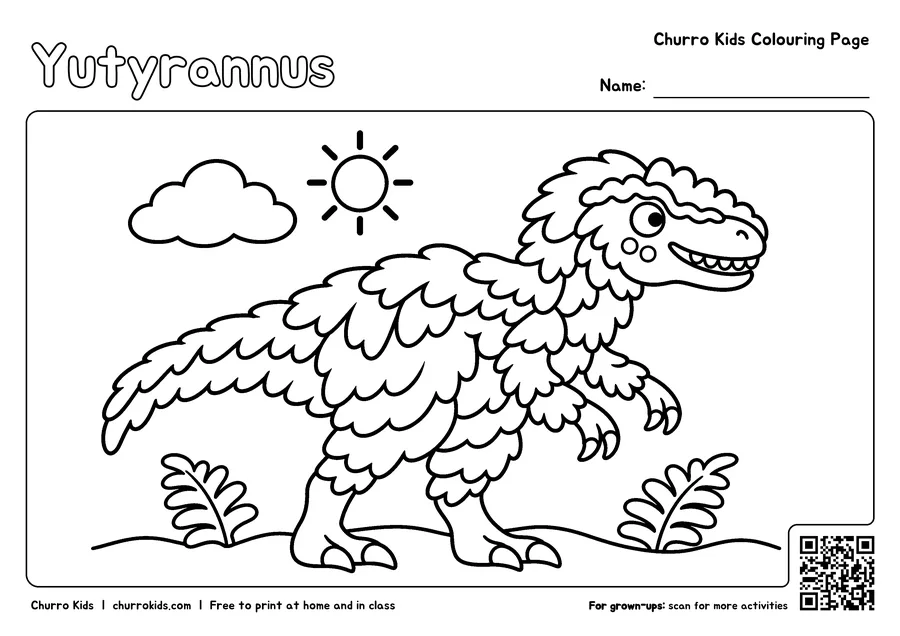
One A4 page, and it is free. Print it freely at home or in class.
Good for parents to know
- Its size differs from source to source. Some put it at about 7.5 metres long and 1.1 tonnes, and others at about 9 metres and 1.4 tonnes.
- Feather marks were found on the neck, upper arm, hips, tail and foot. It is likely that the whole body was covered in feathers, but that is not proven, so it is best to say "feather marks were found on many parts of its body."
- Three being found together does not prove that they hunted in a group. That the fossils came from one place together is also only what has been reported.