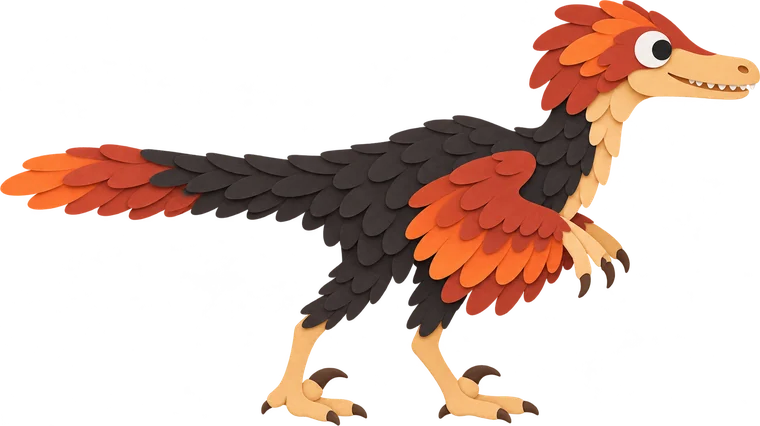
On a day when you have seen a peacock at the zoo, your child may ask, "Dad, did dinosaurs have tail feathers too?" Caudipteryx was a dinosaur with a fan of feathers at the end of its tail.
Caudipteryx was a dinosaur that lived in the Early Cretaceous, about 125 million years ago, in what is now Liaoning Province in China. It was about the size of a turkey or a peacock, and it had feathers on its arms and tail, but it could not fly. Scientists think it probably ran fast on its long legs. Below are the questions children ask most, with answers at a child's level. You can read them out loud as they are.
Fact cardCaudipteryx
- Name means
- tail feather
- Lived
- Early Cretaceous (about 125 million years ago)
- Length
- about 0.9 m (3 ft)
- Weight
- about 2 to 5 kg
- Food
- Eats plants and animals
- Found in
- Asia (Liaoning Province, China)
- Group
- Dinosaurs of Korea and Asia
- Tail feathers like a fan
- Small wing feathers on its arms
- Long, fast legs
How big was Caudipteryx? Measure it with your own height
When your child asks, answer like this
 What does Caudipteryx mean?

How big was it?
What did it eat?
What did it do when a scary dinosaur came?
Who lived with it?
- Sinocalliopteryx predatorsame time and place
Sinocalliopteryx was a meat-eating dinosaur more than 2 m (6.5 ft) long that lived in Liaoning at the same time. When Caudipteryx met this dinosaur, it probably ran away fast on its long legs. - Confuciusornis neighboursame time and place
Confuciusornis was an early bird that lived in the same lakeside forests. Confuciusornis flew in the sky and Caudipteryx ran on the ground, and they probably lived as neighbours.
When and where did it live?
What was it like as a baby? Did it live with friends?
Are there dinosaurs that look like it?
Who found it first?
Caudipteryx facts that make kids say “Wow!”
- Caudipteryx had feathers but could not fly, and it probably ran fast on its long legs.
- The feathers of Caudipteryx were the same shape on both sides, which is different from the feathers of birds that fly.
- Caudipteryx is an important fossil that shows that birds came from dinosaurs.
- Caudipteryx is a distant relative of the huge Gigantoraptor, in the same Oviraptor group.
From head to tail
- It was about 70 to 90 cm (2.3 to 3 ft) long and weighed about 2 to 5 kg, about the size of a peacock.
- The feathers on its hands were 15 to 20 cm (6 to 8 inches) long, about as long as a pencil.
- It had only a few teeth, right at the front of its upper jaw, and the rest of its mouth was like a beak.
- The body feathers left in the fossils are black, and the tail feathers have stripes.
A Caudipteryx story to read aloud
Caudipteryx trots out of the forest by the lake. It spreads the fan of feathers at the end of its tail and shows off to a friend. It pecks up seeds from the ground with its beak. It gulps down small stones too. In its belly, the stones grind the food up small. Up in a tree, a Confuciusornis flaps into the air. Caudipteryx cannot fly, but on its long legs it runs faster than anyone.
A quiz to do together
Tap an answer.
Could Caudipteryx fly?
What was at the end of the tail of Caudipteryx?
What did Caudipteryx swallow to grind up its food?
You finished the quiz! Well done.
Colouring page
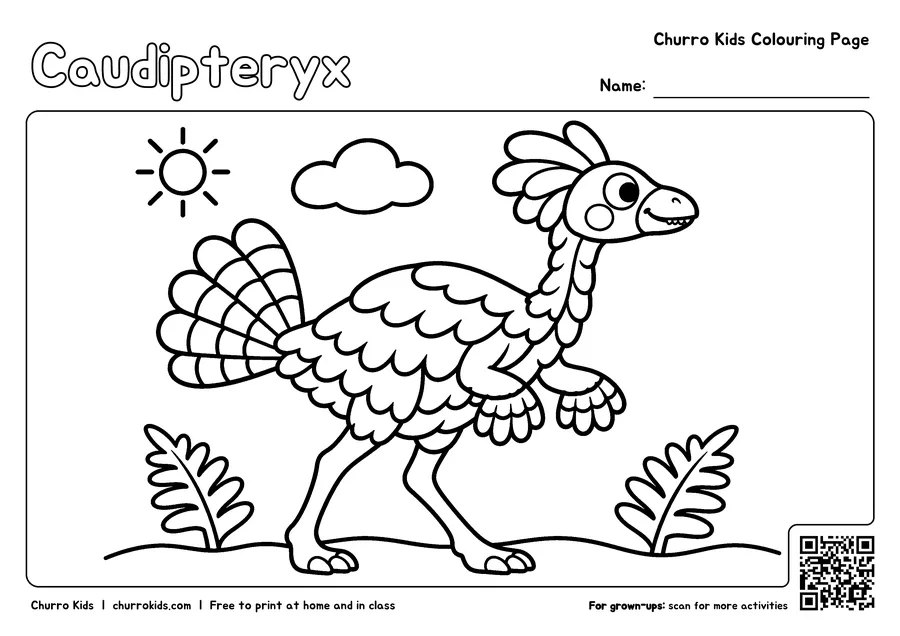
One A4 page, and it is free. Print it freely at home or in class.
Good for parents to know
- It is easy to mix up with real birds such as peacocks and turkeys. Caudipteryx had claws on its fingers and teeth in its upper jaw, and its wing feathers were too small for flying.
- It is thought to have eaten both plants and animals, but that is not proven. The idea comes from the small stones for grinding food that were found in the belly of a fossil.
- Most sources put its length at about 70 to 90 centimetres, and some say 1 metre. Its weight also differs between sources, from about 2 to 5 kilograms. The only colours confirmed by fossils are the black body feathers and the stripes on the tail feathers. Other colours in pictures are guesses.