"Mum, how do we know what patterns dinosaurs had?" If your child asks this while colouring in a dinosaur picture, Sinosauropteryx is a good answer. Its tail stripes were worked out from patterns left in the fossil.
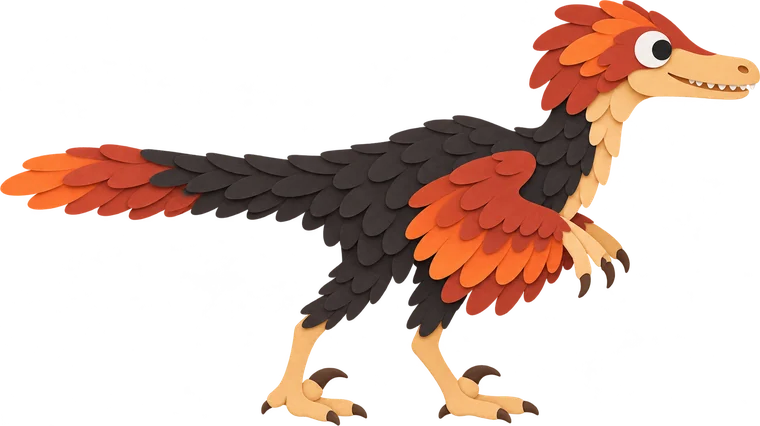
Sinosauropteryx was a small meat-eating dinosaur that lived in the Early Cretaceous in what is now Liaoning Province in China. Even with its tail it was only as long as a child is tall, and it had fluffy feathers like down on its body. Its long tail had stripes like a raccoon's, and lizard bones were found in the belly of a fossil. Below are the questions children ask most, with answers at a child's level. You can read them out loud as they are.
Fact cardSinosauropteryx
- Name means
- Chinese lizard wing
- Lived
- Early Cretaceous (about 125 to 122 million years ago)
- Length
- about 1 m (3 ft)
- Weight
- about 0.5 to 1 kg
- Food
- Meat-eater
- Found in
- Asia (Liaoning Province, China)
- Group
- Dinosaurs of Korea and Asia
- A long tail with stripes
- Fluffy feathers like down
- Short arms
How big was Sinosauropteryx? Measure it with your own height
When your child asks, answer like this
 What does Sinosauropteryx mean?

How big was it?
What did it eat?
How did it hunt?
Who lived with it?
- Dalinghosaurus (a lizard) preyfossil evidence
Lizard bones were found in the belly of a Sinosauropteryx fossil. Scientists think this lizard was probably Dalinghosaurus, a fast runner. - Sinocalliopteryx predatorsame time and place
Sinocalliopteryx was a bigger meat-eating dinosaur, more than 2 m (6.5 ft) long, that lived in Liaoning at the same time. Little Sinosauropteryx probably ran away fast when it saw this dinosaur. - Confuciusornis neighboursame time and place
Confuciusornis was an early bird that lived in very large numbers by the same lakes. Sinosauropteryx probably spent its days looking up at Confuciusornis in the trees.
When and where did it live?
What was it like as a baby? Did it live with friends?
Are there dinosaurs that look like it?
Who found it first?
Sinosauropteryx facts that make kids say “Wow!”
- Sinosauropteryx had stripes on its tail like a raccoon, and it probably had a raccoon-like pattern around its eyes too.
- Sinosauropteryx was the first dinosaur that is not a bird to be found with feather marks.
- Dr Phil Currie, a dinosaur scientist from Canada, knew it was a very important find as soon as he saw the fossil.
- The first fossil found was split into two slabs, and they went to two different museums in China.
From head to tail
- It had 64 tail bones, so its tail was more than half the length of its whole body.
- Its longest down-like feathers were about 4 cm (1.5 inches) long, about as long as a child's finger.
- The eggs found in its belly were about 3.6 cm (1.4 inches) long, a little bigger than a quail's egg.
- The thumb at the end of its short arm, and the claw on it, were very big and thick.
A Sinosauropteryx story to read aloud
Morning comes to the open ground by the lake. Sinosauropteryx stretches out its long striped tail and tiptoes along. Thanks to its dark back and light belly, it is hard to see. Over there on a rock sits a small lizard. Sinosauropteryx dashes after it on its long back legs. It catches the lizard and gulps it down. Up in a tree, a Confuciusornis looks down and watches.
A quiz to do together
Tap an answer.
What pattern was on the tail of Sinosauropteryx?
What food was found in the belly of Sinosauropteryx?
Who first found Sinosauropteryx?
You finished the quiz! Well done.
Colouring page
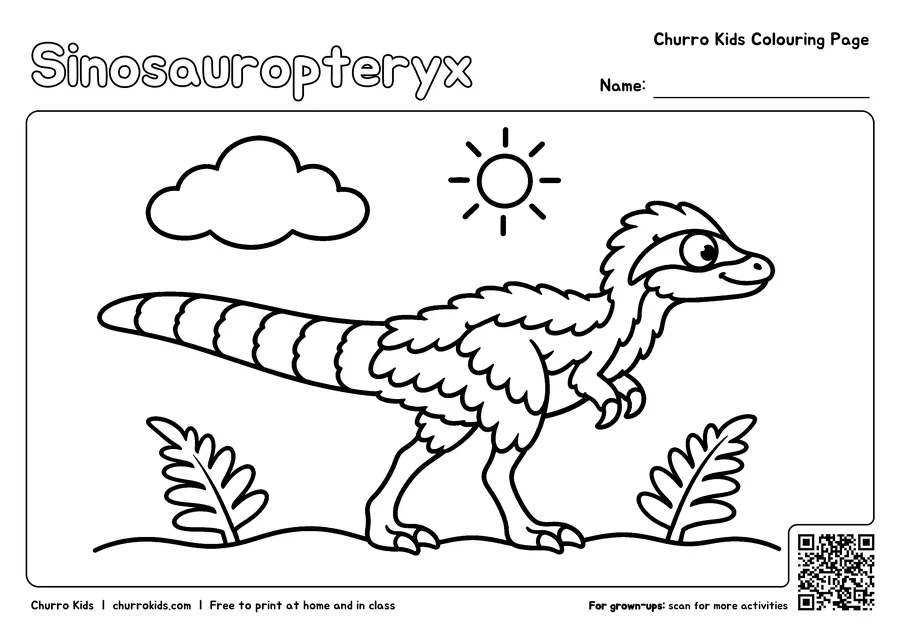
One A4 page, and it is free. Print it freely at home or in class.
Good for parents to know
- The tail stripes, the dark back and light belly, and the pattern around the eyes were worked out from pigment patterns left in the fossils. The reddish-brown colour often seen in pictures is not a confirmed colour. The fossil that was studied for that colour was moved to a different animal in 2025.
- The biggest fossil is about 1.07 metres long, and the first fossil found was a young one of 68 centimetres. That is why books give slightly different sizes.
- It had feathers, but it was not a bird. You can tell your child that it was the first dinosaur that is not a bird to be found with feather marks.