A child lining up duck-billed dinosaur toys asks, "Dad, which of these is the biggest?" The answer is Shantungosaurus.
Shantungosaurus was a plant-eating dinosaur that lived in the Late Cretaceous in what is now Shandong Province in China. It was the biggest of the duck-billed dinosaurs, about as long as one and a half buses, and it had about 1,500 small teeth in its mouth. The bones of many animals were found piled up in one place, so scientists think it probably lived in herds. Below are the questions children ask most, with answers at a child's level. You can read them out loud as they are.
Fact cardShantungosaurus
- Name means
- Shandong lizard
- Lived
- Late Cretaceous (about 77 to 71 million years ago)
- Length
- about 15 m (49 ft)
- Weight
- about 13 to 16 tonnes
- Food
- Plant-eater
- Found in
- Asia (Shandong Province, China)
- Group
- Dinosaurs of Korea and Asia
- A wide, flat snout like a duck's
- A very big body
- A thick, long tail
How big was Shantungosaurus? Measure it with your own height
When your child asks, answer like this
 What does Shantungosaurus mean?

How big was it?
What did it eat?
What did it do when a scary dinosaur came?
Who lived with it?
- Zhuchengtyrannus predatorsame time and place
Zhuchengtyrannus was a big meat-eating dinosaur found in the same fossil pits at Zhucheng in Shandong Province. It may have hunted Shantungosaurus. - Sinoceratops neighboursame time and place
Sinoceratops was a horned dinosaur found in the same place. It was probably a neighbour that fed on plants on the same plain as Shantungosaurus.
When and where did it live?
What was it like as a baby? Did it live with friends?
Are there dinosaurs that look like it?
Who found it first?
Shantungosaurus facts that make kids say “Wow!”
- Shantungosaurus was the biggest of the duck-billed dinosaurs, and it had about 1,500 small teeth in its mouth.
- Leaving out the long-necked dinosaurs, Shantungosaurus is one of the biggest dinosaurs of all.
- Some big bones from Zhucheng were once given other names, such as Zhuchengosaurus, but they all turned out to be Shantungosaurus.
- Zhucheng, where Shantungosaurus was found, is one of the places in the world where the most dinosaur bones are gathered together.
From head to tail
- Its skull alone was about 1.6 m (5 ft) long, about as tall as a grown-up.
- About 1,500 small teeth were packed tightly in its mouth.
- It weighed about 13 to 16 tonnes, as much as two or three big elephants put together.
- The biggest skeleton that has been put up is 16.6 m (54 ft) long.
A Shantungosaurus story to read aloud
A herd of Shantungosaurus walks slowly across the wide plain. They thump along on four legs and nip off ferns with their wide beaks. The small teeth in their mouths grind the leaves up small. When one wants the leaves on a high branch, it stands up on its back legs. Beside them, the horned dinosaur Sinoceratops is feeding on plants too. When Zhuchengtyrannus comes into view far away, they all walk close together. With big friends all around, they feel safe.
A quiz to do together
Tap an answer.
Which animal does the snout of Shantungosaurus look like?
About how many teeth did Shantungosaurus have in its mouth?
In which country was Shantungosaurus found?
You finished the quiz! Well done.
Colouring page
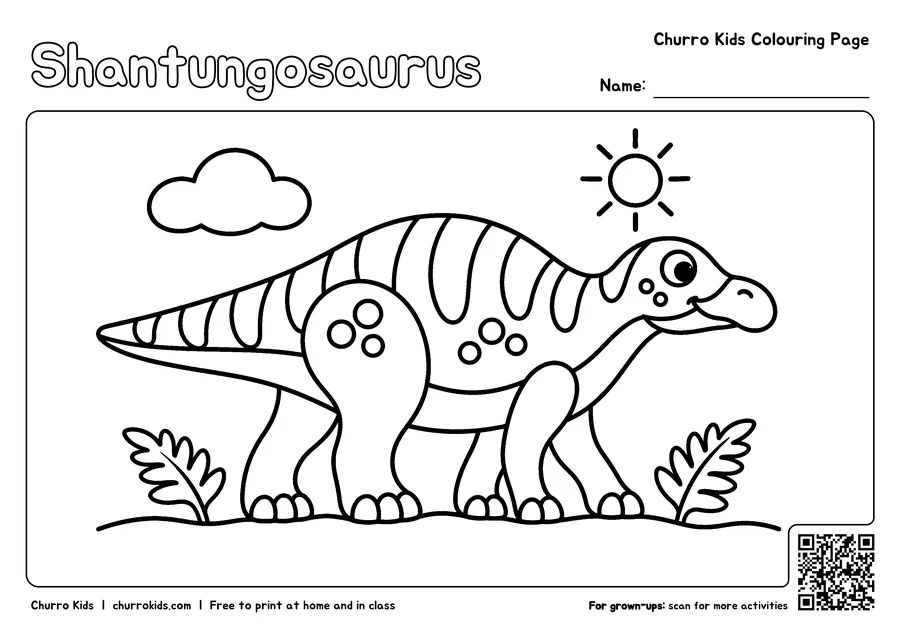
One A4 page, and it is free. Print it freely at home or in class.
Good for parents to know
- Its size depends on the fossil and on the researcher. The numbers range from about 15 metres and 13 tonnes to nearly 17 metres and 16 tonnes. The figure of about 1,500 teeth is also a rough estimate, not an exact count.
- There is no direct evidence that Zhuchengtyrannus hunted Shantungosaurus. All that is confirmed is that their fossils come from the same place, so it is best to say "it may have hunted it."
- Some big bones from Zhucheng were once given other names, such as Zhuchengosaurus. They all turned out to be Shantungosaurus, so if you see another name in a book, you can tell your child it is the same dinosaur.