Your child loves unicorns and comes running with a dinosaur book. "It says there was a unicorn dinosaur! Did it really have a horn?"
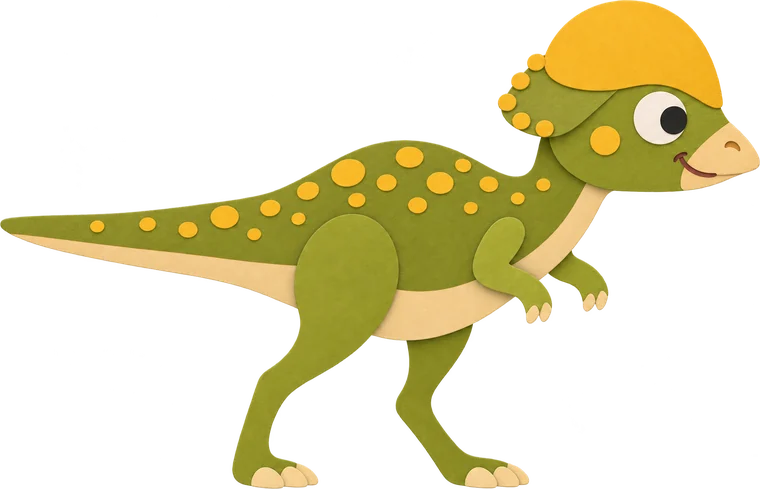
Tsintaosaurus was a duck-billed dinosaur that lived in the Late Cretaceous in what is now Shandong, China. It was as long as two cars in a row, and a crest stood tall on its head. Because the crest looked like a stick, people called it the "unicorn dinosaur", but the crest was probably bigger and wider than that. Below are the questions children ask most, with answers at a child's level. You can read them out loud.
Fact cardTsintaosaurus
- Name means
- lizard of Qingdao
- Lived
- Late Cretaceous (about 84 to 72 million years ago)
- Length
- about 8.3 m (27 ft)
- Weight
- about 2.5 tonnes
- Food
- Plant-eater
- Found in
- Asia (Shandong, China)
- Group
- Duck-billed dinosaurs and friends
- A crest that stands up on its head
- A flat duck bill
- It walked on two legs and on four legs
How big was Tsintaosaurus? Measure it with your own height
When your child asks, answer like this
 What does Tsintaosaurus mean?

How big was it?
What did it eat?
What did it do when a scary dinosaur came?
Who lived with it?
- Laiyangosaurus neighboursame time and place
Laiyangosaurus was another duck-billed dinosaur found in the same rock layer at Laiyang in Shandong, China. The two probably ate plants together on the same plains. - A meat-eating dinosaur with no sure name predatorsame time and place
Pieces of bone from a big meat-eating dinosaur came from the same rock layer. We do not yet know which dinosaur it was, but it probably went after Tsintaosaurus.
When and where did it live?
What was it like as a baby? Did it live with friends?
Are there dinosaurs that look like it?
Who found it first?
Tsintaosaurus facts that make kids say “Wow!”
- It had a crest like a stick on its head, so people called it the "unicorn dinosaur", but the crest was probably bigger and wider than that.
- Scientists once thought the stick crest was just a broken nose bone sticking up, but a second fossil showed that it was a real crest.
- "Tsintao" is an old way of writing the name of the Chinese city Qingdao.
- The second part of its scientific name, "spinorhinus", means "with a spine on the nose".
From head to tail
- The crest left in the fossil is about 40 cm (16 in) long, about as long as a grown-up's arm from elbow to fingertips.
- The crest is hollow, and its top is split in two.
- It was a little over 8 m (27 ft) long, about the same as two cars in a row. Some sources give a longer figure.
- It weighed about 2.5 tonnes, as heavy as a rhinoceros.
A Tsintaosaurus story to read aloud
A herd of Tsintaosaurus walks onto the wide plain. They nip off leaves with their flat beaks and chew them well with their strong teeth. On each head a crest stands tall. Close by, their neighbour Laiyangosaurus is eating plants too. One Tsintaosaurus stands up on its back legs and looks far away. When they see a meat-eating dinosaur, they all run away together. They feel safe with the herd.
A quiz to do together
Tap an answer.
What was the nickname of Tsintaosaurus?
In which country was Tsintaosaurus found?
Which way does the crest of Tsintaosaurus point?
You finished the quiz! Well done.
Colouring page
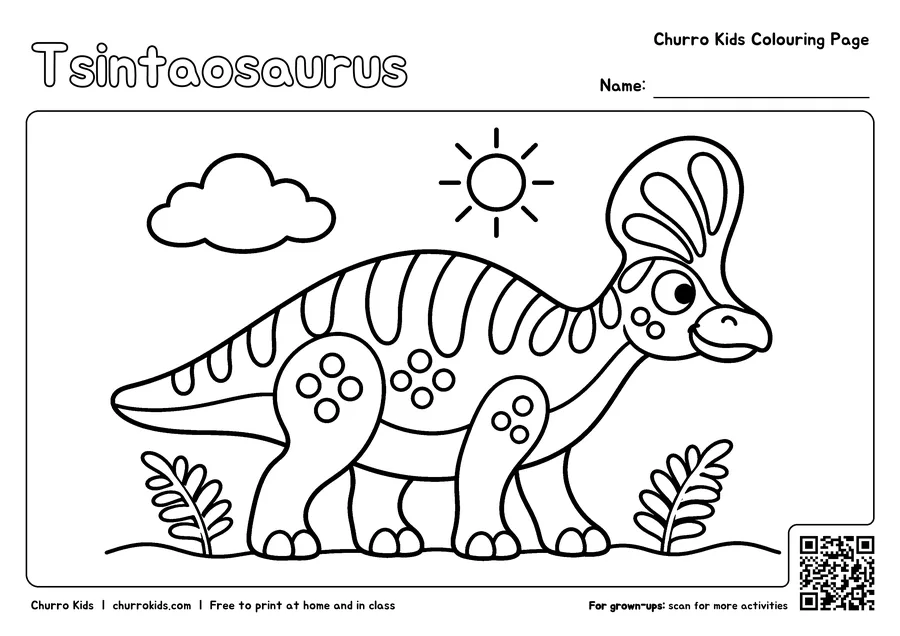
One A4 page, and it is free. Print it freely at home or in class.
Good for parents to know
- The shape of the crest is still debated. Older books and toys show a thin stick-like horn, but a 2013 study found that the stick was only the back part of a bigger, wider crest. You can say "people used to think it looked like a unicorn horn, and now they think it was probably a wider crest."
- Sources differ a lot on its length. Some say about 8.3 metres (27 feet) and some say 12 metres (39 feet). The time it lived is also hard to pin down, so it is given as a wide range, about 84 to 72 million years ago.
- Pieces of bone from a big meat-eating dinosaur came from the same rock layer, but we do not yet know which dinosaur it was. The idea that it went about in herds is also a guess based on other duck-billed dinosaurs.