Watching the dinosaurs that run in a flock in the film Jurassic Park, your child asks, "Dad, is that an ostrich or a dinosaur?"
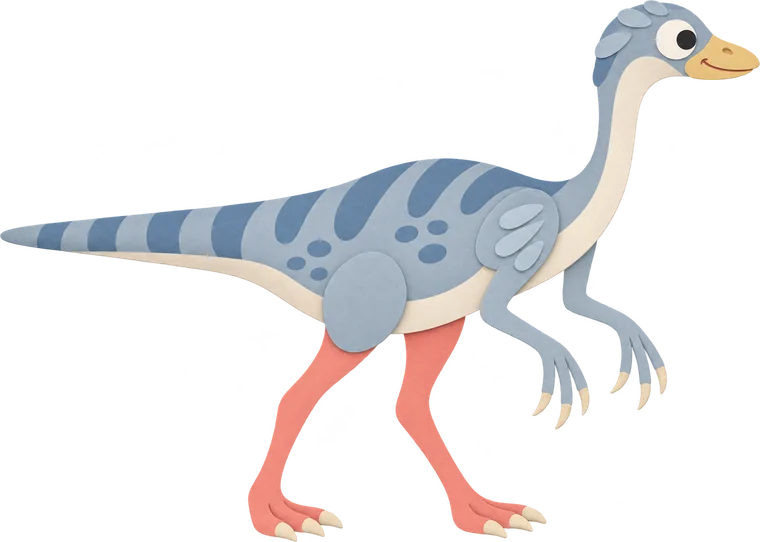
That dinosaur is Gallimimus. It lived in the Late Cretaceous where the Gobi Desert of Mongolia is today, and it was longer than a car. It had a toothless beak, a long slim neck and long legs, and it probably ran very fast, like an ostrich. Below are the questions children ask most, with answers at a child's level. You can read them out loud as they are.
Fact cardGallimimus
- Name means
- chicken mimic
- Lived
- Late Cretaceous (about 70 million years ago)
- Length
- about 6 m (20 ft)
- Weight
- about 400 to 490 kg
- Food
- Eats plants and animals
- Found in
- Asia (Gobi Desert, Mongolia)
- Group
- Dome-headed and unusual dinosaurs
- A beak with no teeth
- A long, slim neck and legs
- Fast running
How big was Gallimimus? Measure it with your own height
When your child asks, answer like this
 What does Gallimimus mean?

How big was it?
What did it eat?
What did it do when a scary dinosaur came?
Who lived with it?
- Tarbosaurus predatorsame time and place
The big meat-eating dinosaur Tarbosaurus lived in the same place. When Gallimimus saw one, it probably dashed away on its long legs. - Deinocheirus neighboursame time and place
Deinocheirus was a big, bulky relative of Gallimimus. They lived by the same rivers, but Deinocheirus probably walked slowly and Gallimimus probably ran fast.
When and where did it live?
What was it like as a baby? Did it live with friends?
Are there dinosaurs that look like it?
Who found it first?
Gallimimus facts that make kids say “Wow!”
- Gallimimus probably ran very fast on its long legs, like an ostrich.
- The dinosaurs running in a flock in the film Jurassic Park are Gallimimus.
- In 2009 foot bones of a Gallimimus were found together with fossil footprints, right underneath them.
- A Gallimimus fossil that had been secretly sold to another country came home to Mongolia in 2014.
From head to tail
- Its skull was about 33 cm (13 inches) long, which is rather small for such a long body.
- It stood about 1.9 m (6 ft) high at the hips, taller than a tall grown-up.
- One scientist worked out that it probably ran at about 42 to 56 km (26 to 35 miles) an hour.
- Its backbones had many hollow spaces filled with air, so its body was light.
A Gallimimus story to read aloud
A group of Gallimimus has gathered by a shallow lake. They peck up leaves and seeds with their toothless beaks. They look this way and that with the big eyes on the sides of their heads. Far away, a Tarbosaurus comes out of the forest. The Gallimimus dash off on their long legs. With their long tails stretched out behind them, they look just like ostriches.
A quiz to do together
Tap an answer.
Which bird does Gallimimus look like?
Did Gallimimus have teeth in its mouth?
What did Gallimimus do when there was danger?
You finished the quiz! Well done.
Colouring page
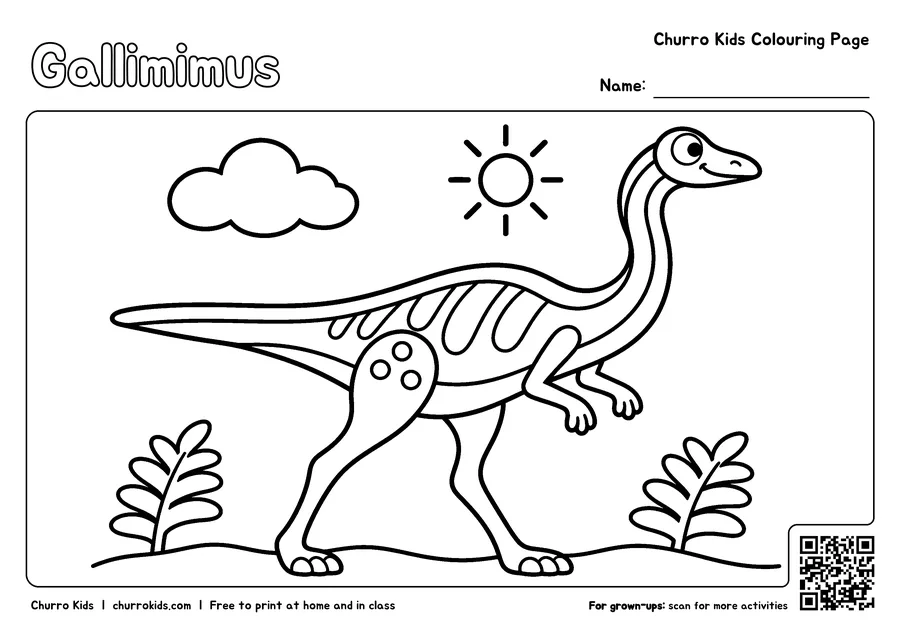
One A4 page, and it is free. Print it freely at home or in class.
Good for parents to know
- The running speed is a number worked out by calculation. It is enough to say that one scientist worked it out at about 42 to 56 km (26 to 35 miles) an hour.
- What it ate is still debated. Some think it ate both plants and small animals, some think it ate mostly plants, and some think it strained food out of the water like a duck.
- No feather fossils of Gallimimus have been found. Pictures that show feathers are based on related dinosaurs.