"Dad, why is this dinosaur called 'terrible hand'?" A photo of fossil arms as long as 2.4 m (8 ft) makes grown-ups curious too.
Deinocheirus was a dinosaur that lived in the Late Cretaceous where the Gobi Desert of Mongolia is today. It was about as long as a bus, with a ridge like a sail on its back and a wide, flat bill like a duck's. For almost 50 years only its two arms were known, and then in 2014 a research team led by Dr Lee Yuong-Nam of Korea showed for the first time what the whole animal looked like. Below you will find the questions children often ask and easy answers. Feel free to read them to your child as they are.
Fact cardDeinocheirus
- Name means
- terrible hand
- Lived
- Late Cretaceous (about 70 million years ago)
- Length
- about 11 m (36 ft)
- Weight
- about 5 to 7 tonnes
- Food
- Eats plants and animals (plants and fish)
- Found in
- Asia (Gobi Desert, Mongolia)
- Group
- Dome-headed and unusual dinosaurs
- A tall ridge on its back like a sail
- A wide, flat bill like a duck's
- Very long arms
How big was Deinocheirus? Measure it with your own height
When your child asks, answer like this
 What does Deinocheirus mean?

How big was it?
What did it eat?
What did it do when a scary dinosaur came?
Who lived with it?
- Tarbosaurus predatorfossil evidence
Tooth marks from Tarbosaurus are left on the belly bones of a Deinocheirus. Nobody can tell whether Tarbosaurus hunted it or ate a Deinocheirus that had already died. - Fish preyfossil evidence
Fish bones and scales were found where the belly of a Deinocheirus had been. This means it caught and ate fish in rivers or lakes. - Therizinosaurus neighboursame time and place
Therizinosaurus, with its very long claws, lived in the same place. Therizinosaurus ate tree leaves and Deinocheirus looked for food at the water's edge, so they probably got along side by side.
When and where did it live?
What was it like as a baby? Did it live with friends?
Are there dinosaurs that look like it?
Who found it first?
Deinocheirus facts that make kids say “Wow!”
- The arms of Deinocheirus alone were as long as 2.4 m (8 ft), and fish bones were found inside its belly.
- For almost 50 years only the two arms were known, so nobody knew what kind of dinosaur it was.
- A skull and foot bones that thieves had secretly taken away were found in Europe and came home to Mongolia in 2014.
- It was a relative of Gallimimus, the fast-running ostrich dinosaur, but Deinocheirus walked slowly.
From head to tail
- Its skull was about 1 m (3 ft) long, about as tall as a five-year-old child.
- Its bill was about 25 cm (10 inches) wide, as wide as a big plate.
- The claws on its hands were about 20 cm (8 inches) long, about a grown-up's hand span.
- The bones at the tip of its tail were joined together, so it probably had a fan of feathers there.
A Deinocheirus story to read aloud
Deinocheirus walks slowly over the soft mud beside a shallow lake. Thanks to its wide toes, it does not sink into the mud. It dips its duck-like bill into the water and crops soft plants. It gulps down a fish too. The stones in its belly grind the food up small. Over by the forest, its neighbour Therizinosaurus is eating tree leaves. A Tarbosaurus can be seen far away, but Deinocheirus, as big as a bus, slowly goes on its way.
A quiz to do together
Tap an answer.
What was found inside the belly of Deinocheirus?
The bill of Deinocheirus looks like the bill of which animal?
The teams that showed what the whole Deinocheirus looked like came from Mongolia and which other country?
You finished the quiz! Well done.
Colouring page
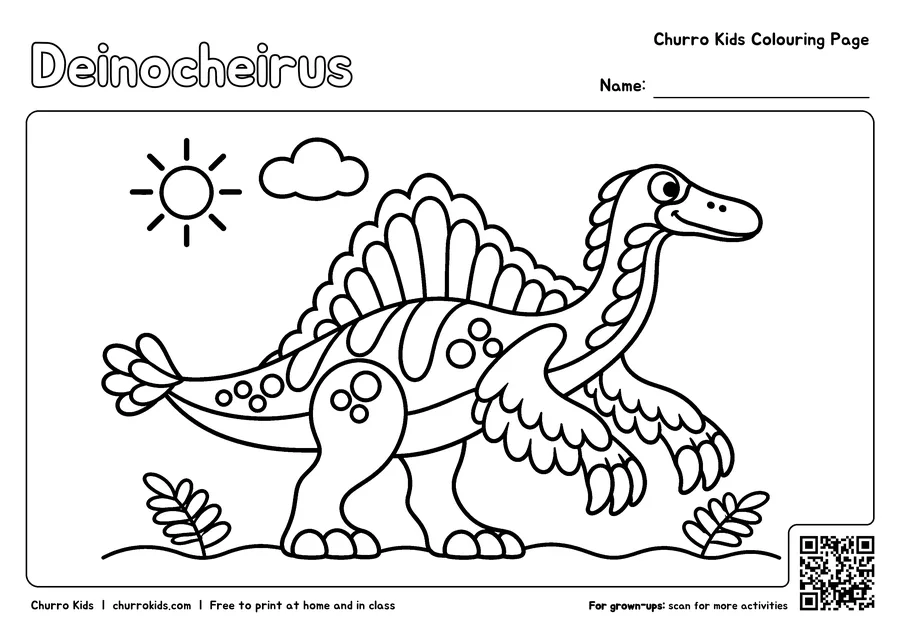
One A4 page, and it is free. Print it freely at home or in class.
Good for parents to know
- Weight estimates cover a wide range, from 5 to 7 tonnes depending on the source. The feathers and the fan of feathers at the tip of the tail are not preserved in the fossils. They are worked out from the shape of the bones.
- The tall spines on its back are sometimes drawn as a sail and sometimes as a hump. That is why pictures differ from book to book.
- There are bones with Tarbosaurus tooth marks on them, but nobody can tell whether Tarbosaurus hunted it. It is safest to say "there are signs that the two met."