Turning the pages of a dinosaur book, your child points at a small dinosaur the size of a goat. "Dad, is this one a dome-head too? Why is it so small?"
Stegoceras was a small dome-headed dinosaur that lived in the Late Cretaceous in what is now Alberta, Canada. It was about the size of a goat, and its head was flat when it was a baby and slowly rose into a round dome as it grew. It probably had a very good sense of smell too. The questions your child is likely to ask, with answers in a child's words, are below. You can read them out loud.
Fact cardStegoceras
- Name means
- horn roof
- Lived
- Late Cretaceous (about 77.5 to 74 million years ago)
- Length
- about 2.2 m (7 ft)
- Weight
- about 10 to 40 kg
- Food
- Plant-eater
- Found in
- North America (Alberta, Canada)
- Group
- Dome-headed and unusual dinosaurs
- A small, round dome head
- Small knobs at the back of the head
- A body the size of a goat
How big was Stegoceras? Measure it with your own height
When your child asks, answer like this
 What does Stegoceras mean?

How big was it?
What did it eat?
What did it do when a scary dinosaur came?
Who lived with it?
- Gorgosaurus predatorsame time and place
Gorgosaurus, a relative of Tyrannosaurus, lived in the same place. Little Stegoceras probably ran into the bushes to keep away from it. - Saurornitholestes predatorsame time and place
Saurornitholestes, a small and quick meat-eating dinosaur, lived nearby too. Young Stegoceras probably had to watch out for it. - Centrosaurus neighboursame time and place
Herds of Centrosaurus, which had a big horn on the nose, ate plants on the same plains. Stegoceras probably ate low plants beside them.
When and where did it live?
What was it like as a baby? Did it live with friends?
Are there dinosaurs that look like it?
Who found it first?
Stegoceras facts that make kids say “Wow!”
- When Stegoceras was a baby its head was flat, and as it grew the head slowly rose into a round dome.
- For a while people wrongly thought it was the same dinosaur as Troodon, a meat-eater.
- Among animals that live on land, the bony tendons that wrap the tail like a basket have been found only in the dome-headed dinosaurs.
- When scientists tested the skull on a computer, its shape turned out to be good at taking the shock of a head-butt.
From head to tail
- It was 2 to 2.5 m (6.5 to 8 ft) long and weighed 10 to 40 kg, about the size of a goat.
- It had about 19 teeth on each side of the upper jaw and about 17 on each side of the lower jaw.
- Thin bony tendons wrapped around its tail like a basket, so the tail was very stiff.
- The part of its brain used for smelling was large, so it probably had a very good nose.
A Stegoceras story to read aloud
In a wet forest by the river, Stegoceras opens its eyes. Sniff, sniff. It smells its way to ferns and leaves and eats plenty of them. Out on the plain, a herd of Centrosaurus is eating plants. When Stegoceras meets a friend, it may push its round head forward for a pushing contest. Just then, the smell of a Gorgosaurus drifts past its nose. Stegoceras stretches out its stiff tail and darts into the bushes on its long back legs.
A quiz to do together
Tap an answer.
Stegoceras was about as big as which animal?
What was Stegoceras probably very good at?
In which country was the first Stegoceras fossil found?
You finished the quiz! Well done.
Colouring page
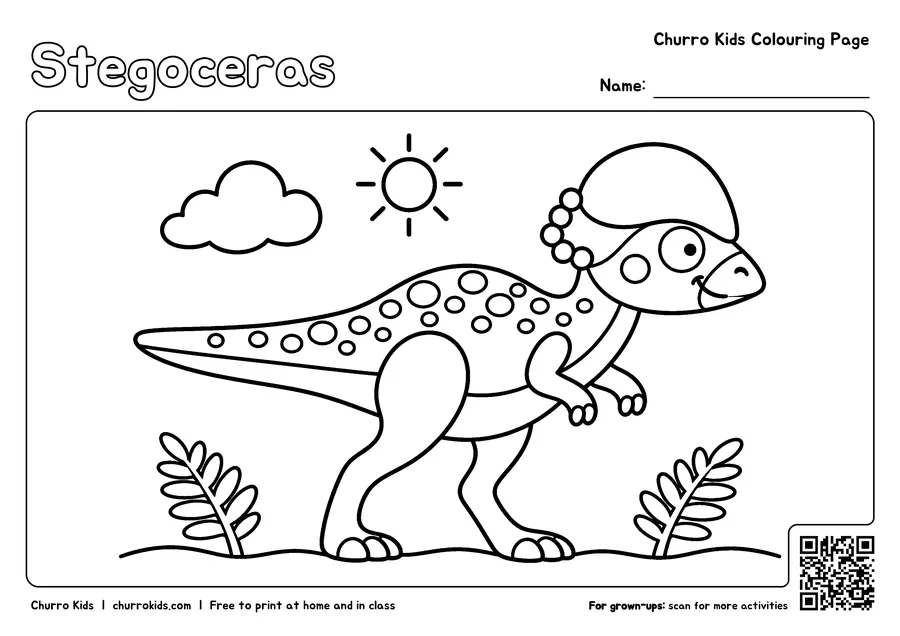
One A4 page, and it is free. Print it freely at home or in class.
Good for parents to know
- What the round head was for is not settled. Butting heads, shoving sides and showing off have all been suggested, so it is best to say "they may have had pushing contests."
- Apart from the skull, the skeleton is not completely known. That is why the numbers cover a wide range, such as 2 to 2.5 metres long and 10 to 40 kg.
- It looks like Pachycephalosaurus, but it is a different dinosaur. Stegoceras is about half as long and has no pointy knobs on its snout.