"Mum, this dinosaur has feathers, so why can't it fly?" A child who sees a fluffy dinosaur model at the museum may well ask this.
Ornithomimus was a dinosaur that lived in North America in the Late Cretaceous, and its name means "bird mimic". Feather marks were found on its fossils, and that is how we learned its body was covered in fluffy feathers. It probably ate a mix of things with its toothless beak, and it could not fly. The questions your child is likely to ask, with answers in a child's words, are below. You can read them out loud.
Fact cardOrnithomimus
- Name means
- bird mimic
- Lived
- Late Cretaceous (about 76.5 to 66 million years ago)
- Length
- about 3.8 m (12 ft)
- Weight
- about 170 kg
- Food
- Eats plants and animals
- Found in
- North America (Alberta in Canada; Colorado and Wyoming in the USA)
- Group
- Dome-headed and unusual dinosaurs
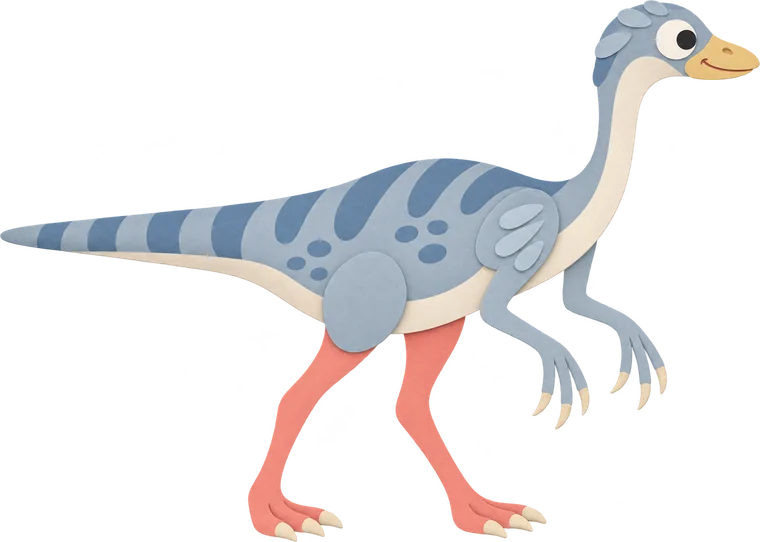
- Fluffy feathers
- Arms like wings
- A beak with no teeth
How big was Ornithomimus? Measure it with your own height
When your child asks, answer like this
 What does Ornithomimus mean?

How big was it?
What did it eat?
What did it do when a scary dinosaur came?
Who lived with it?
- Albertosaurus predatorsame time and place
The meat-eating dinosaur Albertosaurus lived in Alberta, Canada, at the same time as Ornithomimus. Ornithomimus probably ran away on its fast legs. - Edmontosaurus neighboursame time and place
The duck-billed dinosaur Edmontosaurus ate plants in the same place. They probably lived close by without quarrelling.
When and where did it live?
What was it like as a baby? Did it live with friends?
Are there dinosaurs that look like it?
Who found it first?
Ornithomimus facts that make kids say “Wow!”
- Feather marks were found on fossils of Ornithomimus, and that is how we learned its body was covered in fluffy feathers.
- Ornithomimus was the first dinosaur in North America confirmed to have feather marks.
- Thanks to a fossil reported in 2015, we know its tail feathers were like ostrich feathers.
- It had a large brain for a dinosaur, so it was probably good at moving its body and keeping its balance.
From head to tail
- It was about 3.8 m (12 ft) long and weighed about 170 kg, a little heavier than a big ostrich.
- Its shin bone was about one fifth longer than its thigh bone, which was good for running fast.
- A fossil of a young Ornithomimus has marks of downy feathers about 5 cm (2 inches) long.
- The lower part of its legs had no feathers, like an ostrich's.
A Ornithomimus story to read aloud
Morning comes to the forest by the river. A fluffy Ornithomimus blinks its big eyes and gets up. It pecks at leaves and fruit with its toothless beak. Nearby, an Edmontosaurus is calmly eating plants. A grown-up Ornithomimus spreads the long feathers on its arms wide to show off. Just then, an Albertosaurus comes into view far away. Ornithomimus runs off on its long legs like the wind.
A quiz to do together
Tap an answer.
What covered the body of Ornithomimus?
Could Ornithomimus fly?
What does the name Ornithomimus mean?
You finished the quiz! Well done.
Colouring page
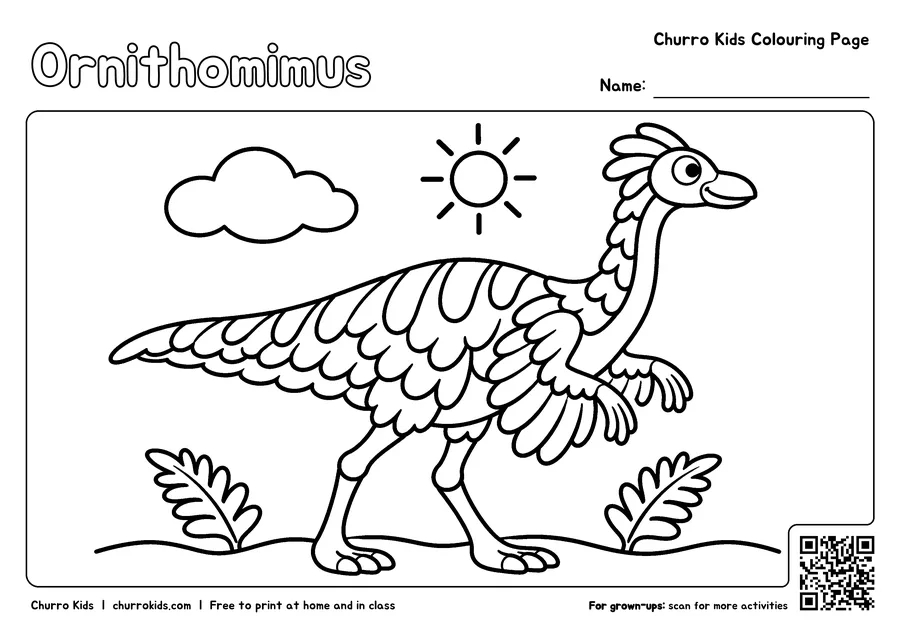
One A4 page, and it is free. Print it freely at home or in class.
Good for parents to know
- The feathers on the body and tail are confirmed by fossils, and the lower legs had no feathers. The long, wing-like feathers on the arms are worked out from marks on the arm bones, and one study has questioned them.
- Scientists are still discussing what it ate most. You can say, "It probably ate leaves, fruit and bugs."
- It looks very much like Struthiomimus, so the two are easy to mix up. Ornithomimus has a shorter body, and its claws are thinner and straighter.