The light is off and your child, lying in bed, suddenly asks, "Could dinosaurs see in the dark at night?" Troodon is a good dinosaur to talk about at a moment like that.
Troodon was a small, quick dinosaur that lived in North America in the Late Cretaceous. It was a little longer than a grown-up lying down, and its eyes were so big that it could probably see well even in dark places. Its brain was also very big for its body, one of the biggest among the dinosaurs. Below are the questions children ask most, with answers at a child's level. You can read them just as they are.
Fact cardTroodon
- Name means
- wounding tooth
- Lived
- Late Cretaceous (about 77 million years ago)
- Length
- about 2.4 m (8 ft)
- Weight
- about 35 to 50 kg
- Food
- Mostly small animals, and maybe plants too
- Found in
- North America (the United States, Canada)
- Group
- Small, fast and feathered dinosaurs
- Very big eyes
- A big head for its body
- Long, thin legs
How big was Troodon? Measure it with your own height
When your child asks, answer like this
 What does Troodon mean?

How big was it?
What did it eat?
What did it do when a scary dinosaur came?
Who lived with it?
- Orodromeus preysame time and place
Orodromeus, a small plant-eating dinosaur, lived in the place where the Troodon group had its nests. Troodon probably hunted this small dinosaur. - Daspletosaurus predatorsame time and place
Daspletosaurus, a big meat-eating dinosaur and a relative of Tyrannosaurus, lived in the same land at the same time. Troodon probably ran away quickly on its long legs.
When and where did it live?
What was it like as a baby? Did it live with friends?
Are there dinosaurs that look like it?
Who found it first?
Troodon facts that make kids say “Wow!”
- Troodon had very big eyes, so it could probably see well even in dark places.
- The name Troodon was given from just one tooth, so what we know about its body comes from the fossils of close relatives.
- At first people thought the eggs of the Troodon group belonged to another dinosaur, Orodromeus. Then the baby bones inside the eggs showed who the real owner was.
- Teeth of the Troodon group from cold Alaska are much bigger than the ones found farther south.
From head to tail
- It was about 2.4 m (8 ft) long, a little longer than a grown-up lying down.
- Its brain was very big for its body, one of the biggest among the dinosaurs.
- Its nest was about 1 m (3.3 ft) across, as big as a hula hoop.
- On its second toe it had a hooked claw that it held up when it ran.
A Troodon story to read aloud
Evening comes to the riverside, where the forest grows thick. Troodon walks on its long, thin legs, its big eyes shining. In the dish-shaped nest the eggs stand side by side, two by two. A grown-up Troodon sits down gently on the nest. When the footsteps of big Daspletosaurus sound far away, it quietly lowers its body. Even when it gets dark, its big eyes can probably help it watch all around.
A quiz to do together
Tap an answer.
What is the feature of Troodon that stands out the most?
What was the name Troodon first based on?
How did the Troodon group lay its eggs?
You finished the quiz! Well done.
Colouring page
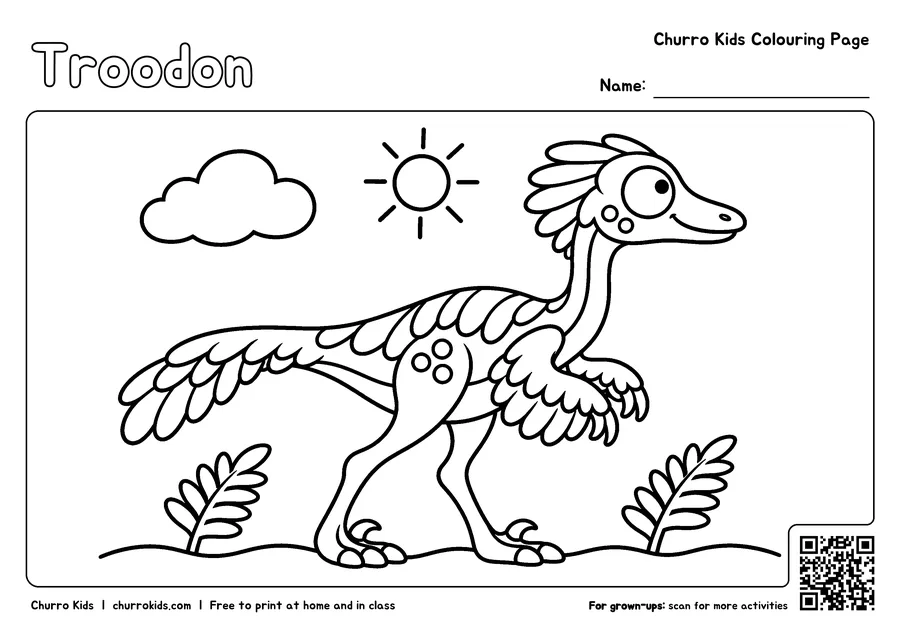
One A4 page, and it is free. Print it freely at home or in class.
Good for parents to know
- The name Troodon was given from a single tooth. For that reason many scientists doubt that the name should still be used. What we know about its body, its size and its big brain comes from the fossils of close relatives, and today those fossils are often called by other names, Stenonychosaurus or Latenivenatrix.
- Sources give its weight as 35 to 50 kilograms. The facts about nests and eggs also come from fossils of the "Troodon group".
- Scientists do not agree about its food either. Some think it ate mainly meat, and others think it ate plants as well. You can say "it mostly ate small animals, and it may have eaten plants too."