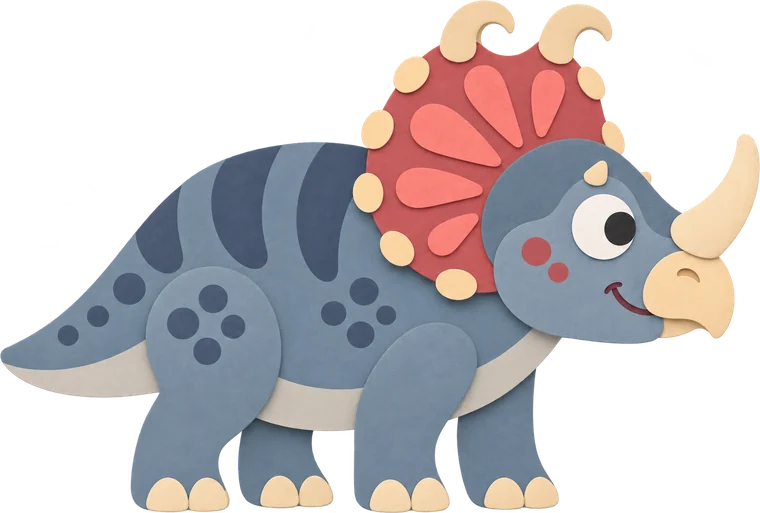
"Dad, penta means five. So does this dinosaur have five horns?" A child who has just learned what the name means starts counting the horns in the picture one by one.
Pentaceratops was a horned dinosaur that lived in the Late Cretaceous in what is now New Mexico, USA. Its name means 'five-horned face', but it had three real horns, and the other two are pointy bones that stick out from its cheeks. Its head and frill were very big, with a skull about 2.3 m (7.5 ft) long. Below are the questions children ask most, with answers at a child's level. You can read them out loud as they are.
Fact cardPentaceratops
- Name means
- five-horned face
- Lived
- Late Cretaceous (about 76 to 73 million years ago)
- Length
- about 6 m (20 ft)
- Weight
- about 2.5 tonnes
- Food
- Plant-eater
- Found in
- North America (New Mexico, USA)
- Group
- Horned dinosaurs
- A very long, big frill
- Two long horns above the eyes
- Pointy spikes on the cheeks
How big was Pentaceratops? Measure it with your own height
When your child asks, answer like this
 What does Pentaceratops mean?

How big was it?
What did it eat?
What did it do when a scary dinosaur came?
Who lived with it?
- Bistahieversor predatorsame time and place
Bistahieversor, a big meat-eating dinosaur that lived in the same place, probably hunted Pentaceratops. - Parasaurolophus neighboursame time and place
Parasaurolophus had a long crest on its head. The two probably ate plants in the same forests. - Nodocephalosaurus neighboursame time and place
Nodocephalosaurus, an armoured dinosaur, lived on the same land too.
When and where did it live?
What was it like as a baby? Did it live with friends?
Are there dinosaurs that look like it?
Who found it first?
Pentaceratops facts that make kids say “Wow!”
- The name Pentaceratops means 'five horns', but it had three real horns. The other two are pointy bones that stick out from its cheeks.
- The skull of Pentaceratops is one of the very big ones among all the animals that have lived on land.
- The bones once known as the biggest Pentaceratops were renamed in 2011 as a different dinosaur, Titanoceratops.
- The full scientific name of Pentaceratops includes the name of Sternberg, who found the fossil.
From head to tail
- Its skull was about 2.3 m (7.5 ft) long, much longer than a grown-up is tall.
- It was about 6 m (20 ft) long and weighed about 2.5 tonnes.
- A row of triangle-shaped bumps ran along the edge of its frill.
- A pointy bone stuck out from each cheek, below the eye.
A Pentaceratops story to read aloud
Morning comes to the damp forest. Pentaceratops lifts its huge head and walks to the edge of the swamp. It snaps off a cycad twig with its sharp beak. Its closely packed teeth cut the leaves into small pieces. Nearby, a Parasaurolophus is eating leaves. With its tall frill, Pentaceratops looks very big, even from far away.
A quiz to do together
Tap an answer.
How many real horns does Pentaceratops have?
What is on the cheeks of Pentaceratops?
What is the frill of Pentaceratops like?
You finished the quiz! Well done.
Colouring page
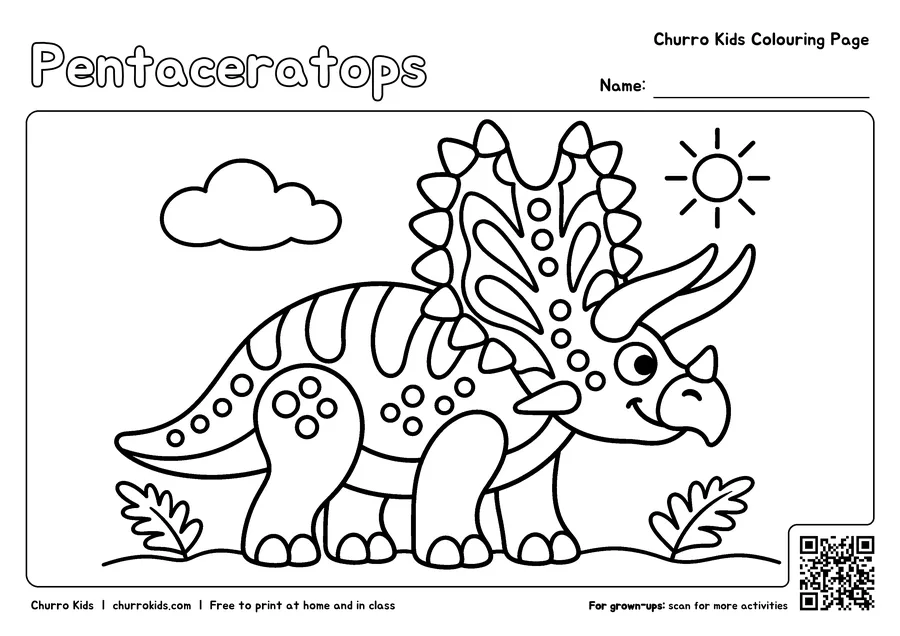
One A4 page, and it is free. Print it freely at home or in class.
Good for parents to know
- Its length is given as anything from about 5.5 to 6.8 metres (18 to 22 ft), depending on the source. This guide uses about 6 metres.
- The skeleton once known as the biggest Pentaceratops was moved in 2011 to a different dinosaur, Titanoceratops. Older books may still show that skeleton as Pentaceratops.
- There is no fossil evidence that Bistahieversor hunted Pentaceratops. We only know that they lived at the same time in the same place. We also do not know yet if it lived in herds or alone. It is fine to tell your child just that: "nobody knows that yet."