"Did a dinosaur ever go to space?" your child asks out of nowhere, looking at a dinosaur book at bedtime. It is a good moment to talk about Coelophysis.
Coelophysis was a slim meat-eating dinosaur that lived in North America in the Late Triassic. It was as long as a small car, but its bones were hollow, so it was only as heavy as a pet dog. In 1998 one of its skulls even rode on a space shuttle to a space station and back. Below are the questions children ask most, with answers at a child's level. You can read them out loud.
Fact cardCoelophysis
- Name means
- hollow form
- Lived
- Late Triassic (about 215 to 201 million years ago)
- Length
- about 3 m (10 ft)
- Weight
- about 15 to 25 kg
- Food
- Meat-eater
- Found in
- North America (New Mexico and Arizona, USA)
- Group
- Small, fast and feathered dinosaurs
- A long, thin neck
- A long, pointed snout
- A slim, light body
How big was Coelophysis? Measure it with your own height
When your child asks, answer like this
 What does Coelophysis mean?

How big was it?
What did it eat?
How did it hunt?
Who lived with it?
- Hesperosuchus (a small relative of crocodiles) preysame time and place
A small relative of crocodiles with long legs lived in the same place. Coelophysis probably chased small animals like this one and ate them. - Phytosaurs (big reptiles that looked like crocodiles) predatorsame time and place
Big reptiles that looked like crocodiles lived in the rivers. Coelophysis probably had to be careful when it went to drink.
When and where did it live?
What was it like as a baby? Did it live with friends?
Are there dinosaurs that look like it?
Who found it first?
Coelophysis facts that make kids say “Wow!”
- The bones of Coelophysis were hollow inside, so its body was light and it could run very fast.
- In 1998 a Coelophysis skull rode on a space shuttle all the way to a space station and back, which made it the second dinosaur to go to space.
- Coelophysis had a V-shaped bone in its chest like a bird's, and it is the oldest one known in any dinosaur.
- The many Coelophysis at Ghost Ranch were probably buried all at once by water that rose suddenly.
From head to tail
- Its skull was about 27 cm (about 11 inches) long, close to the length of one grown-up's shoe.
- It had about 26 teeth on each side of the upper jaw and about 27 on each side of the lower jaw.
- It had four fingers, but it really used only three of them.
- It stood about 1 m (3 ft) high at the hip, close to the height of a five-year-old child.
A Coelophysis story to read aloud
The sun is high over the warm plain by the river. Slim Coelophysis lifts its long neck and looks around. Its big eyes see well in the daytime, and it looks for small prey. Something moves in the grass, and off it dashes on its light body. It is thirsty, but big reptiles that look like crocodiles are in the river, so it comes close very carefully. After a drink, Coelophysis runs back out onto the plain.
A quiz to do together
Tap an answer.
What were the bones of Coelophysis like inside?
Where did a Coelophysis skull travel to?
When did Coelophysis live?
You finished the quiz! Well done.
Colouring page
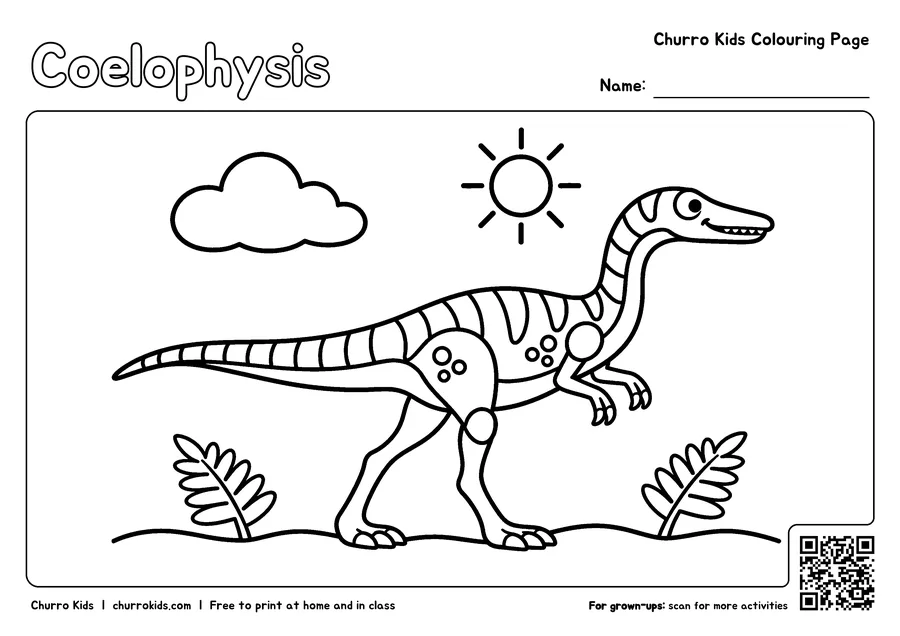
One A4 page, and it is free. Print it freely at home or in class.
Good for parents to know
- Older books say that Coelophysis ate its own young. When the famous fossil was checked again, the bones inside it turned out to belong to a small relative of crocodiles. Scientists still do not agree on whether it ever really ate its young.
- Nobody knows whether it had feathers or fuzz. Some pictures show it with scales and some with fuzz, and both are guesses.
- The fossils of hundreds of animals came from one place, but it is not certain that they really lived in groups. They were probably buried all at once by water that rose suddenly. You can say "lots of them were found together, and nobody knows yet whether they lived together."