"This dinosaur spits poison, right?" your child asks, looking at a picture of Dilophosaurus and thinking of a scene from a film.
Dilophosaurus was a meat-eating dinosaur that lived in the Early Jurassic in what is now Arizona in the USA. It was as long as a big van and had two crests on top of its head. The real Dilophosaurus did not spit poison, and it had no frill that opened out around its neck. It was the biggest animal known so far from the land of North America at that time. Below are the questions children ask most, with answers at a child's level. You can read them out loud.
Fact cardDilophosaurus
- Name means
- lizard with two crests
- Lived
- Early Jurassic (about 195 to 184 million years ago)
- Length
- about 6 m (20 ft)
- Weight
- about 300 to 400 kg
- Food
- Meat-eater
- Found in
- North America (Arizona, USA)
- Group
- Small, fast and feathered dinosaurs
- Two crests on top of the head
- A long, slim body
- Pointed teeth
How big was Dilophosaurus? Measure it with your own height
When your child asks, answer like this
 What does Dilophosaurus mean?

How big was it?
What did it eat?
How did it hunt?
Who lived with it?
- Sarahsaurus preysame time and place
Sarahsaurus, a long-necked plant-eating dinosaur, lived in the same place. There are marks on Sarahsaurus bones that look like tooth marks, so Dilophosaurus probably ate it. - Scutellosaurus neighboursame time and place
Scutellosaurus was a small plant-eating dinosaur with lots of little pieces of armour on its back. When it met Dilophosaurus, it probably ran away fast.
When and where did it live?
What was it like as a baby? Did it live with friends?
Are there dinosaurs that look like it?
Who found it first?
Dilophosaurus facts that make kids say “Wow!”
- Dilophosaurus did not spit poison as it does in the film, and it had no frill that opened out around its neck.
- One Dilophosaurus fossil had hurt bones in eight places, and they show signs of healing, so it lived for a long time afterward.
- In Utah in the USA, there is a mark where a dinosaur like Dilophosaurus squatted down to rest, together with the prints of its hands.
- Dilophosaurus is the state dinosaur of Connecticut in the USA, because footprints of a similar dinosaur were found there.
From head to tail
- Its skull was about 50 to 60 cm (20 to 24 inches) long, close to the length of a grown-up's arm.
- It had about 66 teeth in all.
- It stood about 1.4 m (4.6 ft) high at the hip, about as tall as a child in the third or fourth year of primary school.
- The crests were made of thin bone, and the outside was probably covered with the same stuff as fingernails.
A Dilophosaurus story to read aloud
A river runs between the sand dunes. Dilophosaurus walks out from the shade of the conifers by the water. The two crests on its head shine in the sun. In this land, Dilophosaurus is a very big animal. A little Scutellosaurus is startled and runs away fast. Dilophosaurus looks into the river for fish. Far away, a long-necked Sarahsaurus can be seen too.
A quiz to do together
Tap an answer.
What did Dilophosaurus have on top of its head?
Did the real Dilophosaurus spit poison?
When did Dilophosaurus live?
You finished the quiz! Well done.
Colouring page
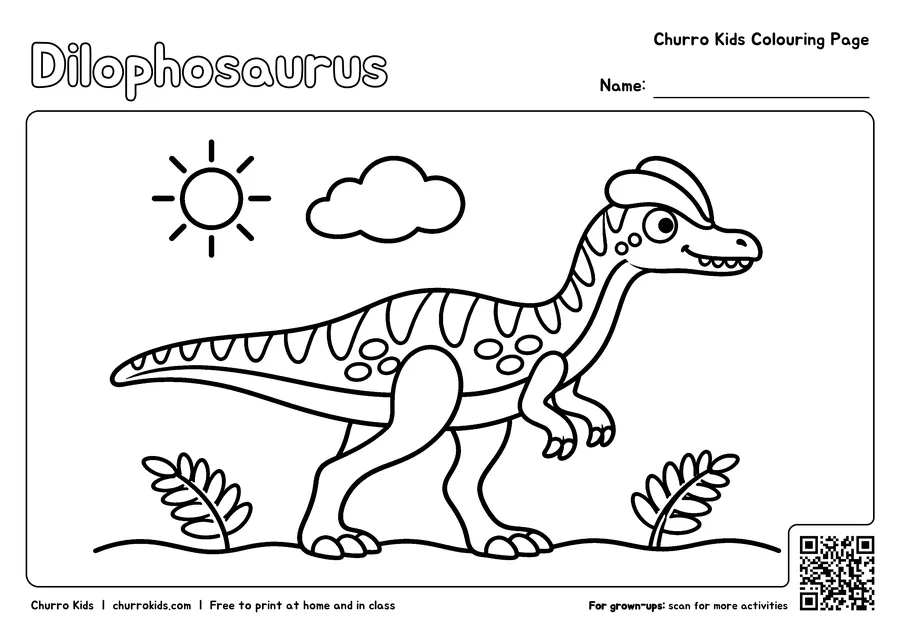
One A4 page, and it is free. Print it freely at home or in class.
Good for parents to know
- The poison spitting and the neck frill were made up for the film. Tell your child that the real one was as long as a van and had no poison and no frill.
- The exact shape of the crests and what they were for are still uncertain. The length is given as about 6 metres, and the biggest fossil is about 7 metres.
- This guide puts it in the same group as the small, fast dinosaurs, but it was about 6 metres long. The idea that it ate Sarahsaurus is a guess that comes from marks on the bones that look like tooth marks, and it is not certain that several lived together in a group.