"This dinosaur's name means egg thief. Is it a bad dinosaur?" your child asks with a frown, reading a dinosaur card. There is an old mix-up hiding in this name.
Oviraptor was a feathered dinosaur that lived in the Late Cretaceous in what is now the Gobi Desert in Mongolia. It was about 1.8 metres (6 feet) long, with a body about as big as a large dog. It had a beak with no teeth and a short face like a parrot's. Its name means "egg thief," but it was really a dinosaur that sat on its own eggs to keep them safe. Below are the questions children ask most, with answers at a child's level. You can read them out loud as they are.
Fact cardOviraptor
- Name means
- egg thief
- Lived
- Late Cretaceous (about 75 to 71 million years ago)
- Length
- about 1.8 m (6 ft)
- Weight
- about 33 to 40 kg
- Food
- Eats plants and animals
- Found in
- Asia (the Gobi Desert in Mongolia)
- Group
- Small, fast and feathered dinosaurs
- A beak with no teeth
- A short face like a parrot's
- Arms with feathers
How big was Oviraptor? Measure it with your own height
When your child asks, answer like this
 What does Oviraptor mean?

How big was it?
What did it eat?
What did it do when a scary dinosaur came?
Who lived with it?
- Protoceratops neighboursame time and place
Protoceratops was a plant-eating dinosaur that lived in the same desert. Scientists long ago thought Oviraptor was stealing the eggs of Protoceratops, but the eggs were Oviraptor's own. - Velociraptor neighboursame time and place
The quick hunter Velociraptor lived in the same place too. Oviraptor was probably careful, to keep its eggs and babies safe.
When and where did it live?
What was it like as a baby? Did it live with friends?
Are there dinosaurs that look like it?
Who found it first?
Oviraptor facts that make kids say “Wow!”
- The name Oviraptor means "egg thief," but it was really a caring dinosaur that sat on its own eggs to keep them safe.
- Even Dr Osborn, who chose the name, worried that the name "egg thief" might be a mistake.
- When the fossil was found, there was only about 10 cm (4 inches) of sand between the skull and the eggs.
- The only sure Oviraptor fossils are one skeleton, one nest of eggs and a few leg bones of a young dinosaur.
From head to tail
- Its skull was about 18 cm (7 inches) long, about the span of a grown-up's hand.
- Its eggs were about 14 cm (5.5 inches) long, long and thin like a small banana.
- It had no teeth, but like its relatives it probably had two pointed bumps like teeth on the roof of its mouth.
- It weighed about 33 to 40 kg, about the same as a large dog.
A Oviraptor story to read aloud
The morning sun comes up over the sand dunes of the Gobi Desert. Oviraptor is sitting on its nest. In the nest, long eggs lie in pairs in a circle. It spreads its feathered arms and covers the eggs, snug and warm. When it is hungry, it eats seeds and leaves with its hard beak. Even when the sandy wind blows, Oviraptor does not leave its nest.
A quiz to do together
Tap an answer.
Was Oviraptor really an egg thief?
What was the mouth of Oviraptor like?
About how many eggs were in the Oviraptor nest?
You finished the quiz! Well done.
Colouring page
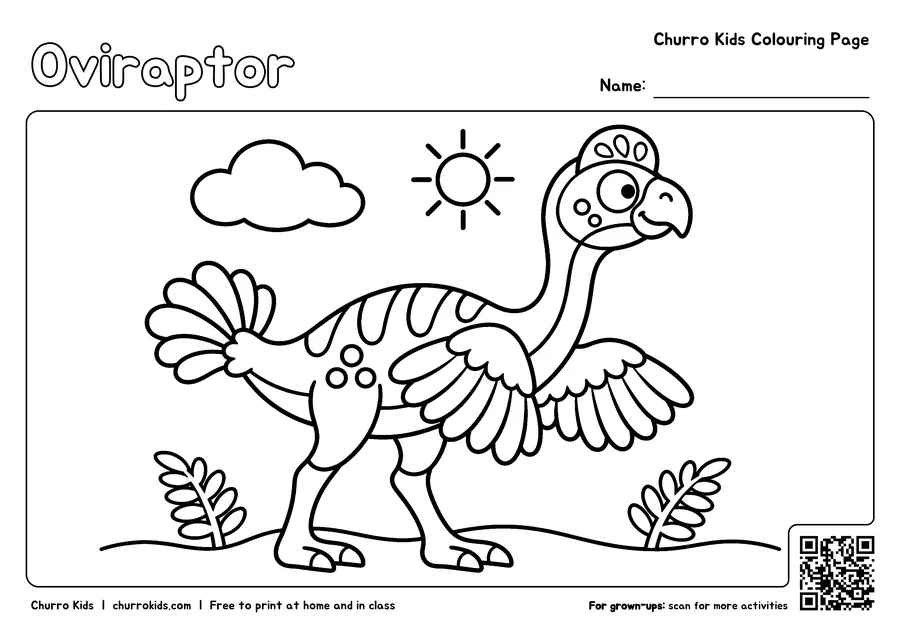
One A4 page, and it is free. Print it freely at home or in class.
Good for parents to know
- In pictures, the "Oviraptor" with a tall crest on its head is very often its relative Citipati. The only good Oviraptor skull is crushed and its top is missing, so it probably had a crest, but nobody knows its shape yet.
- Scientists disagree about what it ate. The usual view is mostly plants plus a few small animals, so "it probably did" is the right way to say it to a child.
- The feathers and the fan of feathers at the end of the tail are worked out from related dinosaurs. The fossil of a dinosaur sitting on its eggs that cleared the name "egg thief" was found in the 1990s and belongs to its relative Citipati.