If your child is looking at a crocodile picture book and asks, "Mum, is there a dinosaur that looks like a crocodile?", show them Suchomimus. Even its name means one that looks like a crocodile.
Suchomimus was a meat-eating dinosaur that lived in the Early Cretaceous in what is now Niger in Africa. It was as long as a bus, with a long, narrow snout like a crocodile's and a big claw on each thumb. It mostly caught and ate the big fish that lived in rivers. Below are the questions children ask most, with answers at a child's level. You can read them out loud as they are.
Fact cardSuchomimus
- Name means
- one that looks like a crocodile
- Lived
- Early Cretaceous (about 120 to 112 million years ago)
- Length
- about 11 m (36 ft)
- Weight
- about 2.5 to 5 tonnes
- Food
- Fish-eater (a meat-eater that ate fish)
- Found in
- Niger, Africa
- Group
- Dinosaurs from around the world
- A long, narrow snout like a crocodile's
- A big claw on each thumb
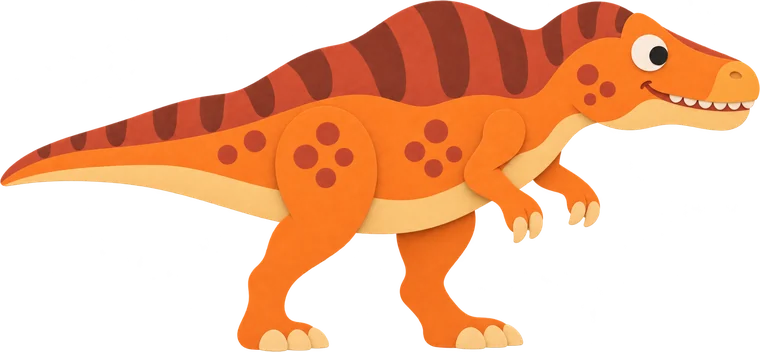
- A low sail on its back
How big was Suchomimus? Measure it with your own height
When your child asks, answer like this
 What does Suchomimus mean?

How big was it?
What did it eat?
How did it hunt?
Who lived with it?
- Sarcosuchus rivalsame time and place
Sarcosuchus was a huge relative of crocodiles, about 9 m (30 ft) long. It lived in the same rivers, so the two probably competed for fish. - Nigersaurus neighboursame time and place
Nigersaurus was a plant-eating dinosaur that fed on low-growing plants on the same riverside plains. Suchomimus liked fish better, so they probably lived side by side eating different food. - Ouranosaurus neighboursame time and place
Ouranosaurus was a plant-eating dinosaur with a sail on its back, and its fossils are found in the same place. Nobody knows yet what went on between the two.
When and where did it live?
What was it like as a baby? Did it live with friends?
Are there dinosaurs that look like it?
Who found it first?
Suchomimus facts that make kids say “Wow!”
- Suchomimus probably caught and ate fish at the water's edge with its long, narrow mouth, like a crocodile.
- The tip of its snout widens into a round shape like a spoon, and long teeth are gathered there in the shape of a flower.
- It was found in a desert that is all sand today, but when Suchomimus lived there, big rivers flowed through it.
- Scientists say the roof of its mouth was firmly joined, so its snout did not twist much even when its food wriggled.
From head to tail
- It had about 122 cone-shaped teeth in its mouth.
- Its skull was about 1.2 m (4 ft) long, as long as a seven-year-old child is tall.
- Its thumb claw was 19 to 30 cm (7.5 to 12 inches) long, depending on the source. That is the span of a grown-up's hand or longer.
- The sail on its back was tallest above the hips.
A Suchomimus story to read aloud
The morning sun comes up, and Suchomimus walks out to the wide riverside. It dips its feet in the shallow water, stands still and looks down into the water. When a big fish swims by, it quickly plunges its long, crocodile-like snout into the water. Its cone-shaped teeth grip the slippery fish tight. Across the river, a Nigersaurus is feeding on low-growing plants. With a full tummy, Suchomimus walks slowly along the riverbank.
A quiz to do together
Tap an answer.
What was the favourite food of Suchomimus?
Which animal does the snout of Suchomimus look like?
What kind of place is it today where the fossils of Suchomimus were found?
You finished the quiz! Well done.
Colouring page
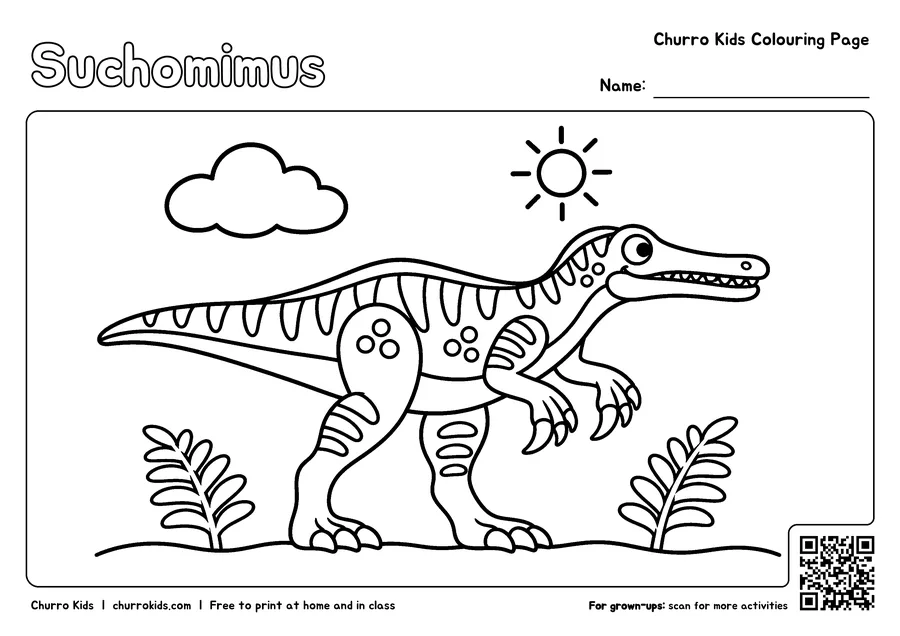
One A4 page, and it is free. Print it freely at home or in class.
Good for parents to know
- Its length is given as about 9.5 to 11 metres and its weight as anything from 2.5 to more than 5 tonnes, depending on the source. The time it lived is also written a little differently from source to source, so it is enough to say "it lived in the Early Cretaceous."
- The sail on its back was low, and its exact shape is not certain. The sail of Spinosaurus is very tall in the middle of the back, but the sail of Suchomimus was low and tallest above the hips.
- That it competed with Sarcosuchus for fish is a guess that comes from the two living in the same rivers. Nobody knows yet exactly how it used its thumb claws either. Some sources give the claw as 19 cm (7.5 inches) long and others as about 30 cm (12 inches).