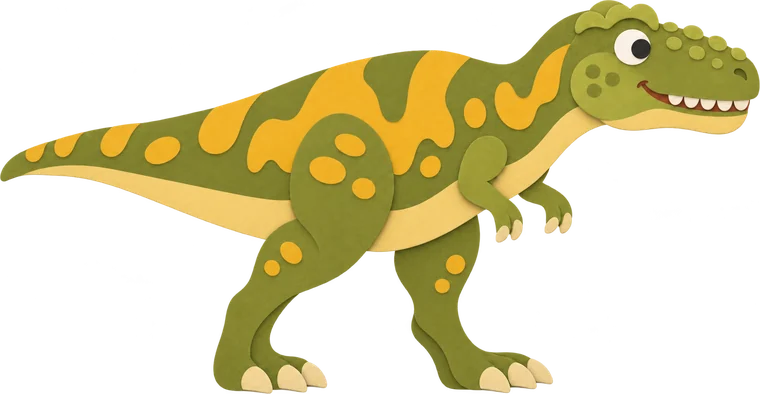
"This dinosaur has a mountain on its back!" your child says, turning the pages of a dinosaur book and tracing the tall ridge of Acrocanthosaurus with one finger.
Acrocanthosaurus was a huge meat-eating dinosaur that lived in North America in the Early Cretaceous. It was as long as a bus, and the spines on its backbone were so long that its back rose up like a mountain ridge from neck to tail. Its arms were so short that they could not even reach its own neck. Below are the questions children ask most, with answers at a child's level. You can read them out loud.
Fact cardAcrocanthosaurus
- Name means
- lizard with high spines
- Lived
- Early Cretaceous (about 125 to 100 million years ago)
- Length
- about 11.5 m (38 ft)
- Weight
- about 4.4 to 8.4 tonnes
- Food
- Meat-eater
- Found in
- North America, USA (Oklahoma, Texas and other states)
- Group
- Dinosaurs from around the world
- A tall ridge along the back from neck to tail
- A big, long head
- Two strong back legs
How big was Acrocanthosaurus? Measure it with your own height
When your child asks, answer like this
 What does Acrocanthosaurus mean?

How big was it?
What did it eat?
How did it hunt?
Who lived with it?
- Sauroposeidon preysame time and place
Sauroposeidon was a very big plant-eater that held its neck up high like a giraffe. The fossil of a young Acrocanthosaurus was once found close to a Sauroposeidon shoulder bone, but nobody knows what happened between the two. - Tenontosaurus preysame time and place
Tenontosaurus was a plant-eater that lived in the same place in very large numbers. Acrocanthosaurus probably hunted it often. - Deinonychus neighboursame time and place
Deinonychus was a small meat-eating dinosaur about 3 metres (10 feet) long. It probably kept out of the way of the much bigger Acrocanthosaurus.
When and where did it live?
What was it like as a baby? Did it live with friends?
Are there dinosaurs that look like it?
Who found it first?
Acrocanthosaurus facts that make kids say “Wow!”
- The spines on the backbone of Acrocanthosaurus were very long, so its back rose up high like a mountain ridge.
- When it held its head in a relaxed way, its snout probably pointed about 25 degrees downward.
- There is a fossil in which one of the spines on the back broke and then healed again.
- One line of big meat-eating dinosaur footprints from Texas is on show at the American Museum of Natural History in New York.
From head to tail
- The skull of the biggest fossil is about 1.3 m (4.3 ft) long, longer than a six-year-old child is tall.
- The spines on its backbone were more than two and a half times as tall as the main part of each back bone.
- Each hand had three fingers with claws.
- Its arms were so short that they could not even reach its own neck.
A Acrocanthosaurus story to read aloud
Acrocanthosaurus appears on the wide plain by the river. The tall ridge on its back, from neck to tail, looks like a line of hills. It sniffs the air and smells what the wind brings. Far away, a herd of Tenontosaurus is eating plants. A small Deinonychus sees the huge Acrocanthosaurus and quickly moves out of the way. Acrocanthosaurus walks on, pressing three-toed footprints into the mud.
A quiz to do together
Tap an answer.
What does the back of Acrocanthosaurus look like?
How many fingers does Acrocanthosaurus have on each hand?
What did Acrocanthosaurus eat?
You finished the quiz! Well done.
Colouring page
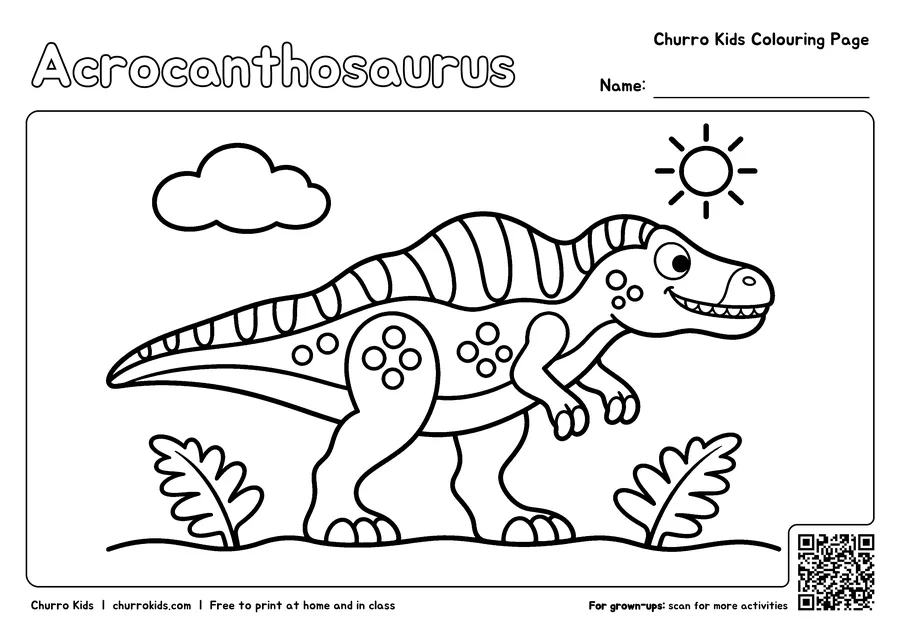
One A4 page, and it is free. Print it freely at home or in class.
Good for parents to know
- Its weight differs a lot from study to study, from about 4.4 to 8.4 tonnes. The dates differ too. Many sources give a narrow span of about 113 to 110 million years ago for the main fossils, and the widest span is about 125 to 100 million years ago. For a child it is enough to say "it lived in the Early Cretaceous."
- Nobody knows yet what the tall spines on its back were for. You can say "scientists are still working out why its back rises up."
- The big three-toed footprints in Texas were very likely made by Acrocanthosaurus, but that is not certain. The fossil of a young Acrocanthosaurus was once found close to a Sauroposeidon shoulder bone, and nobody knows what happened between the two.