"Dad, this dinosaur has a bump on its head." A child looking at a picture of Majungasaurus points to the very top of its head. That bump is a round horn.
Majungasaurus was a meat-eating dinosaur that lived in the Late Cretaceous, about 70 to 66 million years ago, on what is now the island of Madagascar in Africa. It had one round horn on the very top of its head, a short, blunt snout and very small arms. It was about as long as one and a half cars. Below are the questions children ask most, with answers at a child's level. You can read them out loud as they are.
Fact cardMajungasaurus
- Name means
- lizard of Mahajanga (a region of Madagascar)
- Lived
- Late Cretaceous (about 70 to 66 million years ago)
- Length
- about 6.5 m (21 ft)
- Weight
- about 0.75 to 1.1 tonnes
- Food
- Meat-eater
- Found in
- Madagascar, Africa
- Group
- Dinosaurs from around the world
- One round horn on top of its head
- A short, blunt snout
- Very small arms
How big was Majungasaurus? Measure it with your own height
When your child asks, answer like this
 What does Majungasaurus mean?

How big was it?
What did it eat?
How did it hunt?
Who lived with it?
- Rapetosaurus preyfossil evidence
Tooth marks from Majungasaurus have been found on the bones of Rapetosaurus. Nobody knows yet whether it hunted the animal itself or ate one that had already fallen. - Masiakasaurus neighboursame time and place
Masiakasaurus was a small meat-eating dinosaur about 2 m (6.5 ft) long. The two were very different in size, so they probably lived on different food. - Simosuchus neighboursame time and place
Simosuchus was a small relative of crocodiles with a blunt snout, and it ate plants. Its fossils are found on the same plains, but nobody knows what went on between the two.
When and where did it live?
What was it like as a baby? Did it live with friends?
Are there dinosaurs that look like it?
Who found it first?
Majungasaurus facts that make kids say “Wow!”
- Majungasaurus had one round horn that bulged up on the very top of its head.
- When only a piece of its rounded, domed skull had been found, it was once wrongly thought to be a kind of head-butting dinosaur.
- Its teeth grew back much faster than those of other meat-eating dinosaurs. Scientists say a whole set of teeth was replaced in about two months.
- There are traces of air sacs in its backbone, so it probably breathed the way birds do today.
From head to tail
- The skull of a big adult was about 60 to 70 cm (2 to 2.3 ft) long.
- The horn on top of its head was hollow inside.
- Its arms were very short, and its four fingers were short too, like pencil stubs.
- It weighed about 1 tonne, about the same as a small car.
A Majungasaurus story to read aloud
The dry season has come, and Majungasaurus walks across the plains of Madagascar. One round horn sticks up on the very top of its head. It walks slowly along a shallow, sandy river on its short, sturdy legs. Far away, a long-necked Rapetosaurus plods past. Majungasaurus quietly moves in closer. Nearby, a little Masiakasaurus is looking for its own food.
A quiz to do together
Tap an answer.
How many horns does Majungasaurus have on top of its head?
On which island did Majungasaurus live?
What are the arms of Majungasaurus like?
You finished the quiz! Well done.
Colouring page
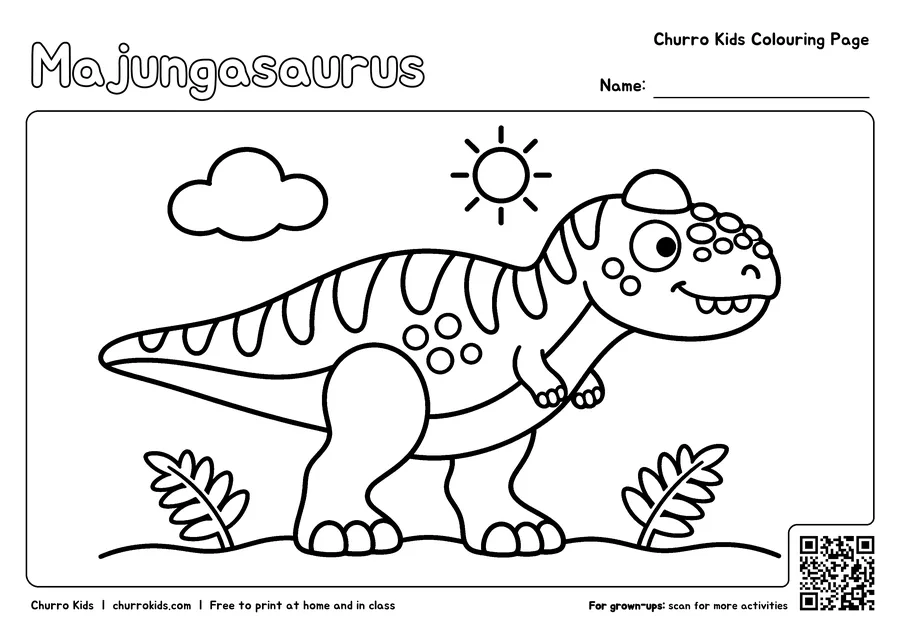
One A4 page, and it is free. Print it freely at home or in class.
Good for parents to know
- Nobody knows yet what the horn on its head was for. If your child asks, you can say "scientists do not know that yet either."
- Tooth marks from Majungasaurus are left on the bones of Rapetosaurus. There is no way to tell whether it hunted the animal itself or ate one that had already fallen.
- It is easy to mix up with Carnotaurus of South America. Carnotaurus had two horns above its eyes, and Majungasaurus had only one horn, on the very top of its head.