"Did big meat-eating dinosaurs live with their families too?" your child asks, lining up toy dinosaurs from biggest to smallest.
Mapusaurus was a big meat-eating dinosaur that lived in the Middle Cretaceous, in the land that is now Argentina. It was as long as a bus, with a long, narrow head and teeth like knife blades. Several fossils, adults and young ones, were found together in one place, so scientists say they may have lived together. Below are the questions children ask most, with answers at a child's level. You can read them out loud.
Fact cardMapusaurus
- Name means
- earth lizard
- Lived
- Middle Cretaceous (about 106 to 93 million years ago)
- Length
- about 11.5 m (38 ft)
- Weight
- about 6 to 8 tonnes
- Food
- Meat-eater
- Found in
- South America, Argentina
- Group
- Dinosaurs from around the world
- A big, long, narrow head
- Teeth like knife blades
- Small front legs
How big was Mapusaurus? Measure it with your own height
When your child asks, answer like this
 What does Mapusaurus mean?

How big was it?
What did it eat?
How did it hunt?
Who lived with it?
- Argentinosaurus preysame time and place
Argentinosaurus was a very big long-necked dinosaur that lived in the same place. Some scientists think several Mapusaurus may have hunted it together, but this is not certain yet. - Skorpiovenator neighboursame time and place
Skorpiovenator was a smaller meat-eating dinosaur that lived in the same land. It probably kept away from big Mapusaurus and looked for smaller prey.
When and where did it live?
What was it like as a baby? Did it live with friends?
Are there dinosaurs that look like it?
Who found it first?
Mapusaurus facts that make kids say “Wow!”
- Several Mapusaurus fossils, adults and young ones, were found together in one place, so scientists say they may have lived together.
- The "Mapu" in its name means earth in the language of the Mapuche people who live in that area.
- Scientists say the small holes that the young ones had in the upper jaw bone went away as they became adults.
- More than 176 Mapusaurus bones came out of one fossil site.
From head to tail
- It had about 15 teeth on each side of its lower jaw.
- Its front legs were very small for its body, like those of Tyrannosaurus.
- It weighed 6 to 8 tonnes, more than one big elephant.
- Its head was taller and narrower than the head of Giganotosaurus.
A Mapusaurus story to read aloud
Mapusaurus stands beside a river that flows in many branches. It lifts its big, long, narrow head and looks around. Across the river, a very big Argentinosaurus walks slowly along. Between the ferns and the conifers there is a young Mapusaurus too. Little Skorpiovenator passes by, keeping well away. Mapusaurus opens its mouth wide, full of teeth like knife blades, and yawns.
A quiz to do together
Tap an answer.
How were the fossils of Mapusaurus found?
What does the name Mapusaurus mean?
What do the teeth of Mapusaurus look like?
You finished the quiz! Well done.
Colouring page
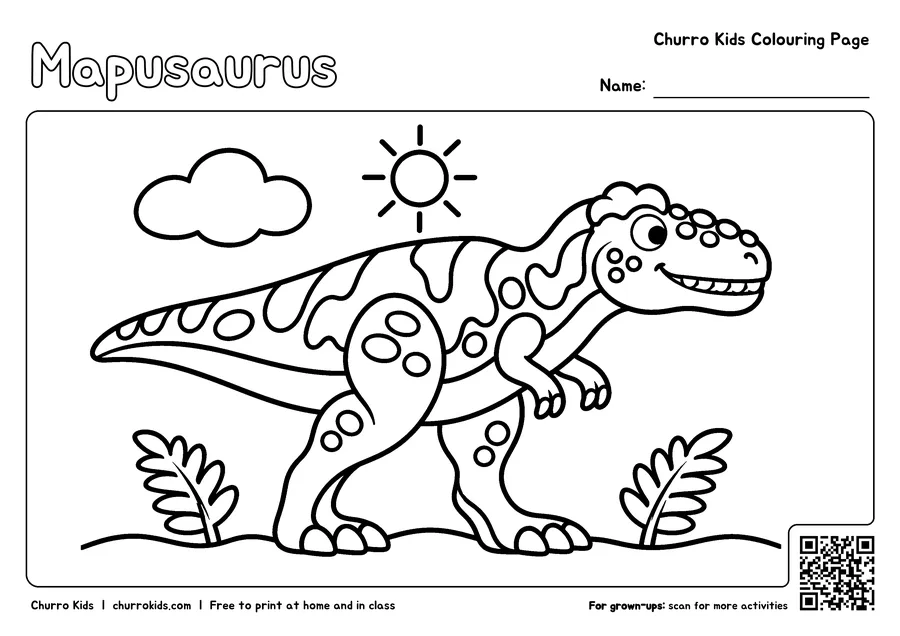
One A4 page, and it is free. Print it freely at home or in class.
Good for parents to know
- Living in a group or hunting together is an idea that comes from the fossils of seven to nine animals found in one place. There is no sure evidence yet, so say "scientists think they may have lived together."
- The first study gave its length as about 10.2 metres (33 feet), and later estimates go up to 12.6 metres (41 feet). This guide uses 11.5 metres (38 feet).
- For a long time it was dated to about 97 to 93 million years ago, early in the Late Cretaceous. A study from 2026 measured the age of the rocks again and places it earlier, near the end of the Early Cretaceous. So this guide covers both and says Middle Cretaceous, about 106 to 93 million years ago.