Your child is turning the pages of a dinosaur book and stops at one picture. "Mum, this dinosaur is wearing a crown!" Children often say this the first time they see Styracosaurus.
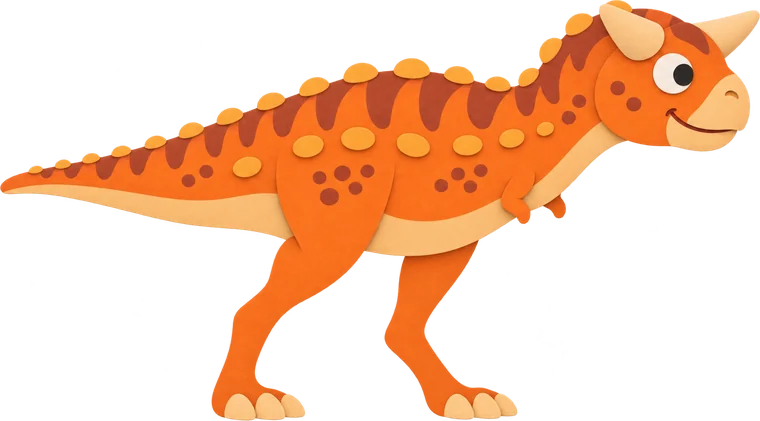
Styracosaurus was a horned dinosaur that lived in North America in the Late Cretaceous. It had one long horn on its nose, and long spikes of more than 50 cm (20 inches) stood on its frill like a crown. It was about 5.5 m (18 ft) long, a little longer than a car. Below are the questions children ask most, with answers at a child's level. You can read them out loud as they are.
Fact cardStyracosaurus
- Name means
- spiked lizard
- Lived
- Late Cretaceous (about 75.5 to 74.5 million years ago)
- Length
- about 5.5 m (18 ft)
- Weight
- about 2 to 3 tonnes
- Food
- Plant-eater
- Found in
- North America (Canada, USA)
- Group
- Horned dinosaurs
- One long horn on the nose
- Long, pointy spikes on the frill
- A chubby body that walked on four legs
How big was Styracosaurus? Measure it with your own height
When your child asks, answer like this
 What does Styracosaurus mean?

How big was it?
What did it eat?
What did it do when a scary dinosaur came?
Who lived with it?
- Daspletosaurus predatorsame time and place
Daspletosaurus, a big meat-eating dinosaur that lived in the same place, probably hunted Styracosaurus. - Lambeosaurus neighboursame time and place
Lambeosaurus was a duck-billed dinosaur with a crest on its head. The two probably ate plants by the same rivers.
When and where did it live?
What was it like as a baby? Did it live with friends?
Are there dinosaurs that look like it?
Who found it first?
Styracosaurus facts that make kids say “Wow!”
- The horn on the nose of Styracosaurus probably grew as long as a child's arm.
- The number and shape of the frill spikes were a little different in each Styracosaurus.
- One skull has been found with spikes that are a different shape on the left and on the right.
- The small horns above the eyes of a young one went away when it grew up, and a shallow dip was left in their place.
From head to tail
- It was about 5.5 m (18 ft) long and stood about 1.8 m (6 ft) tall, about as tall as a grown-up.
- Each long frill spike was more than 50 cm (20 inches) long, about as long as a child's arm.
- There were four to six long spikes, and the number was a little different from one animal to the next.
- It weighed about 2 to 3 tonnes, about the same as a big rhinoceros.
A Styracosaurus story to read aloud
On a warm morning, Styracosaurus opens its eyes in the forest by the river. It walks to the edge of the swamp with its friends. It nips off low ferns with its beak, slices them with its teeth and swallows them. Next to it, a crested Lambeosaurus is eating leaves too. The long spikes on its frill catch the sunlight and look as fine as a crown. When a Daspletosaurus comes into view far away, the Styracosaurus move close together.
A quiz to do together
Tap an answer.
Where is the long horn of Styracosaurus?
What is on the frill of Styracosaurus?
In which country was the first Styracosaurus fossil found?
You finished the quiz! Well done.
Colouring page
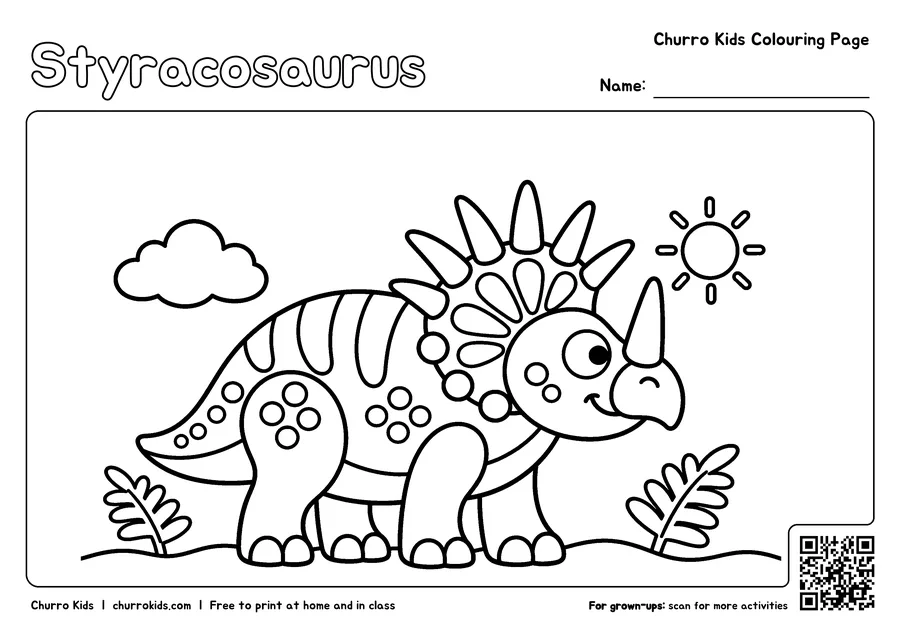
One A4 page, and it is free. Print it freely at home or in class.
Good for parents to know
- The tip of the nose horn is missing from the fossil. So the length of the horn is an estimate, and it is often given as up to about 60 cm (2 ft).
- There were four to six long frill spikes, and the number differed from animal to animal. It is normal for pictures in different books to show different numbers of spikes. Scientists think the spikes were mainly for looking good to other Styracosaurus.
- There is no fossil evidence yet that Daspletosaurus hunted Styracosaurus. We only know that they lived at the same time in the same place, so it is safest to say "it may have hunted them."