Your child is turning the pages of a dinosaur book and stops at a meat-eater with horns. "Mum, this one eats meat, so why does it have horns like a cow?"
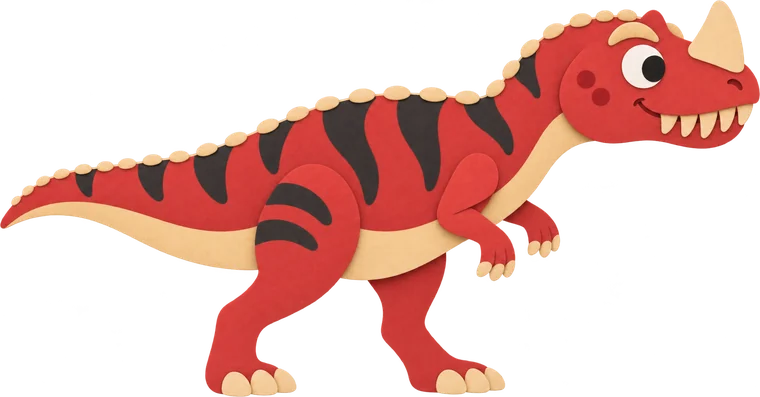
Carnotaurus was a meat-eating dinosaur that lived in Argentina, in South America, in the Late Cretaceous. Its name means "meat-eating bull", and it had two horns above its eyes, like a bull's. Its arms were even shorter than the arms of Tyrannosaurus. Thanks to fossil skin prints, we also know that its body was covered in bumpy scales. Below are the questions children ask most, with answers at a child's level. You can read them out loud as they are.
Fact cardCarnotaurus
- Name means
- meat-eating bull
- Lived
- Late Cretaceous (about 70 to 66 million years ago)
- Length
- about 8 m (26 ft)
- Weight
- about 1.3 to 2 tonnes
- Food
- Meat-eater
- Found in
- South America (Argentina)
- Group
- Big meat-eating dinosaurs
- Two horns above the eyes, like a bull's
- Very, very short arms
- A short, blunt face
How big was Carnotaurus? Measure it with your own height
When your child asks, answer like this
 What does Carnotaurus mean?

How big was it?
What did it eat?
How did it hunt?
Who lived with it?
- Titanomachya preysame time and place
Titanomachya, a long-necked plant-eater, lived on the same plains by the sea. Carnotaurus probably hunted Titanomachya. - Koleken rivalsame time and place
Koleken, a meat-eating dinosaur and a close relative of Carnotaurus, lived in the same place. The two probably competed for food.
When and where did it live?
What was it like as a baby? Did it live with friends?
Are there dinosaurs that look like it?
Who found it first?
Carnotaurus facts that make kids say “Wow!”
- Fossil skin prints of Carnotaurus have been found, so we know its body was covered in bumpy scales.
- Only one Carnotaurus skeleton has ever been found.
- For its body size, the tail muscle that pulled the back legs of Carnotaurus was the biggest of any meat-eating dinosaur studied so far.
- Its arms were even shorter than the arms of Tyrannosaurus. For its body size, it had the shortest arms of all the big meat-eating dinosaurs.
From head to tail
- The horns above its eyes were about 15 cm (6 inches) long, about the same as a pencil.
- Its skull was about 60 cm (2 ft) long, short and tall for its body size.
- It had four fingers, but they were joined together and probably could not move.
- Its skin had raised, bumpy scales about 2 to 6 cm (about 1 to 2.5 inches) across, scattered here and there.
A Carnotaurus story to read aloud
A wind blows across the plain by the sea. Carnotaurus strides along on its long, slim back legs. Above its eyes, two horns like a bull's stick out to the sides. Its very short arms are tucked close against its body. Carnotaurus sniffs the air with its nose. Far away it sees a long-necked Titanomachya. Carnotaurus kicks off from the ground with its strong tail muscles and runs.
A quiz to do together
Tap an answer.
Where are the horns of Carnotaurus?
What does the name Carnotaurus mean?
What are the arms of Carnotaurus like?
You finished the quiz! Well done.
Colouring page
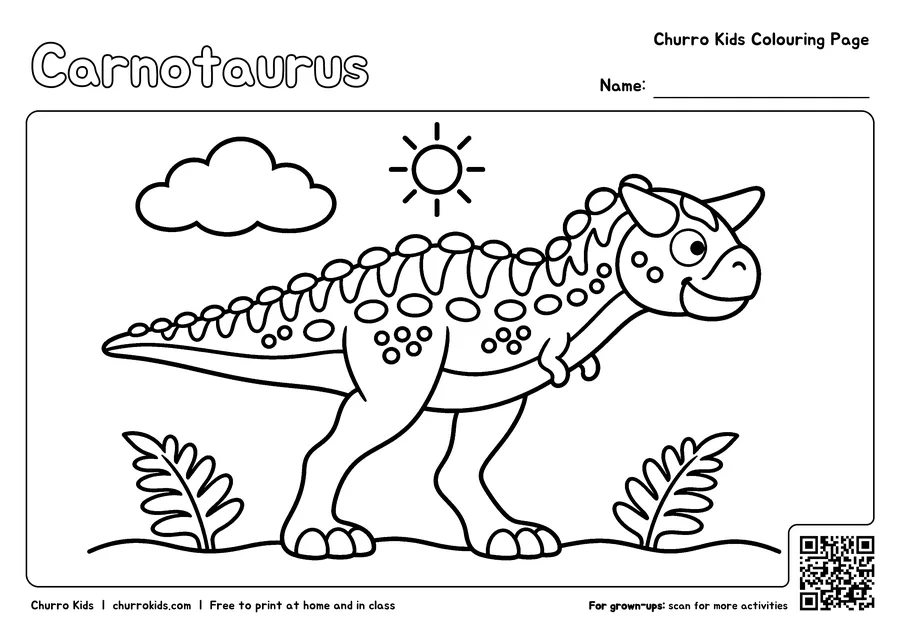
One A4 page, and it is free. Print it freely at home or in class.
Good for parents to know
- Only one Carnotaurus skeleton has ever been found. So there is a lot we do not know yet, such as its eggs, its babies and whether it lived in groups.
- The time when it lived differs a little between sources. Older sources give about 72 to 69 million years ago, and newer dating gives about 69 to 66 million years ago.
- No fossil shows what it ate. Some scientists think it caught small animals, and others think it went after big prey. The idea that it used its horns in tests of strength is also a guess, so you can say "It probably pushed head to head with other Carnotaurus."