"Is Archaeopteryx a bird or a dinosaur?" your child asks, head tilted, standing in the museum in front of a fossil with the marks of feathers.
Archaeopteryx lived in the Late Jurassic in what is now southern Germany. It was about the size of a crow. It had feathered wings like a bird, but it also had teeth, a long bony tail and claws at the ends of its wings like a dinosaur. Below are the questions children ask most, with answers at a child's level. You can read them out loud.
Fact cardArchaeopteryx
- Name means
- very old wing
- Lived
- Late Jurassic (about 150 million years ago)
- Length
- about 0.5 m (1.6 ft)
- Weight
- about 0.5 to 1 kg
- Food
- Meat-eater (insects and small animals)
- Found in
- Europe (southern Germany)
- Group
- Small, fast and feathered dinosaurs
- Wings with feathers
- A mouth with teeth
- A long tail with bones in it
How big was Archaeopteryx? Measure it with your own height
When your child asks, answer like this
 What does Archaeopteryx mean?

How big was it?
What did it eat?
How did it hunt?
Who lived with it?
- Compsognathus neighboursame time and place
Compsognathus, a meat-eating dinosaur the size of a chicken, lived on the same islands at the same time. No fossil has been found yet that shows how the two got along. - Rhamphorhynchus (a pterosaur) neighboursame time and place
Rhamphorhynchus, a pterosaur with a long tail, flew over the sea around the islands. Archaeopteryx probably looked for food in the bushes and on the shores of the islands.
When and where did it live?
What was it like as a baby? Did it live with friends?
Are there dinosaurs that look like it?
Who found it first?
Archaeopteryx facts that make kids say “Wow!”
- Archaeopteryx had feathered wings like a bird, but it also had teeth, a long tail and claws at the ends of its wings like a dinosaur.
- So far 14 fossils with Archaeopteryx bones have been found, and all of them came from limestone near Solnhofen in Germany.
- Scientists studied the tiny grains of colour inside a fossil feather and found that the feather was black.
- One Archaeopteryx fossil was first thought to be a Compsognathus, because the two animals had such similar bodies.
From head to tail
- Its body was about 50 cm (20 inches) long, and its wings were about 70 cm (28 inches) across when spread.
- It weighed 0.5 to 1 kg (about 1 to 2 pounds), the same as a one-litre carton of milk or lighter.
- Each wing had three fingers with claws.
- Almost one third of its brain was used for seeing.
A Archaeopteryx story to read aloud
The morning sun comes up over a small island in a warm sea. Archaeopteryx spreads its feathered wings on a low branch in the bushes. It holds the branch with the three clawed fingers on its wing. With its good eyes it spots an insect on a leaf. It balances with its long bony tail and goes down to the shore. Over the sea, the pterosaur Rhamphorhynchus is flying. Today, again, Archaeopteryx goes all around the island looking for food.
A quiz to do together
Tap an answer.
What did Archaeopteryx have in its mouth?
In which country were Archaeopteryx fossils found?
What did Archaeopteryx have on its wings?
You finished the quiz! Well done.
Colouring page
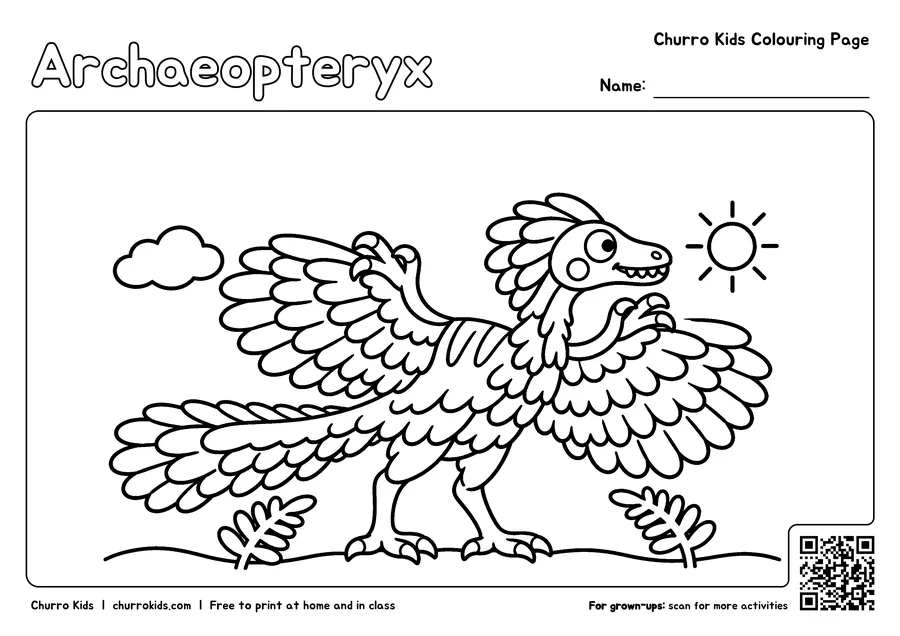
One A4 page, and it is free. Print it freely at home or in class.
Good for parents to know
- Scientists still disagree about whether Archaeopteryx is the "first bird" or a bird-like dinosaur close to the raptors. For a child you can say "it was an animal that looked like a bird and like a dinosaur."
- How well it could fly is still being studied too. Something like "it had wings, and scientists are still finding out how well it flew" is about right.
- Only some feathers are known to have been black, so it is hard to say the whole body was black. No fossil shows what it ate, so insects and small animals are a guess. It is often mixed up with Microraptor: Archaeopteryx had two wings and Microraptor had four.