Your child is watching the animated film "Jeombagi" and asks, "Dad, is Jeombagi a Tyrannosaurus?" It looks very similar, but it is a dinosaur with a different name: Tarbosaurus.
Tarbosaurus was a big meat-eating dinosaur that lived in Asia in the Late Cretaceous, about 70 million years ago. It was a close relative of Tyrannosaurus, and many of its fossils have been found in the Gobi Desert in Mongolia. It was about as long as a bus, and its very short arms had two fingers each. Below are the questions children ask most, with answers at a child's level. You can read them out loud.
Fact cardTarbosaurus
- Name means
- alarming lizard
- Lived
- Late Cretaceous (about 70 million years ago)
- Length
- about 10 m (33 ft)
- Weight
- about 4 to 5 tonnes
- Food
- Meat-eater
- Found in
- Asia (Mongolia, China)
- Group
- Big meat-eating dinosaurs
- A big, narrow head
- Very short arms with two fingers
- Strong back legs
How big was Tarbosaurus? Measure it with your own height
When your child asks, answer like this
 What does Tarbosaurus mean?

How big was it?
What did it eat?
How did it hunt?
Who lived with it?
- Saurolophus preyfossil evidence
Tarbosaurus tooth marks were found on an arm bone of Saurolophus. Scientists say the marks were made when Tarbosaurus fed on a Saurolophus that had already died. They are not marks from a hunt. - Deinocheirus preyfossil evidence
Deinocheirus was a dinosaur with very long arms. Its belly bones also have Tarbosaurus tooth marks on them. This means that Tarbosaurus ate Deinocheirus. - Therizinosaurus neighboursame time and place
Therizinosaurus, which had very long claws, lived in the same forests. If it met a Tarbosaurus, it probably protected itself with those long claws.
When and where did it live?
What was it like as a baby? Did it live with friends?
Are there dinosaurs that look like it?
Who found it first?
Tarbosaurus facts that make kids say “Wow!”
- Tarbosaurus was a close relative of Tyrannosaurus, and many of its fossils have been found in the Gobi Desert in Mongolia.
- The hero of the Korean animated film "Jeombagi" is a Tarbosaurus, but the real fossils come from Mongolia and China.
- A Tarbosaurus skeleton that had been secretly sold to another country went back home to Mongolia in 2013.
- Fossil skin prints show that it had very small scales, about 2 mm (under a tenth of an inch) across.
From head to tail
- It had 58 to 64 teeth in its mouth.
- The biggest skull is about 1.35 m (4.4 ft) long, as tall as a primary school child.
- For its body size, its arms were the smallest of all the tyrannosaur family, and each hand had two fingers.
- A fossil footprint thought to be from Tarbosaurus is 61 cm (2 ft) long.
A Tarbosaurus story to read aloud
Morning mist hangs over the forest where the big river runs. Tarbosaurus walks along the riverbank, sniffing the air. Its big feet press deep footprints into the mud. It listens closely so that it will not miss even a small sound. In the forest over there, a Therizinosaurus with long claws walks by. Across the river is a duck-billed Saurolophus. Tarbosaurus opens its mouth, full of thick teeth, and moves closer.
A quiz to do together
Tap an answer.
Where have many Tarbosaurus fossils been found?
Which dinosaur is a close relative of Tarbosaurus?
How many fingers does Tarbosaurus have on each hand?
You finished the quiz! Well done.
Colouring page
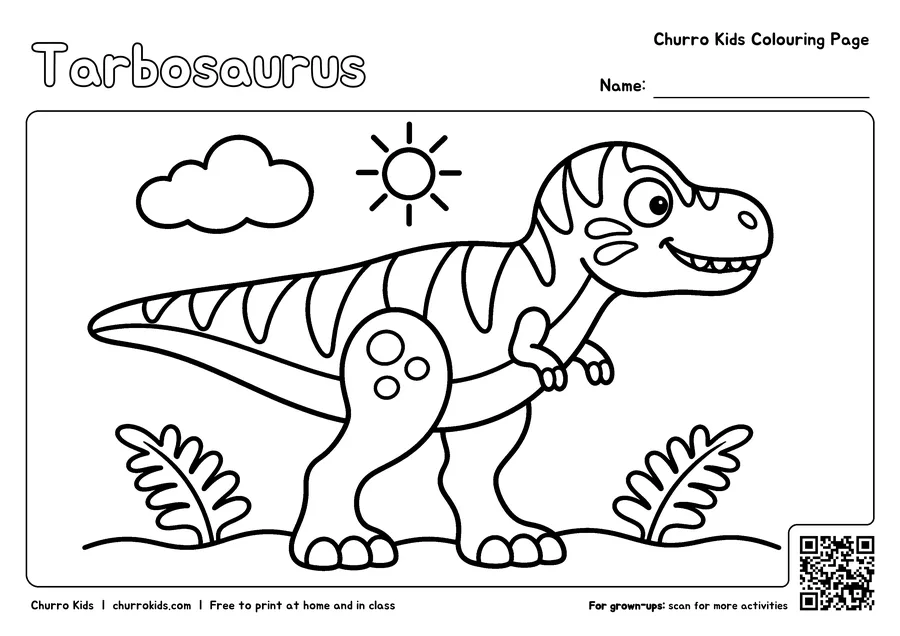
One A4 page, and it is free. Print it freely at home or in class.
Good for parents to know
- A few researchers treat Tarbosaurus as an Asian species of Tyrannosaurus, but most keep them as two different dinosaurs. For a child, "It is a close relative of Tyrannosaurus" is enough.
- This guide gives its length as about 10 metres. The biggest Tarbosaurus grew to 10 to 12 metres.
- The tooth marks on the Saurolophus arm bone are said to come from feeding on a Saurolophus that had already died. Also, children may know Tarbosaurus as the hero of the Korean animated film "Jeombagi", but the real fossils come from Mongolia and China.