"Mum, did dinosaurs live in Korea too?" When this question comes up, Koreanosaurus is a good one to talk about. It is a dinosaur from Korea, with Korea right in its name.
Koreanosaurus was a small plant-eating dinosaur that lived in the Late Cretaceous, about 81 million years ago, in what is now Boseong in South Jeolla Province. It was a little longer than a grown-up lying down, and scientists think it used its strong front legs to dig burrows and live in them. Below are the questions children ask most, with answers at a child's level. You can read them out loud as they are.
Fact cardKoreanosaurus
- Name means
- Korean lizard
- Lived
- Late Cretaceous (about 81 million years ago)
- Length
- about 2.2 m (7 ft)
- Weight
- Not known exactly (probably about as heavy as a large dog)
- Food
- Plant-eater
- Found in
- Asia (Boseong, South Jeolla Province, South Korea)
- Group
- Dinosaurs of Korea and Asia
- Strong front legs
- A long neck and a small body
- A dinosaur that dug in the ground
How big was Koreanosaurus? Measure it with your own height
When your child asks, answer like this
 What does Koreanosaurus mean?

How big was it?
What did it eat?
What did it do when a scary dinosaur came?
Who lived with it?
- Asprosaurus (a big lizard) neighboursame time and place
A fossil of a big lizard, with a head about 20 cm (8 inches) long, was found in the same rock layer in Boseong as Koreanosaurus. The two probably lived on the same land, but nobody knows yet how they got along. - Dinosaurs that laid eggs at Boseong neighboursame time and place
Koreanosaurus was found at Bibong-ri in Boseong, a place where many dinosaur egg fossils are found. It probably lived as a neighbour to the other dinosaurs that came there to lay their eggs.
When and where did it live?
What was it like as a baby? Did it live with friends?
Are there dinosaurs that look like it?
Who found it first?
Koreanosaurus facts that make kids say “Wow!”
- Koreanosaurus probably used its strong front legs to dig burrows in the ground and lived in them.
- Koreanosaurus is a dinosaur from Korea, with Korea right in its name.
- In 2026 the bone fossils of Koreanosaurus were made a Natural Monument of South Korea.
- Its close relatives lived in North America, and scientists say this is evidence that dinosaurs once travelled between Asia and North America.
From head to tail
- It was about 2 to 2.4 m (6.5 to 8 ft) long, a little longer than a grown-up lying down.
- Its shoulder blade and upper arm bone were very big and strong for its body size.
- Its relatives walked on two legs, but Koreanosaurus probably walked on four legs.
- Not a single skull has been found yet, so its face is guessed from its relatives.
A Koreanosaurus story to read aloud
The morning sun comes up, and Koreanosaurus pokes its head out of its burrow. It toddles out on four legs and looks for low-growing ferns. It snips off the leaves with its small beak. Nearby there are nests where other dinosaurs have laid their eggs. A big lizard walks past, and Koreanosaurus watches it quietly. If it feels unsafe, it slips back into the burrow it dug with its strong front legs. Inside the burrow it is cosy and safe.
A quiz to do together
Tap an answer.
In which country was Koreanosaurus found?
What did Koreanosaurus do with its strong front legs?
What did Koreanosaurus eat?
You finished the quiz! Well done.
Colouring page
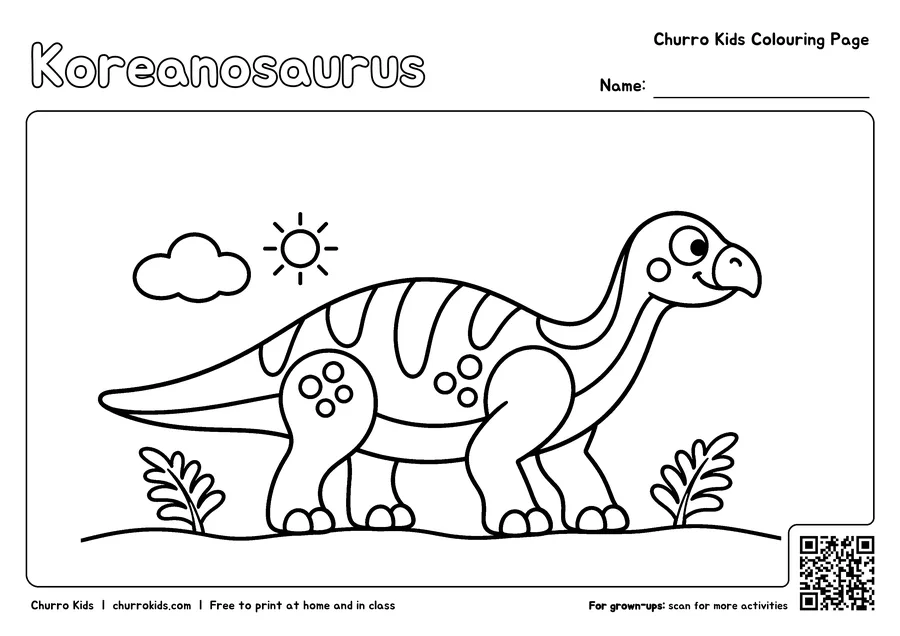
One A4 page, and it is free. Print it freely at home or in class.
Good for parents to know
- Its skull has not been found yet. The face and the way it ate are guessed from related dinosaurs, so the face looks a little different from picture to picture.
- That it dug burrows and walked on four legs is worked out from its strong shoulder blades and front legs, from its relatives, and from traces of small burrows in the same rock layer. With a child, it is enough to say "scientists think it probably dug burrows."
- No weight estimate has been published, so it is only guessed to be about as heavy as a large dog. Some Korean sources spell the name 코레아노사우루스, but Korean news and museums use 코리아노사우루스.