On the day you come home from seeing ostriches at the zoo, your child opens a dinosaur book and says, "Mum, there's an ostrich dinosaur in here!"
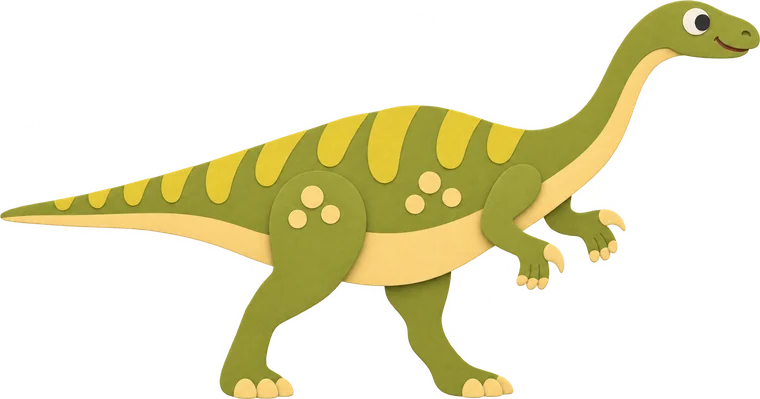
The very name Struthiomimus means "ostrich mimic". It lived in North America in the Late Cretaceous and was about as long as a car. It had a toothless beak, long thin arms and a long tail held out straight, and it probably ran as fast as an ostrich too. Below are the questions children ask most, with answers at a child's level. You can read them out loud as they are.
Fact cardStruthiomimus
- Name means
- ostrich mimic
- Lived
- Late Cretaceous (about 77 to 66 million years ago)
- Length
- about 4.3 m (14 ft)
- Weight
- about 150 kg
- Food
- Eats plants and animals
- Found in
- North America (Alberta in Canada; USA)
- Group
- Dome-headed and unusual dinosaurs
- A body like an ostrich's
- Long, thin arms and hands
- A long tail held out straight
How big was Struthiomimus? Measure it with your own height
When your child asks, answer like this
 What does Struthiomimus mean?

How big was it?
What did it eat?
What did it do when a scary dinosaur came?
Who lived with it?
- Gorgosaurus predatorsame time and place
Gorgosaurus, a relative of Tyrannosaurus, lived in the same place. Struthiomimus probably ran away on its fast legs. - Saurornitholestes predatorsame time and place
Saurornitholestes, a small and quick meat-eating dinosaur, lived nearby too. Young Struthiomimus probably had to watch out for it. - Corythosaurus neighboursame time and place
Corythosaurus, which had a round crest on its head, ate leaves in the same forest. Struthiomimus probably walked past it while looking for food.
When and where did it live?
What was it like as a baby? Did it live with friends?
Are there dinosaurs that look like it?
Who found it first?
Struthiomimus facts that make kids say “Wow!”
- Just as its name says, Struthiomimus looked very much like an ostrich, and it probably ran as fast as one too.
- About 100 years ago Osborn drew Struthiomimus walking with its body level and its tail lifted, and later that idea turned out to be right.
- Its second and third fingers probably could not move separately and moved together.
- Osborn said the arms of Struthiomimus were like the arms of a sloth.
From head to tail
- It was about 4.3 m (14 ft) long and about 1.4 m (4.5 ft) high at the hips.
- It weighed about 150 kg, about the same as a big ostrich.
- Its three fingers were almost exactly the same length.
- Its tail had about 35 bones in a row, and it was stiff, so it helped with balance when running.
A Struthiomimus story to read aloud
The river sparkles across the wide plain. Struthiomimus holds its long neck up and looks around with its big eyes. It pulls a branch closer with its long hands and picks off a bud with its beak. In the forest, a Corythosaurus is eating leaves. Suddenly a Gorgosaurus appears. Struthiomimus keeps its balance with its stiff tail and dashes away like an ostrich.
A quiz to do together
Tap an answer.
What does the name Struthiomimus mean?
How many fingers did Struthiomimus have on each hand?
What did the stiff tail of Struthiomimus help with when it ran?
You finished the quiz! Well done.
Colouring page
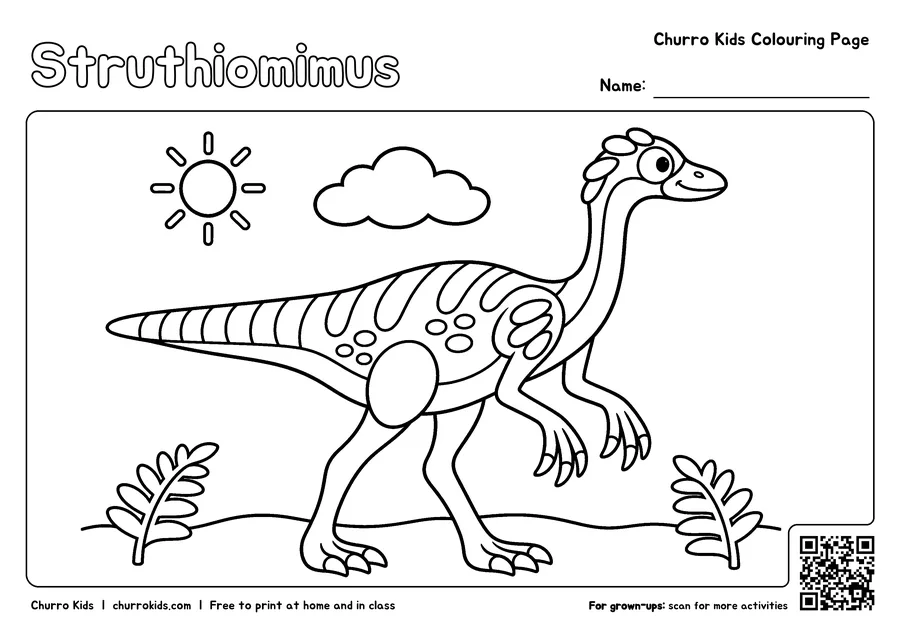
One A4 page, and it is free. Print it freely at home or in class.
Good for parents to know
- Its running speed is put at roughly 50 to 80 km (30 to 50 miles) an hour, but that number is very uncertain. "It probably ran as fast as an ostrich" is enough.
- It very likely had feathers, but that is worked out from close relatives. What it mostly ate is still not certain either.
- It looks very much like Ornithomimus, so the two are easy to mix up. Struthiomimus has stronger arms and longer hands and claws.