"Mum, did dinosaurs live in cold places too?" If your child asks this while watching the snow through the window, it is time for the story of Leaellynasaura.
Leaellynasaura was a small plant-eating dinosaur that lived in the Early Cretaceous in what is now Victoria, Australia. Back then that land lay close to the South Pole, so the sun did not rise in winter. With its big eyes it could probably see well even in the dark, and it probably did not sleep through the winter. Below you will find the questions children often ask and easy answers. Feel free to read them to your child as they are.
Fact cardLeaellynasaura
- Name means
- Leaellyn's lizard (named after the daughter of the scientists who found it)
- Lived
- Early Cretaceous (about 118 to 106 million years ago)
- Length
- about 1 m (3 ft)
- Weight
- not known exactly (thought to be about the weight of a small dog)
- Food
- Plant-eater (low plants such as ferns and horsetails)
- Found in
- Oceania (Victoria, Australia)
- Group
- Dome-headed and unusual dinosaurs
- Big eyes
- A very long tail
- A small, quick body
How big was Leaellynasaura? Measure it with your own height
When your child asks, answer like this
 What does Leaellynasaura mean?

How big was it?
What did it eat?
What did it do when a scary dinosaur came?
Who lived with it?
- Atlascopcosaurus rivalsame time and place
Atlascopcosaurus, a small plant-eating dinosaur that looked similar, lived in the same place. The two probably shared the low plants. - Timimus neighboursame time and place
A leg bone of a dinosaur called Timimus was found in the same sea cliffs. There are only a few bones, so nobody knows yet how the two got along.
When and where did it live?
What was it like as a baby? Did it live with friends?
Are there dinosaurs that look like it?
Who found it first?
Leaellynasaura facts that make kids say “Wow!”
- Leaellynasaura lived near the cold South Pole, where the sun does not rise in winter, and with its big eyes it could probably see well even in the dark.
- At that time Australia and Antarctica were joined together.
- Timimus, a dinosaur found in the same place, is named after the Rich family's son Tim and another scientist, Tim Flannery.
- The place was close to the South Pole, but the Earth was much warmer then than it is now, so forests could grow.
From head to tail
- The young Leaellynasaura that was found is about 1 m (3 ft) long, about as long as a five-year-old child is tall.
- When fully grown it may have been close to 2 m (6.5 ft) long with its tail, but that is not certain yet.
- Its eye sockets were big, so its eyes were big, but that may be because it was still young.
- Its tail is said to have been about three times as long as its body, but it is not certain that those bones really belong to Leaellynasaura.
A Leaellynasaura story to read aloud
A long winter has come to the forest near the South Pole. The sun does not rise, so the forest is dim. Little Leaellynasaura walks between the ferns, its big eyes shining. It munches ferns and horsetails with its small teeth. Nearby, an Atlascopcosaurus is eating plants too. Leaellynasaura does not sleep through the winter, and even in the cold it keeps busy looking for food. When it hears a rustle, it runs away quickly on its nimble legs.
A quiz to do together
Tap an answer.
Leaellynasaura lived close to which place?
Who is Leaellynasaura named after?
What did Leaellynasaura eat?
You finished the quiz! Well done.
Colouring page
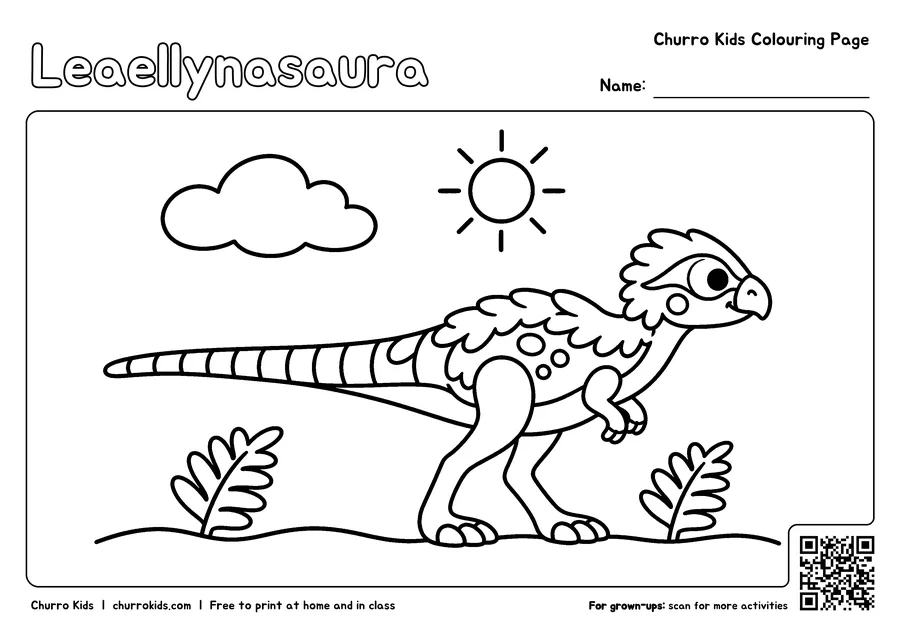
One A4 page, and it is free. Print it freely at home or in class.
Good for parents to know
- Its adult size is not known yet. The fossil that was found is a young animal about 1 metre long, and some sources give 1.8 to 2 metres with the tail.
- The big eyes may be there because it was still young. The long tail, said to be about three times the length of the body, comes from bones that may not really belong to Leaellynasaura, so it is best to say "it may have been like that."
- In Korean the name is written two ways depending on the book. Pictures that show a fuzzy coat are imagined.