Your child stops at one page of the dinosaur book. "This one has a long neck. Why is it standing on two legs?"
Plateosaurus was a plant-eating dinosaur that lived in Europe in the Late Triassic. It lived very early in the age of dinosaurs and was one of the biggest animals in Europe at that time. It could not turn its palms down to the ground, so it always walked on its two back legs. More than 100 of its fossils have been found so far. Below are the questions children ask most, with answers at a child's level. You can read them out loud.
Fact cardPlateosaurus
- Name means
- broad lizard
- Lived
- Late Triassic (about 214 to 204 million years ago)
- Length
- about 7 m (23 ft)
- Weight
- about 0.6 to 4 tonnes
- Food
- Plant-eater
- Found in
- Europe (Germany, Switzerland, France)
- Group
- Very early dinosaurs (Triassic and Jurassic)
- A long neck
- A small head
- Hands with a big thumb claw
How big was Plateosaurus? Measure it with your own height
When your child asks, answer like this
 What does Plateosaurus mean?

How big was it?
What did it eat?
What did it do when a scary dinosaur came?
Who lived with it?
- Liliensternus predatorsame time and place
Liliensternus was a meat-eating dinosaur whose teeth and bones were found in the same place. It probably went after young or weak Plateosaurus. - Proganochelys (a very early turtle) neighboursame time and place
Proganochelys was an early turtle whose fossils came from the same land in Germany. It probably lived its slow life near Plateosaurus.
When and where did it live?
What was it like as a baby? Did it live with friends?
Are there dinosaurs that look like it?
Who found it first?
Plateosaurus facts that make kids say “Wow!”
- Plateosaurus stood on its two back legs and picked leaves from high branches.
- More than 100 Plateosaurus fossils have been found so far.
- Off the coast of Norway, a piece of Plateosaurus bone came up from rock 2,256 m (7,402 ft) below the sea floor.
- Scientists think only the heavy grown-ups got stuck in the mud and became fossils, while the light babies got out.
From head to tail
- Fully grown animals were very different in size, from about 5 m to 10 m (16 to 33 ft) long.
- Its teeth were shaped like small leaves and had bumpy edges.
- It could not turn its palms down to the ground, so it always walked on its two back legs.
- Its eyes were on the sides of its head, so it could see all around.
A Plateosaurus story to read aloud
It is a morning in the Late Triassic. Plateosaurus gets up on its two back legs and walks across the wide plain. It stretches its long neck and pulls leaves from a high branch. It crushes them with its leaf-shaped teeth and gulps them down. With the eyes on the sides of its head it looks all around. When it sees the meat-eating dinosaur Liliensternus far away, it moves off on its strong back legs. After the rain, it steps carefully past the sticky mud pools.
A quiz to do together
Tap an answer.
How many legs did Plateosaurus walk on?
What did Plateosaurus eat?
Where have many Plateosaurus fossils been found?
You finished the quiz! Well done.
Colouring page
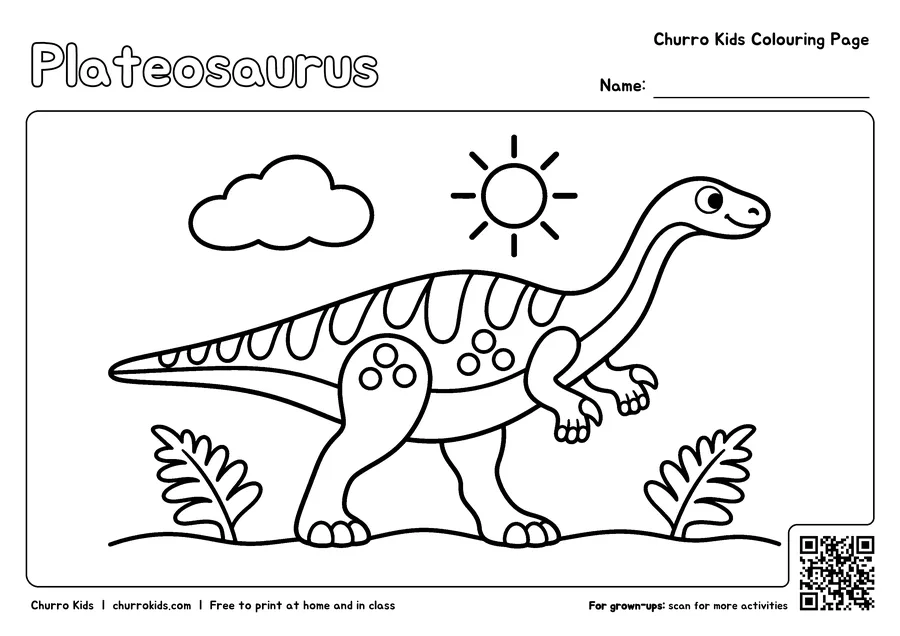
One A4 page, and it is free. Print it freely at home or in class.
Good for parents to know
- Fully grown animals were very different in length, from about 5 metres to 10 metres. The 7 metres in this guide is a number from the middle of that range. The weight also covers a wide range, about 0.6 to 4 tonnes.
- Some older books draw it walking on four legs. Studies of the arm bones show that it could not put its palms on the ground, so it walked only on its two back legs. If your child asks about an old picture, you can say "people used to think that."
- Many books translate the name as "flat lizard", but "broad lizard" is more likely. Fossils of many animals are found in one place, but it is still not certain that they lived in herds.